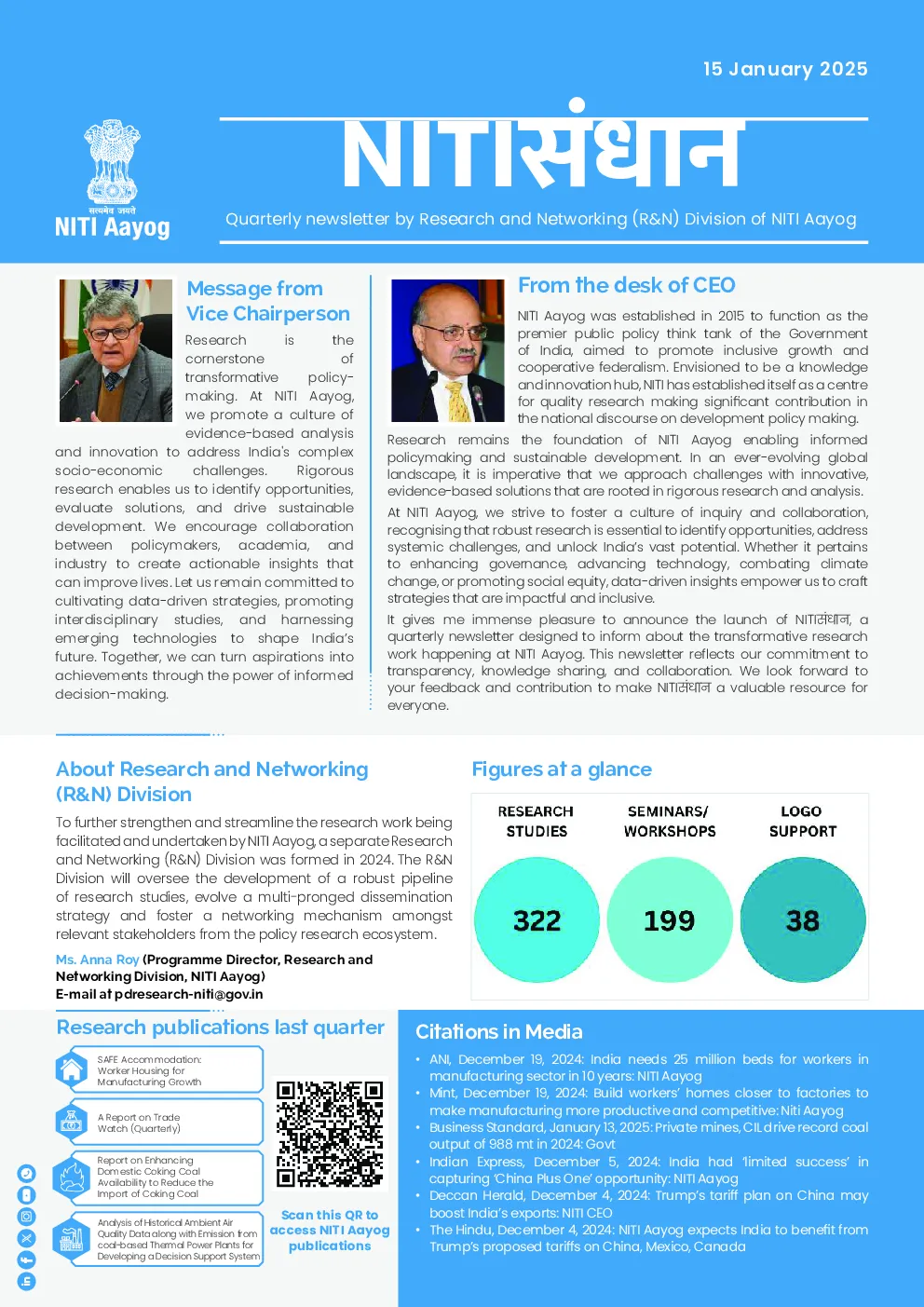
Quarterly newsletter by Research and Networking (R&N) Division of NITI Aayog From the desk of CEO Message from NITI Aayog was established in 2015 to function as thepremier public policy think tank of the GovernmentofIndia,aimed to promote inclusive growth andcooperative federalism. Envisioned to be a knowledge Researchisthecornerstoneoftransformativepolicy- Researchremains the foundation of NITI Aayog enabling informedpolicymakingand sustainable development.In an ever-evolving globallandscape, it is imperative that we approach challenges with innovative, andinnovation to address India's complexsocio-economicchallenges.Rigorousresearch enables us to identify opportunities,evaluatesolutions,and drive sustainabledevelopment.We encourage collaborationbetweenpolicymakers,academia,and At NITI Aayog, we strive to foster a culture of inquiry and collaboration,recognising that robust research is essential to identify opportunities, addresssystemic challenges, and unlock India’s vast potential. Whether it pertains It gives me immense pleasure to announce the launch of NITIसंधान, aquarterly newsletter designed to inform about the transformative researchwork happening at NITI Aayog. This newsletter reflects our commitment to About Research and Networking Figures at a glance To further strengthen and streamline the research work beingfacilitated and undertaken by NITI Aayog, a separate Researchand Networking (R&N) Division was formed in 2024. The R&NDivision will oversee the development of a robust pipeline Ms. Anna Roy (Programme Director, Research andNetworking Division, NITI Aayog) Research publications last quarter Citations in Media •ANI, December 19, 2024: India needs 25 million beds for workers inmanufacturing sector in 10 years: NITI Aayog•Mint, December 19, 2024: Build workers’ homes closer to factories to SAFE Accommodation:Worker Housing forManufacturing Growth make manufacturing more productive and competitive: Niti Aayog•Business Standard, January 13, 2025: Private mines, CIL drive record coal A Report on TradeWatch (Quarterly) output of 988 mt in 2024: Govt•Indian Express,December 5,2024:India had‘limited success’incapturing ‘China Plus One’ opportunity: NITI Aayog •Deccan Herald, December 4, 2024: Trump’s tariff plan on China mayboost India’s exports: NITI CEO Analysis of Historical Ambient AirQuality Data along with Emission fromcoal-based Thermal Power Plants forDeveloping a Decision Support System •TheHindu,December4,2024:NITIAayogexpectsIndiatobenefitfromTrump’s proposed tariffs on China, Mexico, Canada 2 15 January 2025 Voice of our Services have rapidly emerged as the cornerstone of the global economy, andthis trend is especially prominent in developing countries including India. In 2022,services contributed a massive 67-70% to global GD, totaling about USD 67 trillion. Italso accounted for 50% of the global workforce, with high-income countries seeingeven greater participation. This growth trajectory is expected to continue, withservices likely to reach USD 100 trillion by 2047. In India, the services sector is alreadya dominant force, contributing more than 50% to the country’s Gross Value Added(GVA), worth approximately USD 1.4 trillion in 2022-23. By 2047, services are projected Co-authors:Sonia Pant,Pratibha Sharma,Aarushi Gupta,Pooja Agrawal{Services Division, NITI Aayog} But as promising as these statistics are, there is a growing debate about whetherthe services sector can create jobs at the same scale as manufacturing, particularlyfor low-skilled workers. Services are inherently heterogeneous in nature, rangingfrom highly skilled professional services to lower-skilled sectors such as personalservices. Accordingly, there are questions as to whether it can absorb surplus labourfrom agriculture or provide widespread employment opportunities for lower-skilledworkers. There is a valid concern that services may not be able to deliver both SONIA PANTPROGRAM DIRECTOR,NITI AAYOG For India, this means that while services will continue to play a central role in thecountry’s economic transformation, the path to job creation requires a morenuanced approach. Given the diverse nature of the services sector in India, NITIAayog’s Working Paper - ‘Identifying Potential Service Sub-Sectors: Insights fromGVA, Exports, and Employment Data,’ presents an approach to holistically examineservices from various dimensions, including contribution to gross value-added Given the diverse nature ofthe services sector in India,NITI Aayog’s Working Paper -‘Identifying Potential Service Sub-Sectors: Insights from GVA, Exports,and Employment Data,’ presents The identified sub-sectors vary significantly in terms of some excelling in exports,others in GVA contributions, and some in job creation. No single subsector embodiesall these factors equally, making it essential to analyze the sector through adisaggregated lens, focusing on the interplay between GVA, employment, andexports. Th