2025年ACT考试毕业班PreACT考试成绩和成长总结
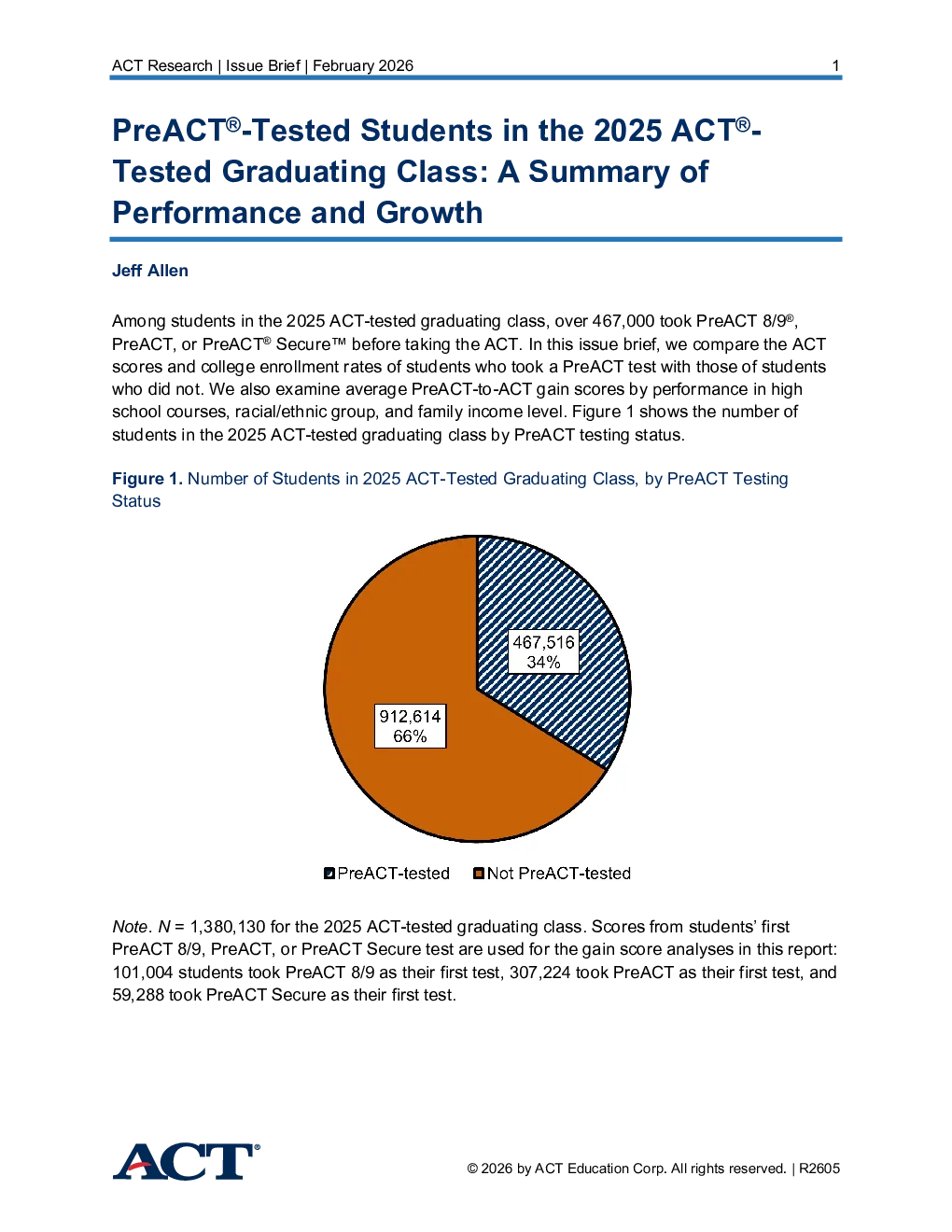
Jeff Allen Among students in the 2025 ACT-tested graduating class, over 467,000 took PreACT 8/9®,PreACT, or PreACT®Secure™ before taking the ACT. In this issue brief, we compare the ACTscores and college enrollment rates of students who took a PreACT test with those of studentswho did not. We also examine average PreACT-to-ACT gain scores by performance in highschool courses, racial/ethnic group, and family income level. Figure 1 shows the number of Note.N= 1,380,130for the 2025 ACT-tested graduating class. Scores from students’ firstPreACT 8/9, PreACT, or PreACT Secure test are used for the gain score analyses in this report:101,004 students took PreACT 8/9 as their first test, 307,224 took PreACT as their first test, and Finding 1: PreACT-tested students scored higher on the ACTand were more likely to be ready for college courses. The average ACT score for students who took a PreACT test was higher than that for studentswho did not (Figure 2). Results varied across states, but on average, the state mean ACTComposite score was 20.86 for students who took PreACT and 19.86 for students who did not. Figure 2.Mean ACT Scores by PreACT Testing Status Note. For each state, mean ACT scores were obtained for students who took PreACT and forstudents who did not. To ensure that the state mean scores could be reliably estimated, weincluded only states with at least 1,000 PreACT-tested students in the 2025 ACT-tested The difference in average scores ranged from 0.84 for mathematics to 1.30 for English(Figure 3). The PreACT and No PreACT groups are not randomly equivalent. Differencesbetween the two groups may be due to factors other than taking a PreACT test. We thereforeused linear regression to estimate the adjusted difference between the two groups, accountingfor academic and background variables associated with ACT scores. The adjusted differenceprovides an estimate of what the difference between the average ACT scores of the PreACT date). After the statistical adjustment, the differences in mean scores were much smaller, as The difference in average ACT scores means that PreACT-tested students are more likely to beready for first-year college courses and earn exemptions from remedial coursework. Figure 4shows the percentage of students meeting each ACT College Readiness Benchmark by The difference in readiness for college courses ranged from 3.1% for courses commonly takenby STEM majors to 8.7% for English Composition (Figure 5). After we made the statisticaladjustments described earlier, the differences in college readiness were smaller. The adjusted Finding 2: College enrollment rates are higher for PreACT- For ACT-tested high school graduates of 2022, 2023, and 2024, we compared collegeenrollment rates by PreACT testing status. For all three cohorts, college enrollment rates werehigher for the PreACT group than the No PreACT group (Figure 6). We obtained the collegeenrollment rates presented in Figure 6 by averaging rates from states that had at least 1,000 Note.We used college enrollment data from the National Student Clearinghouse. Weconsidered students enrolled if they were enrolled at a postsecondary institution for any term The PreACT and No PreACT groups are not randomly equivalent. Group differences in collegeenrollment may be due to factors other than taking a PreACT test. After being statisticallyadjusted for high school grades and course rigor, student demographics (gender, race/ethnicity, As part of the PreACT 8/9 and PreACT assessments, students complete a survey that includesa question about their educational plans. Using the survey data, we examined collegeenrollment rates for students within each educational plan group, combining data for the 2022, As expected, college enrollment rates were higher for students who planned to attend college,especially for those who planned to attend a 4-year college. Among students who had noeducation or training planned, 26% still enrolled in college, with 14% enrolling at 4-year collegesand 12% enrolling at 2-year colleges. This suggests that student plans often change during the Finding 3: Average gain from PreACT to the ACT varies Figure 9 shows the average PreACT and ACT scores for the 467,516 students who took both aPreACT test and the ACT. For students who took multiple PreACT assessments, their first testwas used for this analysis. The average gain from PreACT to the ACT varied across subjects, Finding 4: Average gain from PreACT to the ACT increases The average Composite gain steadily increased with grades earned and the rigor of high school Note. This chart is based on data from 236,804 students who took a PreACT test and the ACTand reported their high school coursework and grades when they registered for the ACT. Thehigh school grades and rigor decile are based on the ACT Rigor Index, which is similar to highschool GPA but awards more points for taking more difficult courses (Allen & Mattern, 2019).The ACT Rigor Index is based on s