您的浏览器禁用了JavaScript(一种计算机语言,用以实现您与网页的交互),请解除该禁用,或者联系我们。 [联合国]:把握机遇时刻:大力推动可再生能源、能效和电气化的新能源时代 - 发现报告

把握机遇时刻:大力推动可再生能源、能效和电气化的新能源时代

电气设备 2026-02-09 - 联合国 单字一个翔
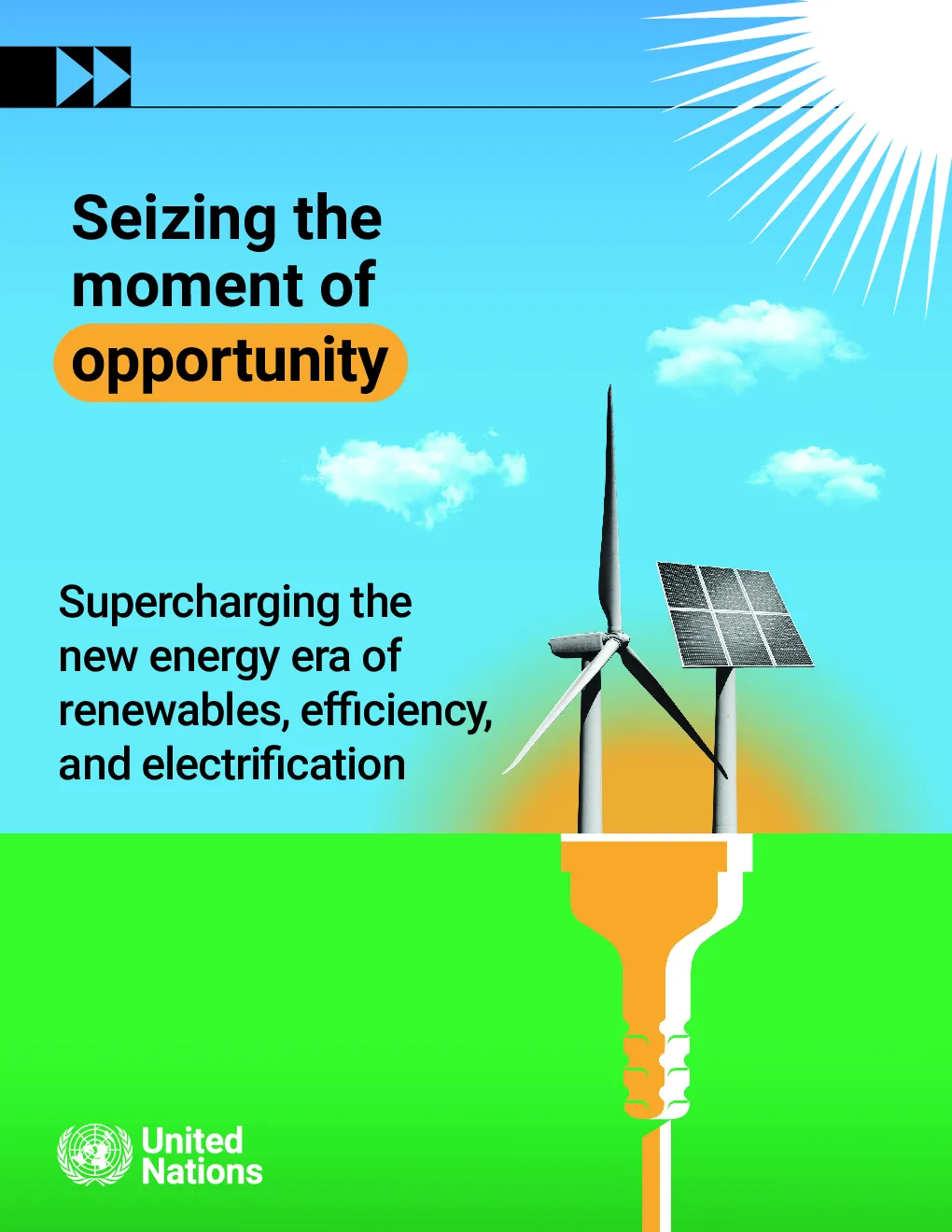
报告封面

Supercharging thenew energy era of Acknowledgements This report was written by the Climate ActionTeam in the Executive Office of the United NationsSecretary-General.Ploy Achakulwisut served asthe lead author.The following United Nations(UN) agencies and other intergovernmentalorganizations provided inputs, data, and reviews:International Labour Organization(ILO —Moustapha Kamal Gueye, Marek Harsdorff, CamilaPereira Rego Meireles);International MonetaryFund(IMF — staff of FADCP, RESSC, and SPRCDdivisions);International Renewable Energy The report also benefitted from data provided bythe International Energy Agency (IEA) and Ember;and from review comments in various sections byCarolina Aguirre Echeverri, Amar Bhattacharya(Brookings Institute), John Christensen (CONCITO), The report was edited by Richard Andersonand designed by the UN Department of Global Agency(IRENA — Deborah Ayres, Ute Collier, NorelaConstantinescu, Saied Dardour, Francis Field, RicardoGorini, Diala Hawila, Rodrigo Leme, Julian Prime,Mirjam Reiner, Anke Schoenlau);UN Trade andDevelopment(UNCTAD — Chantal Line Carpentier,Claudia Contreras, Hamed El Kadi StephaniaMageste, Tansug Ok, Amelia U. Santos Paulino);UN Development Programme(UNDP — JenniferBaumwoll, Cassie Flynn, Chibulu Luo, Riad Meddeb, Recommended citation: United Nations.Seizing the moment of opportunity:Supercharging the new energy era of renewables, The report can be accessed online atun.org/en/climatechange/moment-opportunity-2025 Stefano Pistolese, Mateo Salomon);UN Environment Table of contents Acknowledgements.................................................................................................................ii Executive summary...............................................................................................................01 Section 1 — Introduction...................................................................................................04 Section 2 — The energy transition today: Progress since Paris Section 3 — Opportunities and benefits of acceleratingthe energy transition............................................................................................................16 Section 4 — Barriers and challenges of the current transition Section 5 — Seizing the moment of opportunity Annex: Data and terminology........................................................................................33 References.....................................................................................................................................34 Executive summary We stand at a unique and defining moment inhistory. In the ten years since the Paris Agreementwas adopted, renewable energy technologies haveundergone a remarkable transformation.Withspectacular cost declines and manufacturing capacitygrowth, the global deployment of solar, wind, andelectric vehicles (EVs) has exceeded even the most Solar and wind are now almost always the leastexpensive — and the fastest — option for newelectricity generation.Between 2010 and 2022,solar and wind power became cost-competitivewith fossil fuels without financial support in manycountries.By 2023, an estimated 96% of newlyinstalled, utility-scale solar photovoltaics (PV)and onshore wind capacity had lower powergeneration costs than new coal and gas plants,while around 75% of new wind and solar PVplants offered cheaper power than existing fossil This special report provides a high-level synthesisof the state of play of — and the economicimperative and opportunity for — accelerating the The plummeting costs mean that solar and windhave become the fastest growing sources ofelectricity in history, and growth in renewableenergy is now outpacing that in fossil fuels in thepower sector. In 2024, renewables made up 92.5%of all new electricity capacity additions and 74%of electricity generation growth.Between 2015 and2024, global annual electricity capacity of renewablesincreased by around 2,600 gigawatts (GW) (140%),while that of fossil fuels increased by around 640 GW(16%). Consequently, the shares of fossil fuels andrenewables in global installed electricity capacity nowstand at almost 1:1. In terms of global annual electricitygeneration, renewables increased by 4,470 terawatt- the costs of heating, cooling, lighting, and mobility,and indirectly pushed up the costs of other goodsand services throughout global supply chains,exacerbating the cost-of-living crisis in 2022.Onaverage, consumers worldwide spent 20% more on Centralized and decentralized renewables-basedsystems also offer the most cost-effective andfastest solutions for delivering universal cleanenergy access by 2030.The combination of grid,mini-grid, and off-grid renewable solutions can beleveraged to deliver fast and lasting access, especiallyin difficult-to-reach rural locations where eight outof ten people without access to electricity live. Stand-alone, off-grid solar solutions served 490 millionpeople in total by 2