全球储能:长期展望:电池只会越来越好
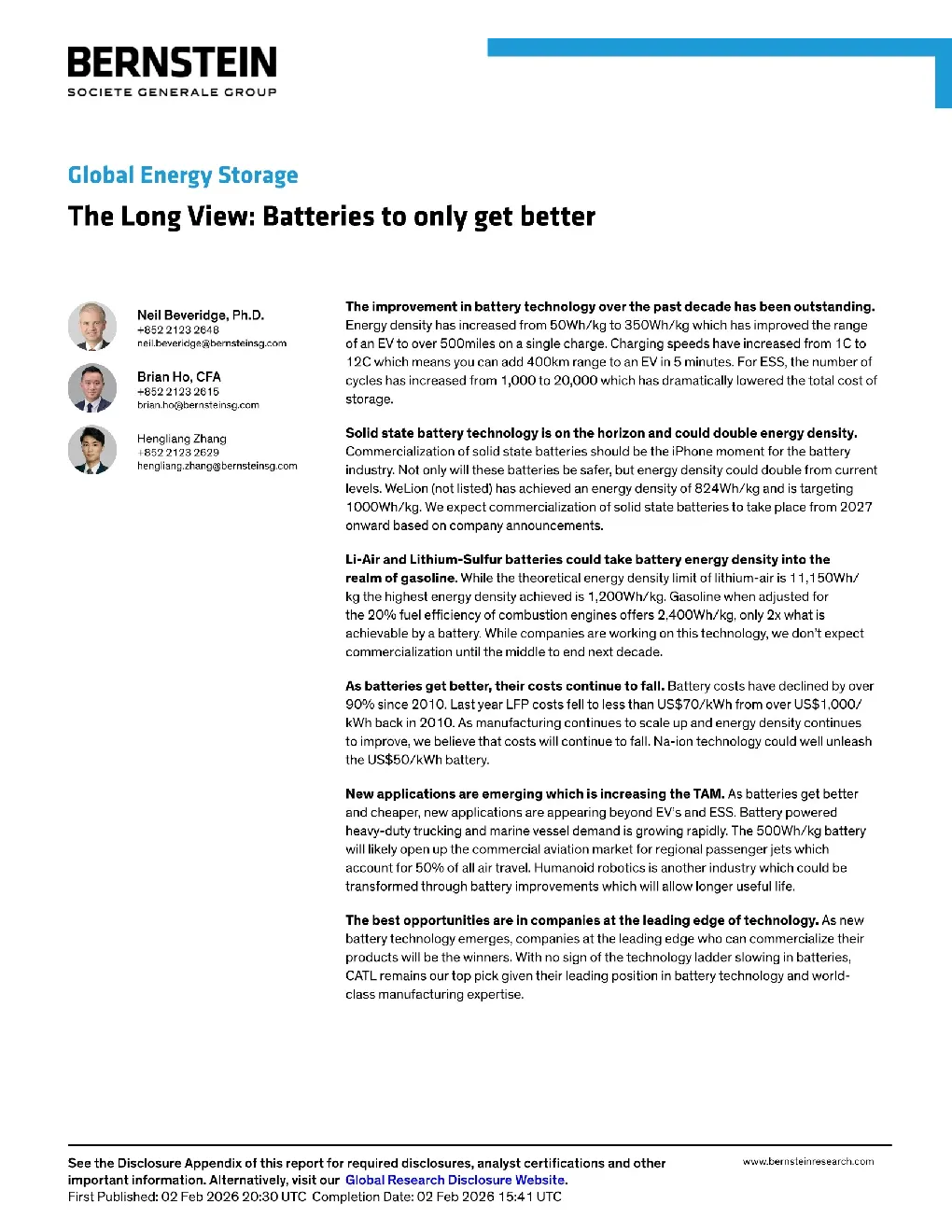
Energydensityhas increasedfrom50Wh/kgto350Wh/kg whichhas improvedtherangeof an EVto over 500miles on a single charge.Charging speeds have increased from 1C to12C whichmeans you can add 400km range to an EV in 5minutes.For ESS,the number ofcycles has increased from 1,000 to 20,000 which has dramatically lowered the total cost ofstorage.Solidstate battery technology is on thehorizon and could double energy density. neil.beveridge@bernsteinsg.comBrian Ho, CFA +85221232615brian.ho@bernsteinsg.comHengliang Zhang Commercializationof solid statebatteries should be the iPhonemomentforthe batteryindustry.Not only will these batteries be safer, but energy density could double from current +85221232629hengliang.zhang@bernsteinsg.com levels. WeLion (not listed) has achieved an energy density of 824Wh/kg and is targeting1000Wh/kg.We expect commercialization of solid statebatteriesto takeplace from2027onwardbasedoncompanyannouncements. realm of gasoline. While the theoretical energy density limit of lithium-air is 11,150Wh/kgthehighestenergydensityachievedis1,2OOWh/kg.Gasolinewhenadjustedforthe 20% fuel efficiency of combustion engines offers 2,400wh/kg, only 2x what isachievableby a battery.While companies are working on this technology,wedon't expectcommercialization until the middle to end next decade. 90%since2010.LastyearLFPcostsfell toless than US$70/kWhfromoverUS$1,000/to improve, webelieve that costs will continue to fall. Na-ion technology could well unleashthe US$50/kWh battery. heavy-duty trucking and marine vessel demand is growing rapidly.The 500Wh/kg batterywill likely open up the commercial aviation market for regional passenger jets whichaccount for 50% of allair travel. Humanoid robotics is another industry which could betransformed through battery improvements whichwill allow longer useful life. products will be the winners. With no sign of the technology ladder slowing in batteries,classmanufacturing expertise. speed has moved from 1C to 12C which means a battery can be changed in 5 mins with over 400km of range. The number ofthishasbeendonewhilethecostsofabatteryhavebeenloweredby95%fromoverUS$100O/kWhtolessthanUS$70/kWhfor LFP last year.With cheaper, better batteries more applications will open. Today battery demand is dominated by EV's andESS.In the future,demand will likely comefrom heavy-duty commercial vehicles, shipping,aviation and robotics.While batterieshave come along way,energydensity could potentiallydouble from currently with solid-state to 7oowh/kgand doubleagain toover 1,200Wh/kg with lithium-air and lithium sulfur.This would take batteries to 50% of the useful energy density of gasoline,but with costs which are much lower. For companies at the forefront of battery technology, this continued technology laddershould offera competitive moat, which is why we continue to favor CATL as our toppick in the industry. 100 years ago.Overtime,the energy density of batteries has consistently improved as new chemistries and newproductionmethods have been developed. The discovery of the lithium-ion battery (LiB's) effectively doubled the energy density of thenickel-cadmiumbattery.In the early1990's, LiBs had an energy density of 50wh/kg.Today,the best lithium-ion batteries whicharecommerciallymassmanufactured havean energydensityatthecell levelofupto350Wh/kg.This is almostan orderofmagnitude higher than lead-acid batteries (the original battery format) which have an energy density of 30-4OWh/kg. Over thepast30 years annual improvement in energydensityhas been on average1owh/kgper year.This hasenabled electric vehiclesto transition from niche products with a range of 250 miles to vehicles which can achieve over 600miles on a single charge. But a keyquestion is howmuch further can the energydensity of batteries improve? There is good reasonto think much furtherand that we are still at anearly stage of thistechnology.At itsupperlimit, Li-airtechnology isthe only electrochemical systemthat approaches the energy density of gasoline making it the"holy grail" for long-range electric aviation and heavy transport. The"theoretical limit" of a Li-air battery (the most advanced battery yet conceived) varies based on the electrolyte used (aqueous vs.non-aqueous) and the specific chemical discharge product (lithium peroxide vs. lithium oxide). But purely in scientific terms, thespecific energy of a lithium air battery could reach 40.1MJ/kg or 11,150Wh/kg. This is 85% of the chemical energy density ofgasoline, which is 46.8MJ/kg or 12,900Wh/kg. While this is impressive, the'effective gap'between lithium-ion batteries and gasoline is much smaller.Gasoline engines areto 85% is lost as heat and friction.Electric drivetrains on the other hand convert 90% of the energy stored in thebattery intomotion.This means thatwhen adjustedfor efficiency,the"useful"energydensity ofgasolinedrops toapproximately2,58oWh/kg.This is only 7x greater than thebest commercial cells (35oWh/g),and only2xbetter than thebest lithium