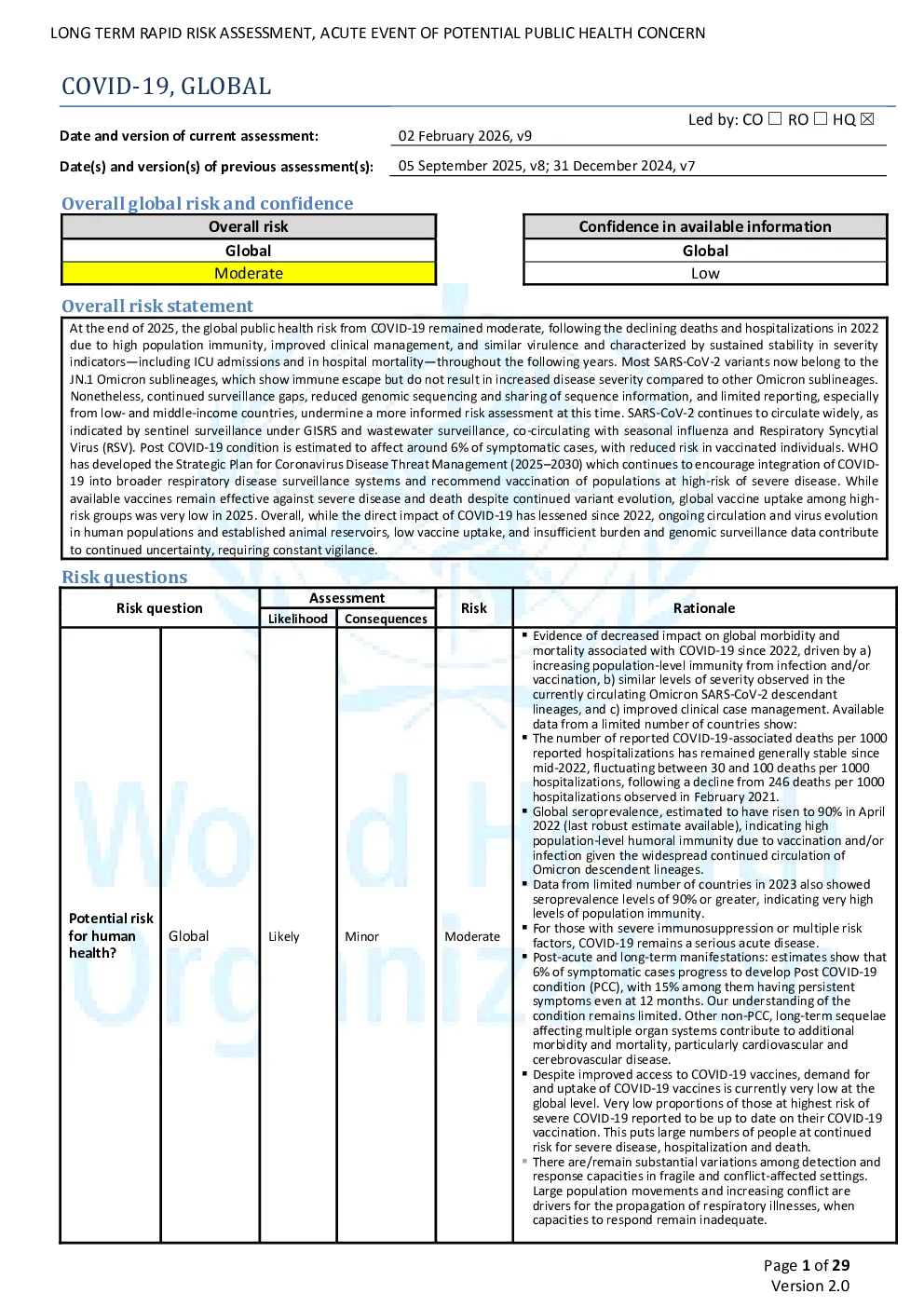
Led by: CO☐RO☐HQ☒ Dateandversionof current assessment: Date(s)and version(s)of previous assessment(s): Overallrisk statement Atthe end of2025, the global public health risk from COVID-19remainedmoderate,following thedeclining deaths and hospitalizationsin2022due to high population immunity, improved clinical management, andsimilarvirulenceandcharacterized by sustained stability in severityindicators—including ICU admissions andin hospitalmortality—throughout thefollowingyears.Most SARS-CoV-2 variants now belong to theJN.1 Omicronsublineages, which show immune escape butdonotresult inincreaseddiseaseseveritycompared to other Omicron sublineages.Nonetheless,continuedsurveillance gaps, reduced genomic sequencingand sharing of sequence information, and limited reporting,especiallyfrom low-and middle-income countries,underminea more informedrisk assessmentat this time. SARS-CoV-2 continues to circulate widely, asindicated by sentinelsurveillanceunder GISRSand wastewater surveillance, co-circulating withseasonalinfluenza and RespiratorySyncytialVirus(RSV). PostCOVID-19 conditionis estimated toaffect around 6% of symptomatic cases, with reduced risk in vaccinated individuals. WHOhas developedthe Strategic Plan for Coronavirus Disease Threat Management (2025–2030)whichcontinues toencourage integration of COVID- Major actions recommended by the risk assessmentteamAction ☐Refer the event for review by IHR Emergency Committee for consideration as a PHEIC by DG (Art 12, IHR)☐Immediate activation of ERF responsemechanism (IMS) as urgent public health response is required☐Recommend setting up of grading call☐Immediate support to response, butno grading recommended at this point in time☐Rapidly seek further information and repeat RRA (including field risk assessment)☐Support Member State toundertake preparedness measures☒Continue to closely monitor☐No further risk assessment required for this event, return to routine activities LONG TERM RAPID RISK ASSESSMENT,ACUTE EVENT OF POTENTIAL PUBLIC HEALTH CONCERN Globalstrategicobjectives(Immediate actions) The WHO Director-General issued Standing Recommendations toMemberStates (MS)to offer immediate,actionable guidance to countries to support the effective COVID-19 management. Released alongside theDirector-General’sdecisionthatCOVID-19isanestablishedand ongoing health issue which no longer constitutes The Strategic Plan for Coronavirus Disease Threat Management(2025–2030)was launched on2 December 2025.This plan sets out the global framework for the sustained, integrated, and evidence-based management ofcoronavirus disease threats, including COVID-19, MERS, and potential novel coronavirusdiseases of public healthimportance, covering the 2025-2030 period. Building on the experience of the pastsixyears of COVID-19 •Establishes a long-term approach to coronavirus disease threat managementwithin broader respiratoryand other infectious disease control programmes;•Articulates high-level strategic directions to support Member Statesin the management of coronavirusdisease threats, sustaining advances made while closing remaining gaps; and To supportMSin implementing the Standing Recommendationsand theStrategic Plan,WHOmaintainsaseriesof COVID-19policybriefs.Thesepolicybriefssummarize and distil thelatest WHO guidance into key steps forMS Supporting information Hazard assessment Virusorigins Whileavailable informationisinsufficientto definitively conclude the origins of SARS-CoV-2, theindependentassessment of SARS-CoV-2 originsreport(June 2025)publishedbytheScientific Advisory Group for the Originsof Novel Pathogens (SAGO)reviewedall available evidence for each of thetwomain hypotheses:introductionfrom anaturalzoonotic source(s) as aspilloverevent(s) either directlyto humans from wild animalsor throughan intermediate host,oran accidentallaboratory-related event, which may have involved exposure to the virusduring field research or abreach inlaboratorybiosafetyprocedures.It concludedthatwhile a zoonotic origin Virusevolution and variants Omicron, the last designated variant of concern (VOC), has accountedfor 97%ofallsubmittedsequences sinceJanuary 2022.Omicronhasdiversifiedconsiderably,givingrisetomore than3200descendent lineages. AllOmicrondescendent lineages share similar phenotypic characteristics, namelyhighertransmissibilitydueto WHO continuously updates itstracking system and definitions for variants of SARS-CoV-2to reflect the currentglobal variant landscape. At present,WHO is monitoringonedesignated variant of interest (VOI),JN.1, andfivedesignatedvariantsundermonitoring(VUMs):KP.3.1.1,LP.8.1, NB.1.8.1,XFG, andBA.3.2.Allthe VUMs aredescendent lineages of JN.1exceptforBA.3.2 which is a descendent lineage of an earlier Omicron BA.3.Betweenepidemiological weeksending on9November2025and30November2025,the VOI JN.1showed a slight overalldecreaseinproportionfrom5.0% to4.5%.During thesame period,the VUMXFGremained dominant with a LONG TERM RAPID RISK ASSESSMENT,ACUTE E