概况介绍:浮式光伏电站
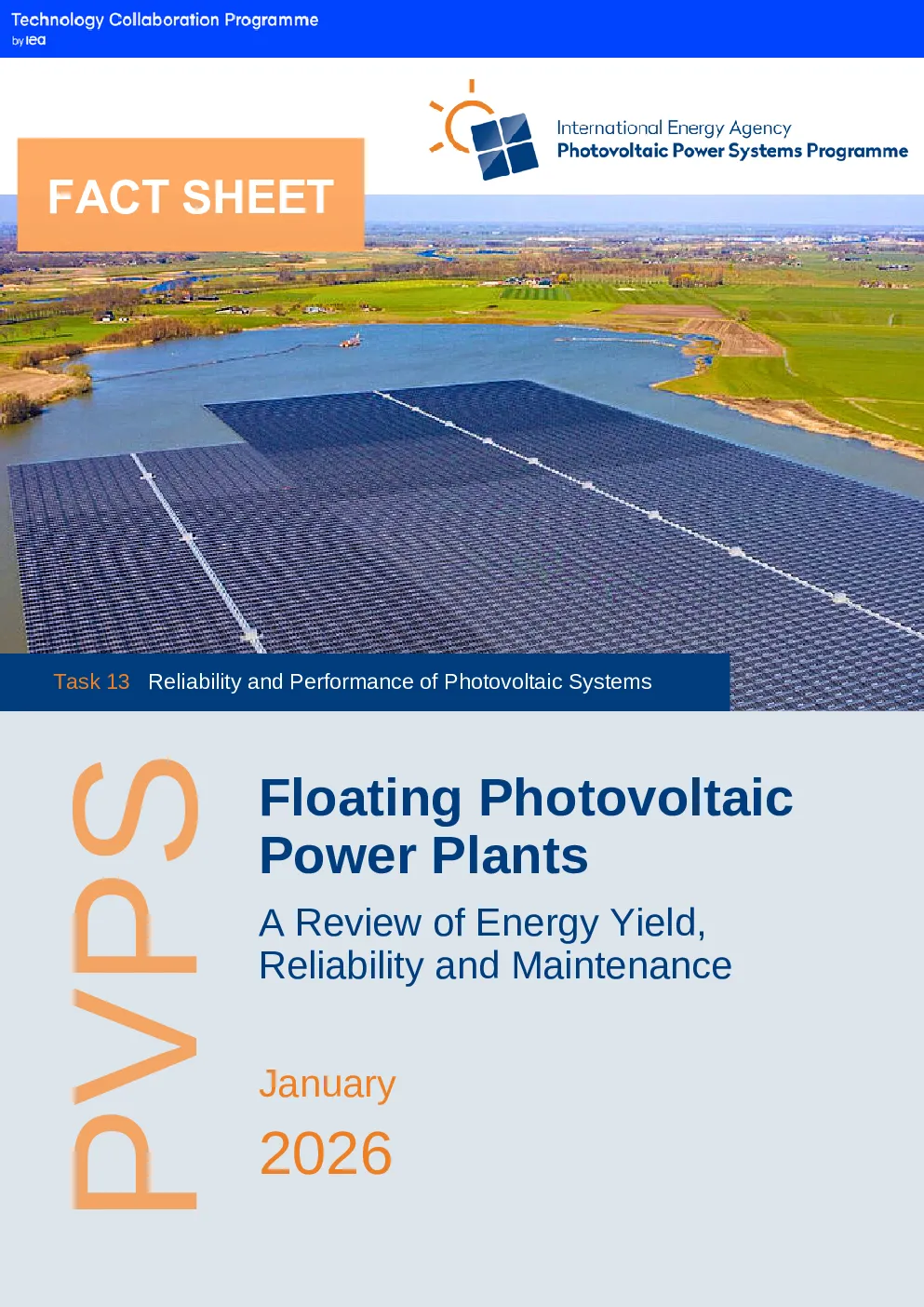
Floating PhotovoltaicPower Plants A Review of Energy Yield,Reliability and Maintenance PVPSJanuary2026 What is Floating PV? Photovoltaic systems are essential for the transition to sustainable energy,reducing fossil fuel dependence and mitigating climate change. Although PVrequires minimal land area – PV can meet the European Union's energyneeds using only 0.26% of its land – space for deployment is often scarce indensely populated regions. Floating photovoltaics (FPV)offer an effective solution to land-use challenges by installing PV systems on floatingstructures in water bodies. FPV shows strong potential to support climate targets, but still faces challenges likeregulatory barriers, cost competitiveness compared to ground-based PV (GPV), and uncertainties aboutenvironmental impacts and system reliability. Almost90% Cumulative installed capacity reached7.7 GWglobally by 2023(50% in China). of the installed FPV capacity is in Asia.The Netherlands and France are the largestmarkets outside Asia. Categorization of Floating PV Inland FPV Marine FPV Static freshwater bodies No wavesLimited wind Nearshore FPV Reasonably sheltered areaSignificant wave height < 2-3 m Inner waters Small to medium (1 m) wavesWater areas of 1-3 km Offshore FPV Unsheltered waterSignificant wave height > 2-3 m Larger inner watersMedium waves (> 1 m)Area > 3 km Development of Floating PV Examples of Floating PV Systems Fully composed of high-density polyethylene(HDPE) floats supporting modules directlyMarket leaders: Sungrow (27%), Ciel & Terre(12.7%), Northman (14.9%)Float properties and design have greatdevelopment potential, particularly regarding tiltangle and electrical configuration.Most widely deployed FPV technology globally Metal or fiber-reinforced plastic (FRP) structuresmounted on floats or pipesFloats support the structural frame, notindividual modulesExample: ZIM Float (>250 MW installed,dominant in Europe), Scotra (3.4% marketshare) Different technologies based on other floatingstructures.Example: Ocean Sun (patented membranetechnology with HDPE buoyancy ring)Horizontal mounting with modules in thermalcontact with waterDifferent environmental impacts: uniqueirradiance, wave effects, and cooling behavior Energy Yield: Critical Parameters Thermal Losses Operating temperature affects both efficiency and long-term degradation. FPVthermal behavior varies significantly by design. Improved thermal performance is not an inherent advantage of all FPVinstallations; it depends critically on system design and local climate conditions. Soiling Losses These losses occur when particles or objects accumulate on top of the solarpanel, blocking the irradiance reaching the solar cells, and reducing power output. Too little open information is currently available to establish a span of expectedsoiling rates for various FPV technologies in different climates. Optimisation for Different Conditions FPV Specific Stressors The economic viability of PV power plants is fundamentallylinked to their lifetime energy yield. TemperatureExtreme TemperatureFluctuationsWave LoadsWind LoadsHumidityShadingBiofouling & SoilingFlora & FaunaTidal VariationsHigh VoltagesCorrosive CompoundsUV Radiation Degradation rates and the overall lifespan of the power plantdirectly impact electricity production and the levelized cost ofenergy. Climatic and environmental factors play a major role indegradation and are by nature location specific. In FPV systems, components are exposed to stress factors thatdiffer significantly from those in ground-mounted PV.Mechanical, thermal, chemical, and electrical stresses varydepending on float design, anchoring systems, and electricallayouts. Stress profiles in FPV installations are not yetfully characterised or quantified. As a result, optimisation strategies for FPV systems must accountfor local environmental conditions and specific FPV technologiesto ensure reliable long-term performance. Early Failures or Reliability Concerns in FPV Systems b) Rubbing and stress damage onan HDPE part c) Torsion damage on analuminium part a) Rubbing damage on an HDPEpart d) Loss of mechanical integrity dueto wave forces f) Biofouling of underwatercomponent Image Credits:a, b, c, d, e, and g: TNOf:Oscar Bos/Wageningen Marine Researchh: Institute of Electrical and Electronic Engineers(IEEE) h) Partly delaminated edge seal Operation and Maintenance (O&M) Preventive Regular inspection(monthly/ quarterly/ yearly)Periodic recommissioningchecks Challenges: Addressing additional risks associated with thewater-basedworking environment; Ensuring accessibility and reachability for all maintenanceactivities across all components; Providing safe and cost-effective access to the floatingplatform; Clear cleaning and maintenance requirements areessential, as poor accessibility increases O&M effort anddowntime. FPV Research Priorities Understanding and quantifying theunique operational conditions and stres