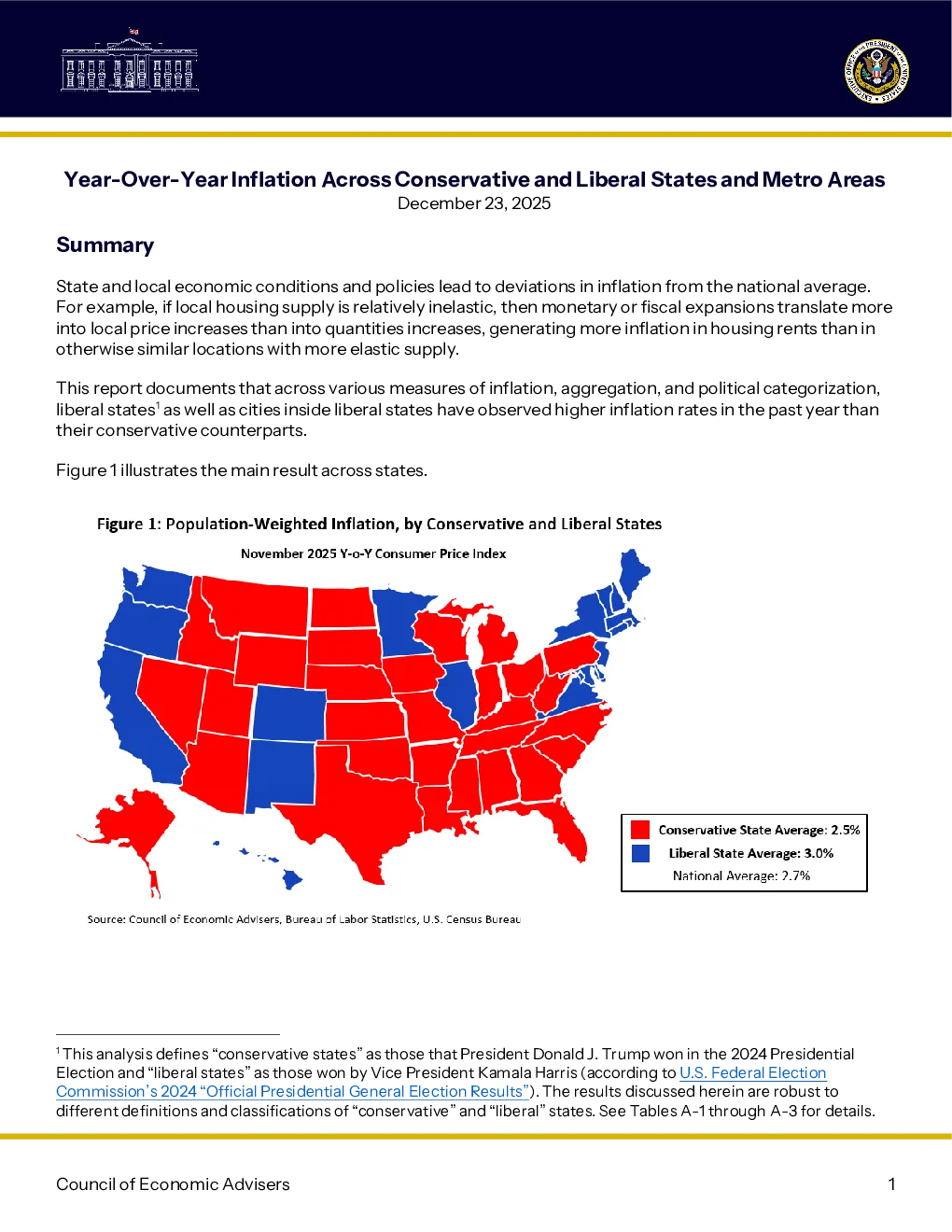
Summary State and local economic conditions and policies lead to deviations in inflation from the national average.For example, if local housing supply is relatively inelastic, then monetary or fiscal expansions translate moreinto local price increases than into quantities increases, generating more inflation in housing rents than inotherwise similar locations with more elastic supply. This report documents that across various measures of inflation, aggregation, and political categorization,liberal states1as well as cities inside liberal states have observed higher inflation rates in the past year thantheir conservative counterparts. Figure 1 illustrates the main result across states. The year-over-year (y-o-y) inflation rate2across conservative states as of November 2025 is 2.5%, lowerthan the average liberal state inflation of 3.0%. Conservative states also had lower y-o-y inflation rates than liberal states for select expenditure categoriesand special aggregate indices. Metro areas in conservative states also had lower y-o-y inflation than those in liberal states. Methodology There are no state-level consumer price index (CPI) estimates. The lowest level of aggregation for CPI datainclusive of whole states is measured at the 9 census divisions, each consisting of several states.3 •To calculate the population-weighted y-o-y inflation average across states by political alignment:4oFirst, using CPI values5for census divisions, derive: (1) y-o-y inflation rates attributable to all items;6(2) inflation expenditure categories of housing, food and beverage, andtransportation;7and (3) the inflation special aggregate index of energy.8oSecond, assign census-division y-o-y inflation to states in their respective divisions (Table A-4).oThird, calculate each state’s population9share of the total population in whichever politicalgroup the state is a part of (collection of conservative or liberal states).oFourth, multiply each state’s population share, calculated in Step 3, by its assigned inflationrate, from Step 2. oLast, sum these weighted contributions for the conservative and liberal states separately toget an average for each group. •To calculate the population-weighted y-o-y inflation average across metro areas in conservativeand liberal states:1011oFirst, using CPI values,12derive: (1) y-o-y inflation rates attributable to all items;13(2) inflationexpenditure categories of housing, food and beverage, and transportation;14and (2) theinflation special aggregate index of energy15(Table A-5).oSecond, using each metro area’s population,16sum up the populations of the metro areasbelonging to conservative and liberal states, respectively.1718oThird, divide each metro area’s population by the sum calculated in Step 2, depending onwhether the metro area is part of a conservative or liberal state.oFourth, multiply each metro area’s population share, calculated in Step 3, by its assignedinflation rate, from Step 1.oLast, sum these weighted contributions for the metro areas in conservative and liberal statesseparately to get an average for each group. Appendix