年轻女性实现金融普惠的途径:金融服务提供商和资助者的机会(英)2025
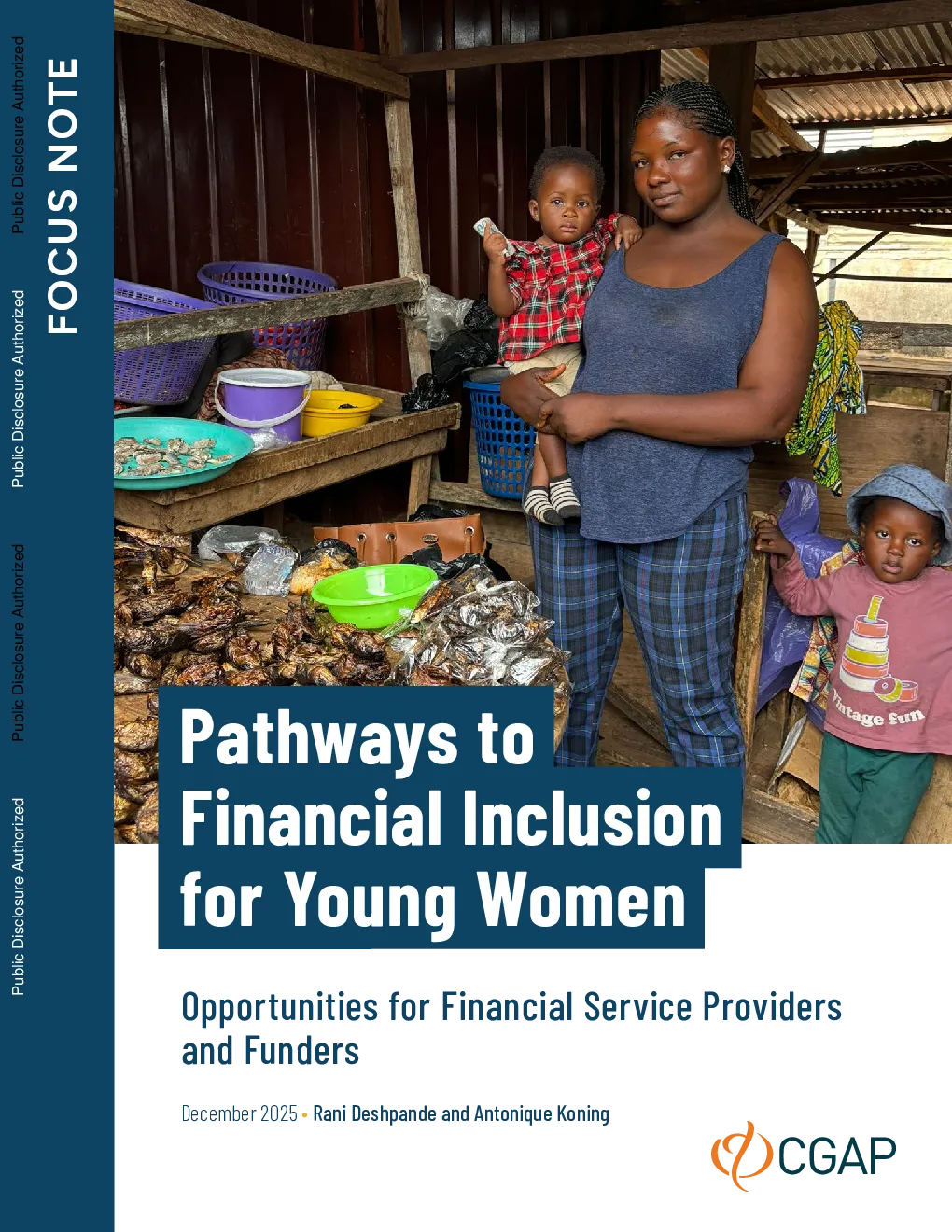
Opportunities for Financial Service Providersand FundersPublic Disclosure Authorized December 2025•Rani Deshpande and Antonique Koning Acknowledgments Rights and Permissions This CGAP Focus Note has been developed followingideation processes with financial services providers inGhana and Tanzania. The authors would like to thankG-Money and CAMFED in Ghana and BRAC and CRDBBank Foundation in Tanzania as well as colleagues This work is available under the Creative CommonsAttribution 4.0 International Public License (https://creativecommons.org/licenses/by/4.0/). Under the Attribution—Cite the work as follows: Deshpande,Rani and Antonique Koning. 2025. “Pathways toFinancial Inclusion for Young Women: Opportunitiesfor Financial Service Providers and Funders.” FocusNote. Washington, D.C.: CGAP.https://www.cgap.org/ Thanks also to the following peer reviewers for theirvaluable feedback: Jamie Anderson, Estelle Lahaye, andXavier Faz of CGAP as well as external reviewers AmaniM’bale from the Gates Foundation and Sukhwinder Translations—If you create a translation of this work,add the following disclaimer along with the attribution:This translation was not created by CGAP/World Bank CGAP 1818 H Street, NW, MSN F3K-306Washington, DC 20433Website:www.cgap.orgEmail:cgap@worldbank.org Adaptations—If you create an adaptation of this work,please add the following disclaimer along with theattribution: This is an adaptation of an original work by Cover photo by Antonique Koning, CGAP. © CGAP/World Bank, 2025. Contents Executive Summary Why Young Women’s Financial Inclusion Matters for FSPs and FundersYoung Women Can Be Viable Clients for FSPsYoung Women Can Help Funders Achieve Development Impact Constraints to Young Women’s Financial Inclusion Opportunities for FSPs and FundersOpportunity 1: Broaden Young Women’s On-Ramps into FinancialOpportunity 2: Help Young Women Save, Not Borrow, to Reach Their GoalsOpportunity 3: Preserve Young Women’s Financial Progress through Clear Roles for FSPs and Funders 23 FSPs Must Be Patient ProvidersFunders Can Incentivize Patience and Build Trust Research Methodology, Selected Segments, and Overview of Respondents25 ANNEX 1: ANNEX 2:Ghana and Tanzania as Financial Service Markets for Young Women29 References30 Acronyms BRACBangladesh Rehabilitation Assistance CommitteeCAMFEDCampaign for Female EducationCBFCRDB Bank FoundationCSOscivil society organizationsFSPfinancial services providerGHCGhana cediIDidentity documentKPIskey performance indicatorsNGOnon-governmental organizationROSCArotating savings and credit associationSIMsubscriber identity moduleSMSshort message service Executive Summary Why Young Women’s FinancialInclusion Matters for FinancialService Providers and Funders groups for qualitative research. CGAP then partneredwith leading financial service providers (FSPs) to designand test prototypes addressing constraints on financial Financial inclusion for young women is not only acontributor to individual empowerment but also acatalyst for broader economic and social development.Young women aged 15-24 represent over 7 percent Drawing from the findings of this research andprototype testing, this Focus Note presents keyopportunities to bring more young women into theranks of viable, long-term financial services customers, Access to financial tools and services can help youngwomen navigate these key life transitions, build skills,generate income, save, and manage risk. Financiallyincluding young women contributes to improving theiroutcomes in areas including psychosocial functioning, Opportunities for FSPs andFunders to Support YoungWomen’s Financial Inclusion 1. Broaden Young Women’s On-Ramps into FinancialInclusion.CGAP’s research revealed that many youngwomen who had accessed financial services by age 24had benefitted from financial and economic mentoringwithin their family and social networks. Unfortunately,many young women lacked such sources of guidance, This Focus Note explores why this remains the case—even after significant efforts to narrow the financialinclusion gender gap—and what can be done toachieve equality in this sphere. Since closing the gapwill require contextually adapted solutions, Ghanaand Tanzania were selected as two representative yet to mitigate this risk. However, improved coverageoptions are needed to correct common shortcomingsthat often lead young women to let their policies lapse.Simplifying sign-up and renewal can minimize friction ata key moment in the customer journey. Offering rebatesbased on certain conditions can provide concrete valuein the short term, in addition to the product’s promisedpayout when the policy is triggered. In Ghana, tailoredbenefits, such as income replacement or payouts information is clear and accessible to this segmentspecifically, and preferably provide it within the contextof broader financial literacy initiatives. To convey thisinformation, all strategies should ideally make use ofresp