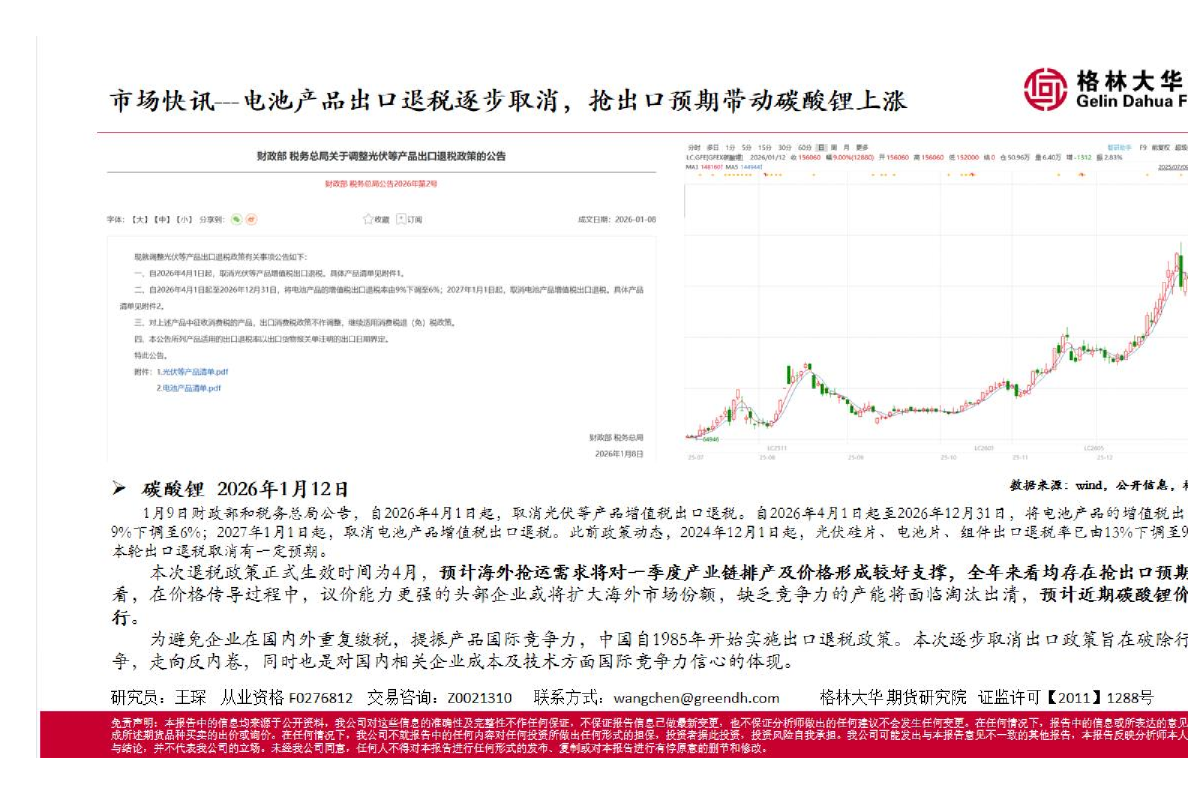
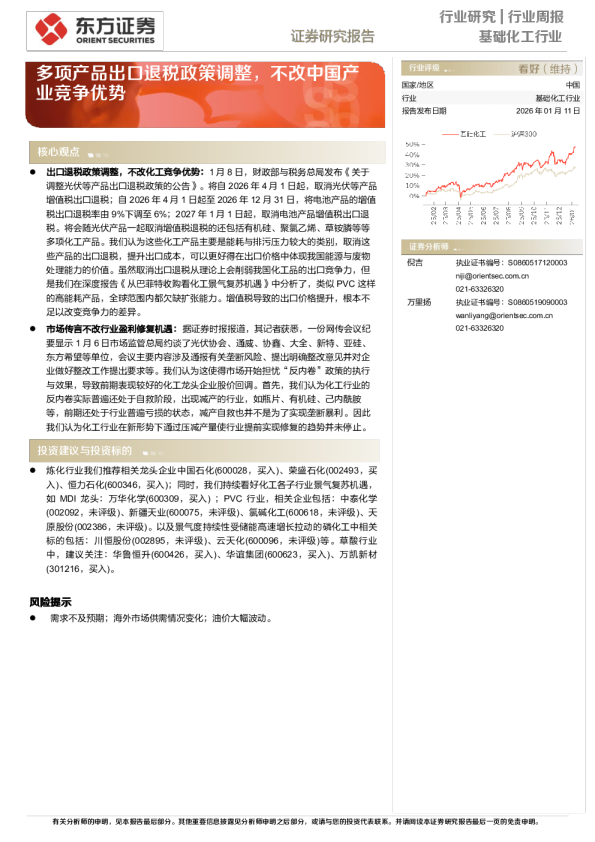
中国:北京宣布终止太阳能及电池产品出口增值税退税
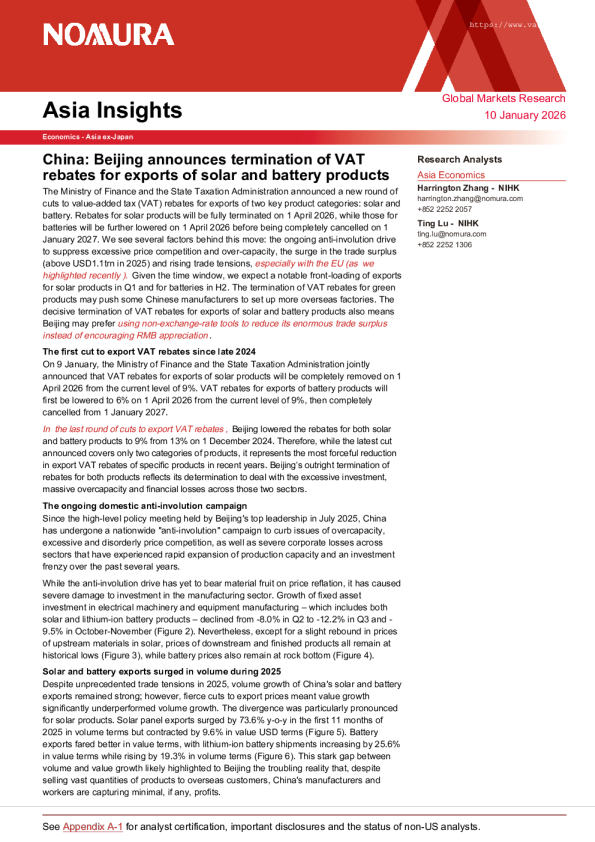
Asia Insights Economics - Asia ex-Japan China: Beijing announces termination of VATrebates for exports of solar and battery products Research Analysts Asia Economics Harrington Zhang - NIHKharrington.zhang@nomura.com+852 2252 2057 The Ministry of Finance and the State Taxation Administration announced a new round ofcuts to value-added tax (VAT) rebates for exports of two key product categories: solar andbattery. Rebates for solar products will be fully terminated on 1 April 2026, while those forbatteries will be further lowered on 1 April 2026 before being completely cancelled on 1January 2027. We see several factors behind this move: the ongoing anti-involution driveto suppress excessive price competition and over-capacity, the surge in the trade surplus(above USD1.1trn in 2025) and rising trade tensions,especially with the EU (as we Ting Lu - NIHKting.lu@nomura.com+852 2252 1306 The first cut to export VAT rebates since late 2024On 9 January, the Ministry of Finance and the State Taxation Administration jointly announced that VAT rebates for exports of solar products will be completely removed on 1April 2026 from the current level of 9%. VAT rebates for exports of battery products will In the last round of cuts to export VAT rebates ,Beijing lowered the rebates for both solarand battery products to 9% from 13% on 1 December 2024. Therefore, while the latest cutannounced covers only two categories of products, it represents the most forceful reductionin export VAT rebates of specific products in recent years. Beijing’s outright termination of The ongoing domestic anti-involution campaign Since the high-level policy meeting held by Beijing's top leadership in July 2025, Chinahas undergone a nationwide "anti-involution" campaign to curb issues of overcapacity,excessive and disorderly price competition, as well as severe corporate losses across While the anti-involution drive has yet to bear material fruit on price reflation, it has causedsevere damage to investment in the manufacturing sector. Growth of fixed assetinvestment in electrical machinery and equipment manufacturing – which includes bothsolar and lithium-ion battery products – declined from -8.0% in Q2 to -12.2% in Q3 and - Solar and battery exports surged in volume during 2025Despite unprecedented trade tensions in 2025, volume growth of China's solar and battery exports remained strong; however, fierce cuts to export prices meant value growthsignificantly underperformed volume growth. The divergence was particularly pronouncedfor solar products. Solar panel exports surged by 73.6% y-o-y in the first 11 months of2025 in volume terms but contracted by 9.6% in value USD terms (Figure 5). Batteryexports fared better in value terms, with lithium-ion battery shipments increasing by 25.6% VAT rebates of solar and battery products in 2025 According to data released by the General Administration of Customs, the ChinaPhotovoltaic Industry Association and the China Passenger Car Association, we calculateChina’s total exports of solar and battery (mostly lithium-ion batteries) products totalledUSD96bn in the first 11 months of 2025. Given the 9% VAT rebate rate for the two While not all products are eligible for export VAT rebate, we believe a majority of the twocategories are entitled to such rebates, and the number could also serve as an upper limit.According to the Ministry of Finance, the total export VAT rebate was RMB1,904bn in the Trade tensions warrant further action from Beijing Aswe have detailed in prior research, the sizeable spare capacity in some of China’smanufacturing sectors and weak domestic demand have caused prolonged PPI deflation,which has transmitted to persistent declines in export prices (Figure 7). Moreover, the This issue has broadly escalated trade tensions.We recently highlighted the risks to EU-China trade from a "second China shock".This risk, which features China's rapidly risingcompetitiveness in high-end machinery and equipment, may be underappreciated bymarkets. We think Brussels may increasingly impose tariffs on Chinese goods and erect Notable front-loading for both products likely over the rest of Q1 Given the latest move, we think exports of both affected products are likely to experiencenotable front-loading over the rest of Q1, particularly solar products, for which export VATrebates will be completely terminated on 1 April 2026. For battery products, the front-loading may take place in two phases, as the rebate reduction is conducted in stages: first Note: Motor vehicle investment in China now comes mostly from the EV sector, whileelectrical machinery and equipment manufacturing include both solar and lithium-ionbattery. Note: 2025 data is as of November.Source: General Administration of Customs, Wind, Nomura Global Economics Note: Index: 30 May 2014 = 100.Source: SOLARZOOM, Wind, Nomura Global Economics Source: Wind, Nomura Global Economics Source: General Administration of Customs, Wind,