环境流量评估简明指南(英)2025
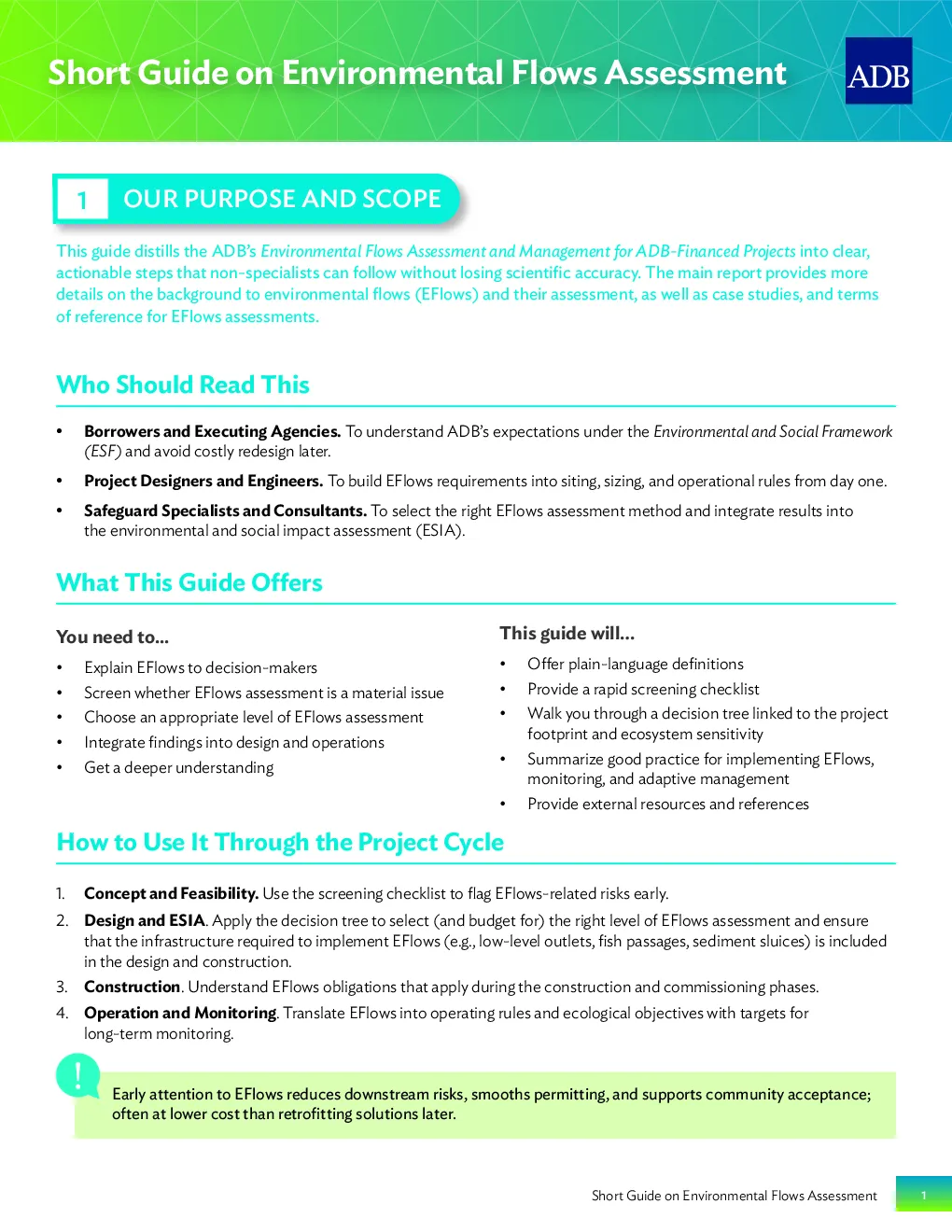
OUR PURPOSEAND SCOPE1 This guide distills the ADB’sEnvironmental Flows Assessment and Management for ADB-Financed Projectsinto clear,actionable steps that non-specialists can follow without losing scientific accuracy. The main report provides moredetails on the background to environmental flows (EFlows) and their assessment, as well as case studies, and termsof reference for EFlows assessments. Who Should Read This •Borrowers and Executing Agencies.To understand ADB’s expectations under theEnvironmental and Social Framework(ESF)and avoid costly redesign later. •Project Designers and Engineers.To build EFlows requirements into siting, sizing, and operational rules from day one.•Safeguard Specialists and Consultants.To select the right EFlows assessment method and integrate results intothe environmental and social impact assessment (ESIA). What This Guide Offers This guide will… You need to... •Offer plain‑language definitions•Provide a rapid screening checklist•Walk you through a decision tree linked to the projectfootprint and ecosystem sensitivity•Summarize good practice for implementing EFlows,monitoring, and adaptive management•Provide external resources and references •Explain EFlows to decision‑makers•Screen whether EFlows assessment is a material issue•Choose an appropriate level of EFlows assessment•Integrate findings into design and operations•Get a deeper understanding How to Use It Through the Project Cycle 1.Concept and Feasibility.Use the screening checklist to flag EFlows‑related risks early. 2.Design and ESIA. Apply the decision tree to select (and budget for) the right level of EFlows assessment and ensurethat the infrastructure required to implement EFlows (e.g., low‑level outlets, fish passages, sediment sluices) is includedin the design and construction.3.Construction. Understand EFlows obligations that apply during the construction and commissioning phases.4.Operation and Monitoring. Translate EFlows into operating rules and ecological objectives with targets forlong‑term monitoring. Early attention to EFlows reduces downstream risks, smooths permitting, and supports community acceptance;often at lower cost than retrofitting solutions later. WHAT ARE ENVIRONMENTAL FLOWS?2 Definition:EFlows are thequantity, timing, and qualityof water, and themovementof sediment andorganisms, that a river, wetland, or estuary needs to stay healthy and keep delivering benefits to people. EFlows help keep rivers healthy by maintaining habitats; supporting fish migration and spawning; rechargingfloodplains, and supporting communities that rely on the river for food, farming, and daily life. Why Do EFlows Matter? River Function Sustained by EFlows Practical Benefit for ADB Projectsand Communities •Seasonal floods shape channels and recharge floodplains•Dry season low flows moderate temperature, maintainhabitats, and keep pools connected•Sediment transport supplies nutrients and maintainshabitat diversity•Connectivity (up‑and downstream and lateral) enablesthe movement of organisms and nutrients•Seasonal changes in water, sediment, and movementsupport the life cycles of river animals and plants. Naturalvariability limits invasive species. •Reduces flood risk, supports agriculture,and buffers droughts•Secures water supply and water quality downstream•Avoids riverbank or riverbed erosion, protectsinfrastructure•Supports fisheries and riparian livelihoods•Supports biodiversity and the benefits that riversprovide to people; lowers long‑term maintenance,restoration, and public health costs Dams, water diversions, and overuse disrupt natural water flow and connections, harming ecosystems,threatening livelihoods, and increasing risks to infrastructure and project success. Six Building Blocks of an EFlows Assessment 1.Hydrology and hydraulics. How do changes in the amount and timing of water flow affect river depth, velocity, and theareas covered by water?2.Sediment movement. How do the volume, timing, and size of sediment change, and what effects do these have onthings like light penetration, erosion, habitat diversity, and fish gill function?3.Water quality. How will shifts in water temperature, nutrients, or pollution affect the food chain, river life, and thepeople who depend on the river?4.Connectivity. Are organisms still able to move freely along and across the river? If not, what problems might that cause?5.Ecology. How do the changes in 1–4 affect key roles of the ecosystem, such as the amount of habitat available, thesignals animals use to move or migrate, their timing for reproduction, and their ability to stay in their natural places?6.People.Which people or economic activities depend on the river; how do they use it; what effects do they have on theriver’s organisms and water; and how might changes in flow, sediment, water quality, and connectivity of the river systemaffect them? These building blocks help EFlows practitioners predict cause‑and‑effect pathways, describe impacts, an