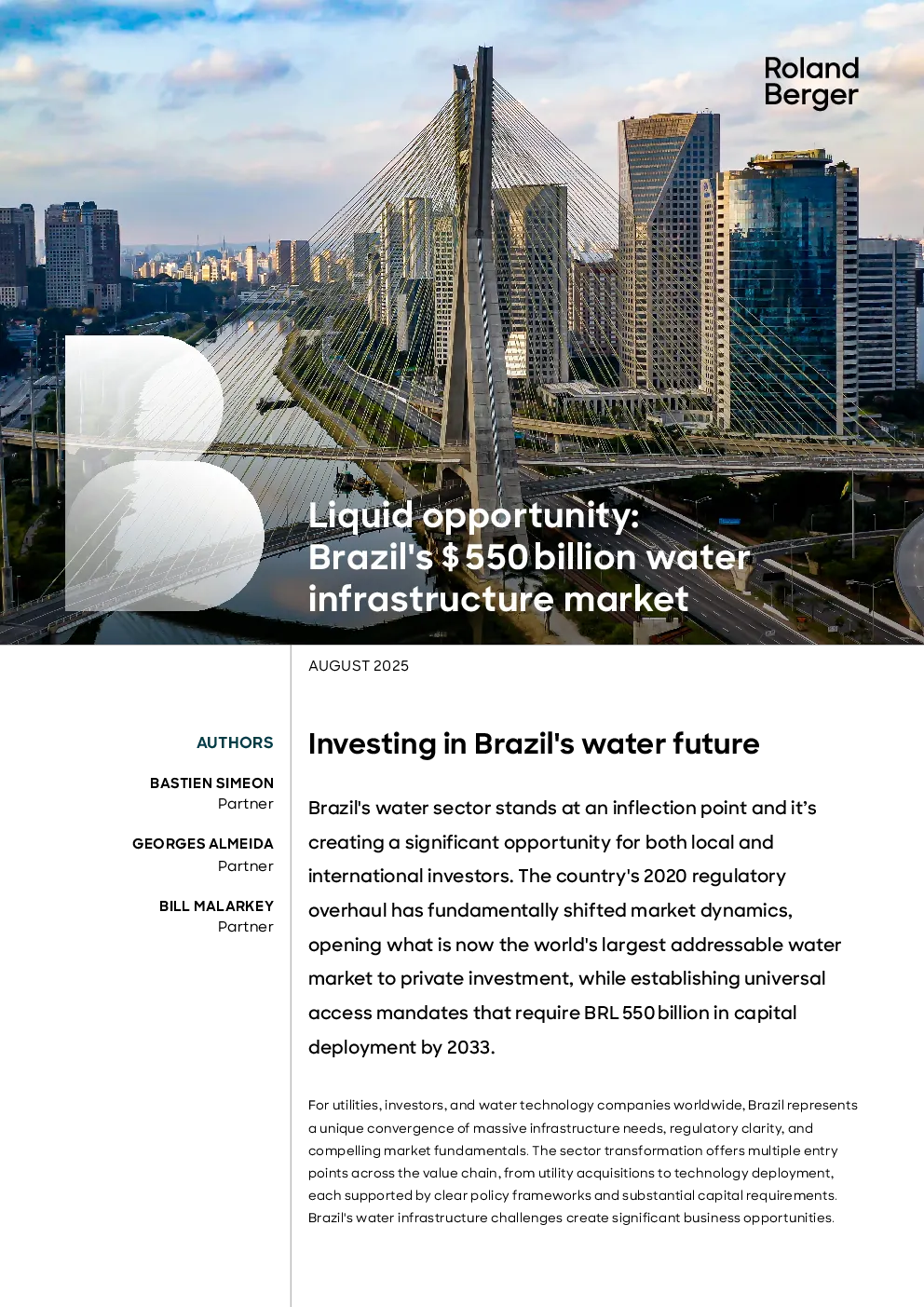
流动性机会:巴西5500亿美元的水利基础设施市场
AUTHORS BASTIEN SIMEONPartner Brazil's water sector stands at an inflection point and it’screating a significant opportunity for both local andinternational investors. The country's 2020 regulatory GEORGES ALMEIDAPartner BILL MALARKEYPartner For utilities, investors, and water technology companies worldwide, Brazil representsa unique convergence of massive infrastructure needs, regulatory clarity, andcompelling market fundamentals. The sector transformation offers multiple entry Today, 33million Brazilians lack access to water supply - 15% of the population - while80million people, representing 38% of the country, live without sewage treatment. In These infrastructure gaps represent substantial market demand that must beaddressed through private capital, given the scale of investment required. Thecombination of urgent need, regulatory support, and market scale has created what Regulatory certainty brings new opportunity The 2020 New Legal Framework represents a fundamental shift from Brazil's historicallypublic-dominated water sector to a competitive private market. This regulatoryclarity has established universal coverage mandates that are driving unprecedentedcapital requirements - and creating a significant investment opportunity. The framework sets ambitious targets for 2033: achieving 99% water coverage and90% treated sewage coverage. To meet these goals, Brazil must reduce thepopulation without water access from 15% to just 1%, and those without sewageaccess from 38% to 10%. The scale of this transformation requires doubling currentinvestment levels immediately. Access to basic sanitation is a global issue, but the situation iseven more alarming in Brazil The numbers are staggering. Current annual sanitation investment stands atBRL23billion, but reaching universalization requires BRL46billion annually - The private sector response has been swift and substantial. Expected privateinvestment includes BRL105billion across 43 privatization projects by 2033, with Brazilian investment demand for sanitation universalization Market evolution: From public monopoly to private The transformation of Brazil's water sector has been rapid and significant over thelast five years. Prior to 2020, the market was characterized by low investment From 2020-2024, following the New Legal Framework, investments focused on largeblocks in the South and Southeast regions. Major players and funds were attracted demonstrating growing investor confidence in Brazil's water market fundamentals.From 2025 onwards, the market is entering a new phase characterized by M&Aopportunities in the private sector, remaining public operations, and increased Three strategic pathways for market entry For utilities, investors, and technology companies looking to participate in Brazil'swater transformation, three distinct pathways offer different risk-return profiles and Private market consolidation The first pathway involves M&A opportunities among current private players,focusing on consolidation in an increasingly competitive market. This approach Many current operators are seeking capital to reduce financial leverage whilepositioning for growth. They're evaluating which assets to retain based on strategic The consolidation trend is accelerating as companies recognize that scaleadvantages are becoming more important in a competitive bidding environment. Public concession opportunities 2 The second pathway focuses on acquiring new concessions through publicauctions, including both privatizations and greenfield opportunities. Potential State and municipal concessions represent expansion opportunities intounderserved regions with significant growth potential. These concessions typically Special public-private partnerships (PPPs) offer innovative structures that canreduce risk while maintaining attractive returns. These arrangements increasingly Value chain expansion3 The third pathway involves transversal opportunities across the water value chain,extending beyond utility operations into construction, operations services, energy, Geographic complexity varies significantly across regions. South and Southeastregions offer more developed infrastructure and higher-income populations, while PartnerParis Office +33 1 7092-8935bastien.simeon@rolandberger.com BASTIEN SIMEON GEORGES ALMEIDA PartnerSão Paulo Office +55 119 7203-7339 BILL MALARKEY PartnerPhiladelphia Office +1 267 240-5563 This publication has been prepared forgeneral guidance only. The reader shouldnot act according to any informationprovided in this publication withoutreceiving specific professional advice.Roland Berger GmbH shall not be liable forany damages resulting from any use of theinformation contained in the publication. ©2025 ROLAND BERGER GMBH.ALL RIGHTS RESERVED.