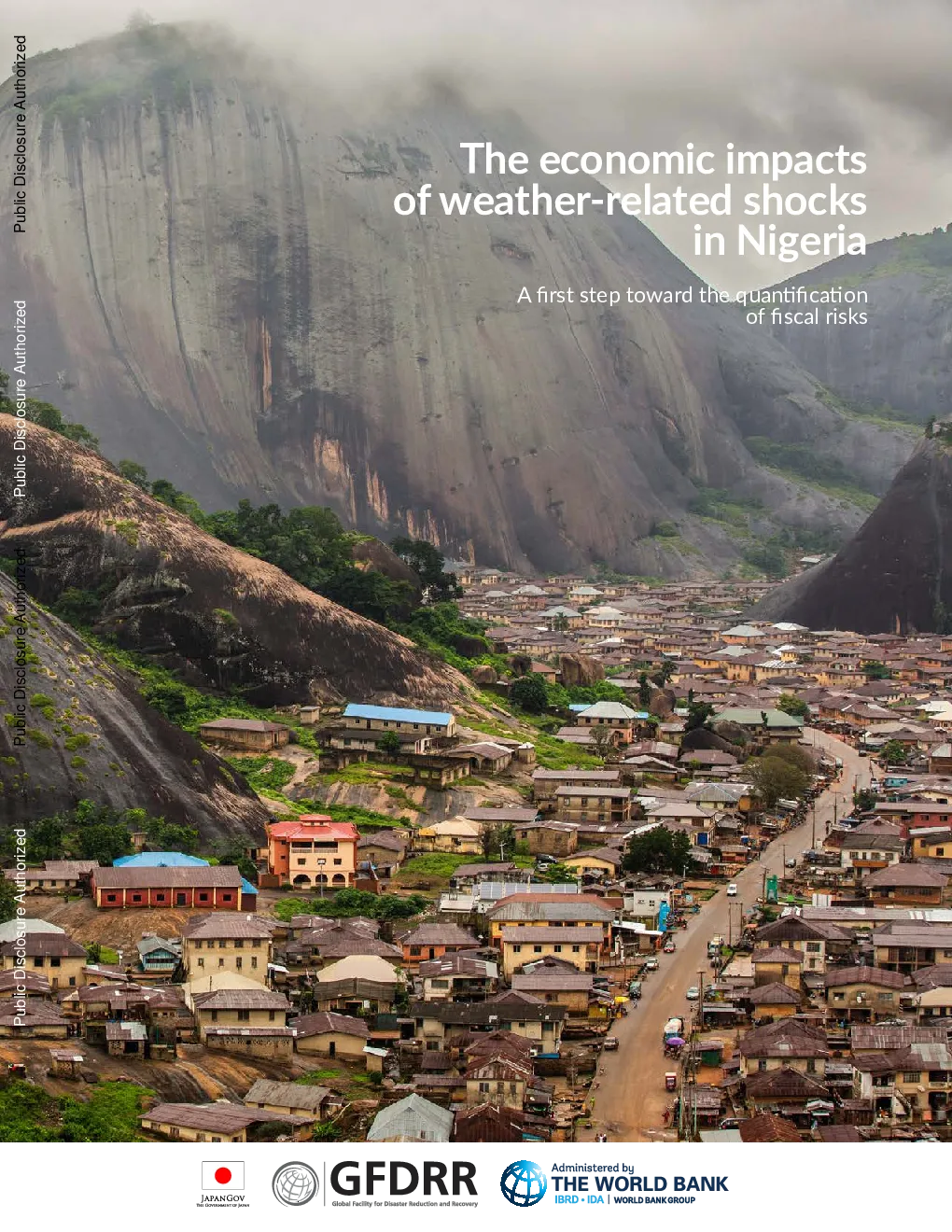
A first step toward the quantificationof fiscal risks 2025 International Bank for Reconstruction and Development / The World Bank1818 H Street NW, Washington, DC 20433Telephone: +1-202-473-1000; Internet: www.worldbank.org Some rights reserved. This work is a product of the staff of The World Bank and the Global Facility for Disaster Reduction and Recovery (GFDRR). Thefindings, interpretations, and conclusions expressed in this work do not necessarily reflect the views of The World Bank, its Boardof Executive Directors, or the governments they represent. The World Bank does not guarantee the accuracy, completeness, orcurrency of the data included in this work and does not assume responsibility for any errors, omissions, or discrepancies in theinformation, or liability with respect to the use of or failure to use the information, methods, processes, or conclusions set forth.The boundaries, colors, denominations, and other information shown on any map in this work do not imply any judgment on thepart of The World Bank concerning the legal status of any territory or the endorsement or acceptance of such boundaries. Nothing herein shall constitute or be construed or considered to be a limitation upon or waiver of the privileges and immunitiesof The World Bank, all of which are specifically reserved. Rights and Permissions.This work is subject to copyright. Because The World Bank encourages dissemination of its knowledge,this work may be reproduced, in whole or in part, for noncommercial purposes as long as full attribution to this work is given. Translations.If you create a translation of this work, please add the following disclaimer along with the attribution:This translationwas not created by The World Bank and should not be considered an official World Bank translation. The World Bank shall not be liablefor any content or error in this translation. Adaptations.If you create an adaptation of this work, please add the following disclaimer along with the attribution:This is anadaptation of an original work by The World Bank. Views and opinions expressed in the adaptation are the sole responsibility of theauthor or authors of the adaptation and are not endorsed by The World Bank. Third-party content.The World Bank does not necessarily own each component of the content contained within the work. TheWorld Bank therefore does not warrant that the use of any third-party-owned individual component or part contained in the workwill not infringe on the rights of those third parties. The risk of claims resulting from such infringements rests solely with you. Ifyou wish to reuse a component of the work, it is your responsibility to determine whether permission is needed for that reuseand to obtain permission from the copyright owner. Examples of components can include, but are not limited to, tables, figures,or images. All queries on rights and licenses, including subsidiary rights, should be addressed to World Bank Publications, The World BankGroup, 1818 H Street NW, Washington, DC 20433, USA; e-mail: pubrights@worldbank.org About the cover: Birdseye view of Idanre, located in Ondo State, in the western part of Nigeria. During the wet season western Nigeria can receiveup to 381 cm of rain. Photo: EyeEm Mobile GmbH | iStock.com. Design: ULTRAdesigns, Inc. The economic impactsof weather-related shocksin Nigeria A first step toward the quantificationof fiscal risks Table of Contents Executive Summary......................................................................................................................................................viiIntroduction.........................................................................................................................................................................1 1Overview of recent disaster and weather-related shocks in Nigeria................................................3 1.1.Historical disaster trends highlight floods as one of the most significant disasters....................................31.2.The devastating floods of 2012 led to unprecedented damages and losses.................................................61.3.The nationwide floods in 2022 affected a significant portion of the population.........................................7 2A first assessment of the economic impacts of weather-related shocks in Nigeria..................9 2.1.Potential damages associated with floods..........................................................................................................102.1.1.National-level damages associated with floods....................................................................................102.1.2.State-level damages associated with floods..........................................................................................112.2.Growth impact of weather-related events..........................................................................................................132.2.1.Extreme precipitation