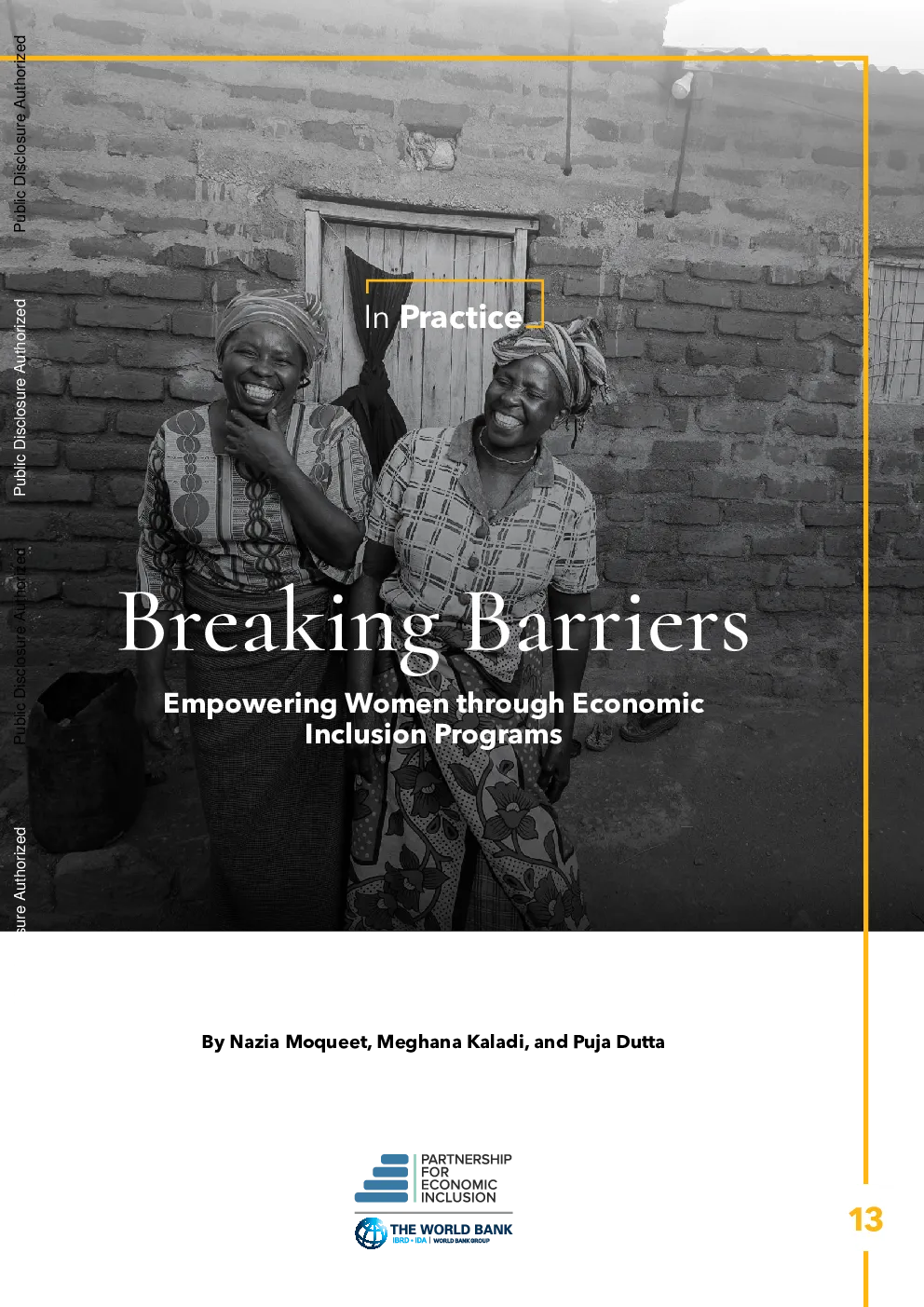
Empowering Women through EconomicInclusion ProgramsPublic Disclosure Authorized © 2025 International Bank for Reconstruction and Development / The World Bank 1818 H Street NWWashington DC 20433Telephone: 202-473-1000Internet: www.worldbank.org This work is a product of the staff of The World Bank with external contributions. Thefindings, interpretations, and conclusions expressed in this work do not necessarily reflect theviews of The World Bank, its Board of Executive Directors, or the governments they represent. The World Bank does not guarantee the accuracy, completeness, or currency of the dataincluded in this work and does not assume responsibility for any errors, omissions, ordiscrepancies in the information, or liability with respect to the use of or failure to usethe information, methods, processes, or conclusions set forth. The boundaries, colors,denominations, and other information shown on any map in this work do not imply anyjudgment on the part of The World Bank concerning the legal status of any territory or theendorsement or acceptance of such boundaries. Nothing herein shall constitute or be construed or considered to be a limitation upon orwaiver of the privileges and immunities of The World Bank, all of which are specificallyreserved. Rights and PermissionsThe material in this work is subject to copyright. Because The World Bank encourages dissemination of its knowledge, this work may be reproduced, in whole or in part, fornoncommercial purposes as long as full attribution to this work is given. Any queries on rights and licenses, including subsidiary rights, should be addressed to WorldBank Publications, The World Bank Group, 1818 H Street NW, Washington, DC 20433, USA;fax: 202-522-2625; e-mail: pubrights@worldbank.org. Cover photo: BRAC/CARE Volume 13November 19, 2025 InPractice Contents AcknowledgmentsAbout theIn Practice seriesAbbreviationsivvvi IntroductionLandscape of Economic Inclusion ProgramsFramework: Operational Approach to IncreasingWomen's Economic EmpowermentGender-intentional Design and Delivery in EconomicInclusion ProgramsStrengthening AgencyIncreasing Access to and Control over ResourcesPromoting Changes in Norms and Contextual BarriersMeasuring Women's Economic EmpowermentConclusion135779152022 InteractiveTable of ContentsClick to navigate NotesReferences2426 Figures 1 |Pathways through which economic inclusion programspromote women’s economic empowerment2 |Approaches programs use to facilitate women’s empowerment3 |Operational approach to women’s economic empowerment345 Boxes 1|A framework for measuring gender outcomes in economicinclusion programs21 Acknowledgements This note was prepared under the guidance of Victoria Strokova, Program Manager of thePartnership for Economic Inclusion (PEI). The authors gratefully acknowledge the generous support of the Gates Foundation and BRACInternational and extend their appreciation to Radu Ban (Gates Foundation) and ClaireHutchings, Anu Kumar, Rasha Natour, and Max Gollin (BRAC International) for their valuableguidance. The note benefited greatly from the insightful comments from peer reviewers: Laura Rawlings,Sarika Gupta, and Margaux Vinez (World Bank) and Tatiana Rincón (Fundación Capital). The authors would further like to thank the PEI team, particularly Janet Heisey and ShilohniSumanthiran, for their support. About theIn Practice Series The Partnership for Economic Inclusion publishes the In Practice series featuring accessible,practitioner-focused publications that highlight learning, good practice, and emerginginnovations for scaling up economic inclusion programs. Guide to navigation TheIn Practiceseries is interactive and provides built-in technical features to assist readers asthey progress, including a navigation bar, progress bar, and the ability to jump to endnotes andback to the text throughout. Progress bar Jump notes1 Chapter navigation 1. Notes throughout the text are linked toallow easy navigation between endnotesand the main text. The navigation bar at the top ofeach page allows easy navigationwith a simple click. Abbreviations ELAGBVIDMSMESEWASWLUPGWEEEmpowerment and Livelihood for Adolescentsgender-based violenceidentificationmicro-, small- and medium-size enterprisesSelf-Employed Women's AssociationSupporting Women's LivelihoodsUltra-Poor Graduationwomen's economic empowerment Introduction Poverty is not gender-neutral. Entrenched social and economicinequalities that limit access to education, employment, andfinancial resources mean that 1 in 10 women lives in extremepoverty (UN Women 2023; Stepanovic et al. 2025). In 2023, only 49percent of women were in the global labor force, compared with 73percent of men (ILO 2024). When they do work, women are more likelythan men to work in the informal sector,where jobs are less secure, and on averagethey earn 20 percent less than men (ILO2022, 2023; OECD 2024). These gaps reflectpersistent barriers in women’s access toresources