您的浏览器禁用了JavaScript(一种计算机语言,用以实现您与网页的交互),请解除该禁用,或者联系我们。 [UNCTAD]:跨境贸易中的妇女:多民族玻利维亚国、厄瓜多尔和秘鲁的案例研究 - 发现报告

跨境贸易中的妇女:多民族玻利维亚国、厄瓜多尔和秘鲁的案例研究

2025-12-16 - UNCTAD 我是传奇
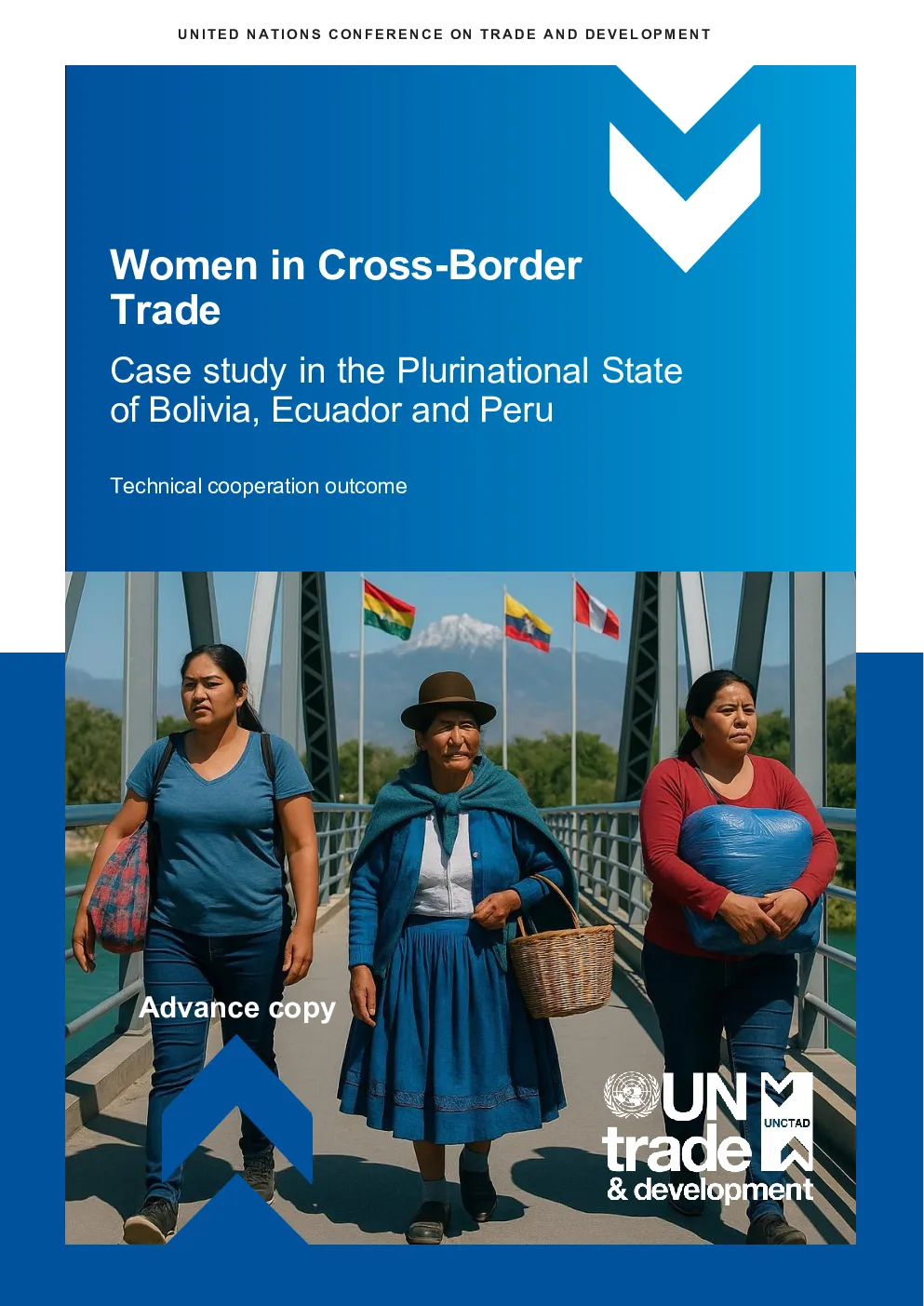
报告封面

Case study inthe Plurinational StateofBolivia, Ecuador and Peru Technical cooperation outcome ©2025, United Nations Conference on Trade and Development Thefindings, interpretations and conclusions expressed herein are those of the authors and do not necessarilyreflect the views of the United Nations or its officials or Member States. Thedesignations employed and the presentation of material on any map in this work do not imply theexpression of any opinion whatsoever on the part of the United Nations concerning the legal status of anycountry, territory, city or area or of its authorities, or concerning the delimitation of its frontiers or boundaries. Mentionof any firm or licensed process does not imply the endorsement of the United Nations. Thispublication has not been formally edited. UNCTAD/TCS/DTL/INF/2025/9(Advance copy) Acknowledgements Thisstudy was prepared under the guidance of Ángel González Sanz and Torbjörn Fredriksson, Officers-in-Charge of the UNCTAD Division on Technology and Logistics, and Regina Asariotis, Poul Hansen andArántzazu Sánchez Belastegui. The report was prepared by Maria Bolotnikov and Pamela Ugaz, with inputsfrom Roxana Cortina and Willy Guadalupe (UNCTAD consultant). Valuable comments and feedback werereceived from Mariangela Linoci and Carolyne Wanjiku. Pamela Ugaz led the coordination of the study. UNCTADgratefully acknowledges the valuable comments and feedback of the secretariats of the NationalTrade Facilitation Committees of the Plurinational State of Bolivia, Ecuador and Peru. Thegraphic design work was done by Akram Hamou of UNCTAD. This document is published in the context of the Accelerate Trade Facilitation Programme, funded by HisMajesty’s Revenue and Customs of the United Kingdom of Great Britain and Northern Ireland. Foreword Women living in border regions often rely on small-scale cross-border trade for their livelihoods, butthis dependence presents significant challenges. The experiences of women in Huaquillas (Ecuador-Peruborder) and Desaguadero (Bolivia-Peruborder) not only highlight individual struggles but alsoreveal broader systemic issues that persist at borders in developing countries around the world. Thesechallenges includeincompleteinformation about border procedures,lack of simplified trade regimes,digitalchallenges, limited access to finance,safety and securityconcernsat border posts, and theburdens of unpaid care work, which often compel women to engage in informal trading. These challenges are not new. Previous work by UNCTAD, such as "Borderline: Women in InformalCross-Border Trade in Malawi, the United Republic of Tanzania, and Zambia," and "GenderPerspectives in Trade Facilitation Reforms," has documented the barriers faced by women tradersand the ways in which trade policy often neglects a more inclusive approach.This study marks thefirst time UNCTAD has applied the same methodology in Latin American countries. The findings from this research are striking. Women traders frequently find themselves excluded fromformal trade channels, not due to a lack of capacity, but because of systemic barriers—such asburdensome regulatory requirements, unclear procedures, financial exclusion, safety concerns,anddigital illiteracy, among others. These obstacles not only limit women’s economic opportunities butalso undermine the resilience and prosperity of entire border communities. Addressing these gapsrequires more than just simplifying regulations; it necessitates a concerted effort to incorporatewomen’sperspectives into trade facilitation reforms.National Trade Facilitation Committees,convening public and private stakeholders, are ideal platforms to bridge those gaps. UNCTAD has actively promoted the integration of gender perspectives in trade facilitation throughinitiatives such as e-learning courses on mainstreaming gender in trade facilitation, support forNational Trade Facilitation Committees via the Empowerment Programme for Trade Facilitation andthe Reform Tracker, as well as the UN Global Survey on Digital and Sustainable Trade Facilitation.These efforts have generated valuable evidence and raised awareness of women’s experiences atborders. Additionally, UNCTAD collaborates with governments and stakeholders to design gender-sensitive initiatives in trade facilitation reforms and track their progress. These initiatives demonstratethat inclusive trade facilitation can lower costs, enhance efficiency, and promote gender equalitysimultaneously. The methodology usedand experiences gainedinthis study can be replicated in otherpartsof theworldand tailoredto their specific contexts. While each country and borderhasuniquecharacteristics,the challenges identified,and the recommendations formulated in this report reflect common patternsaffecting women cross-border tradersand women officialsin various regions. National and international actors are encouraged to use this methodology as afoundationfor similarassessmentsto promote more inclusive