美国银行美股招股说明书(2026-01-02版)
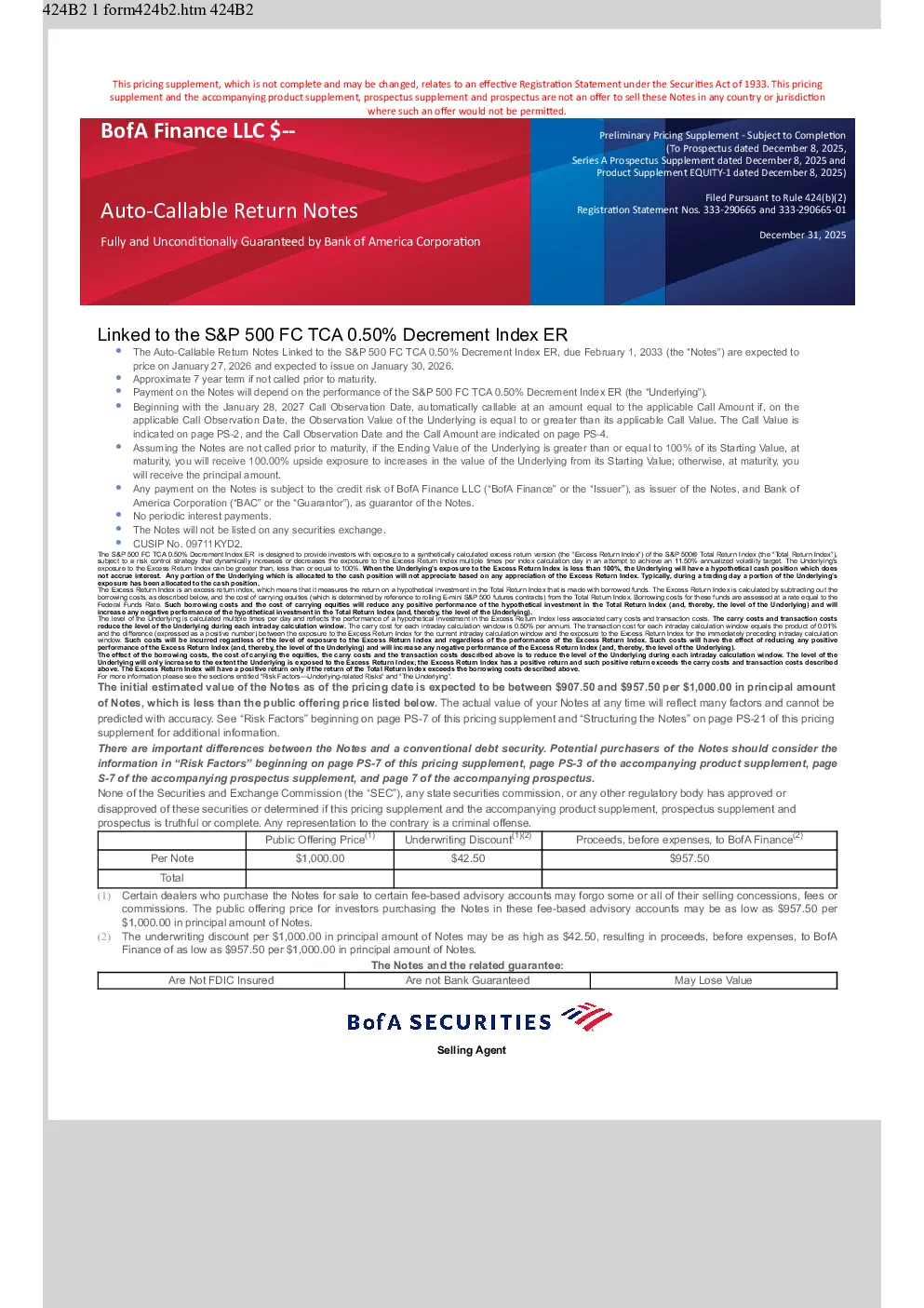
Preliminary Pricing Supplement - Subject to Completion(To Prospectus dated December 8, 2025,Series A Prospectus Supplement dated December 8, 2025 andProduct Supplement EQUITY-1 dated December 8, 2025) Auto-Callable Return Notes Fully and Unconditionally Guaranteed by Bank of America Corporation Linked to the S&P 500 FC TCA 0.50% Decrement Index ER• The Auto-Callable Return Notes Linked to the S&P 500 FC TCA 0.50% Decrement Index ER, due February 1, 2033 (the “Notes”) are expected toprice on January 27, 2026 and expected to issue on January 30, 2026.•Approximate 7 year term if not called prior to maturity.•Payment on the Notes will depend on the performance of the S&P 500 FC TCA 0.50% Decrement Index ER (the “Underlying”).•Beginning with the January 28, 2027 Call Observation Date, automatically callable at an amount equal to the applicable Call Amount if, on theapplicable Call Observation Date, the Observation Value of the Underlying is equal to or greater than its applicable Call Value. The Call Value isindicated on page PS-2, and the Call Observation Date and the Call Amount are indicated on page PS-4.•Assuming the Notes are not called prior to maturity, if the Ending Value of the Underlying is greater than or equal to 100% of its Starting Value, atmaturity, you will receive 100.00% upside exposure to increases in the value of the Underlying from its Starting Value; otherwise, at maturity, youwill receive the principal amount.•Any payment on the Notes is subject to the credit risk of BofA Finance LLC (“BofA Finance” or the “Issuer”), as issuer of the Notes, and Bank ofAmerica Corporation (“BAC” or the “Guarantor”), as guarantor of the Notes.•No periodic interest payments.•The Notes will not be listed on any securities exchange.•CUSIP No. 09711KYD2. The S&P 500 FC TCA 0.50% Decrement Index ERis designed to provide investors with exposure to a synthetically calculated excess return version (the “Excess Return Index”) of the S&P 500® Total Return Index (the “Total Return Index”),subject to a risk control strategy that dynamically increases or decreases the exposure to the Excess Return Index multiple times per index calculation day in an attempt to achieve an 11.50% annualized volatility target. The Underlying’sexposure to the Excess Return Index can be greater than, less than or equal to 100%.When the Underlying’s exposure to the Excess Return Index is less than 100%, the Underlying will have a hypothetical cash position which doesnot accrue interest.Any portion of the Underlying which is allocated to the cash position will not appreciate based on any appreciation of the Excess Return Index. Typically, during a trading day a portion of the Underlying’sexposure has been allocated to the cash position.The Excess Return Index is an excess return index, which means that it measures the return on a hypothetical investment in the Total Return Index that is made with borrowed funds. The Excess Return Index is calculated by subtracting out the borrowing costs, as described below, and the cost of carrying equities (which is determined by reference to rolling E-mini S&P 500 futures contracts) from the Total Return Index. Borrowing costs for these funds are assessed at a rate equal to theFederal Funds Rate.Such borrowing costs and the cost of carrying equities will reduce any positive performance of the hypothetical investment in the Total Return Index (and, thereby, the level of the Underlying) and willincrease any negative performance of the hypothetical investment in the Total Return Index (and, thereby, the level of the Underlying).The level of the Underlying is calculated multiple times per day and reflects the performance of a hypothetical investment in the Excess Return Index less associated carry costs and transaction costs.The carry costs and transaction costs reduce the level of the Underlying during each intraday calculation window.The carry cost for each intraday calculation window is 0.50% per annum. The transaction cost for each intraday calculation window equals the product of 0.01%and the difference (expressed as a positive number) between the exposure to the Excess Return Index for the current intraday calculation window and the exposure to the Excess Return Index for the immediately preceding intraday calculationwindow.Such costs will be incurred regardless of the level of exposure to the Excess Return Index and regardless of the performance of the Excess Return Index. Such costs will have the effect of reducing any positiveperformance of the Excess Return Index (and, thereby, the level of the Underlying) and will increase any negative performance of the Excess Return Index (and, thereby, the level of the Underlying).The effect of the borrowing costs, the cost of carrying the equities, the carry costs and the transaction costs described above is to reduce the level of the Underlying during each intraday calculation window. The level of theUnderlying will only increase to the extent the Underlyi