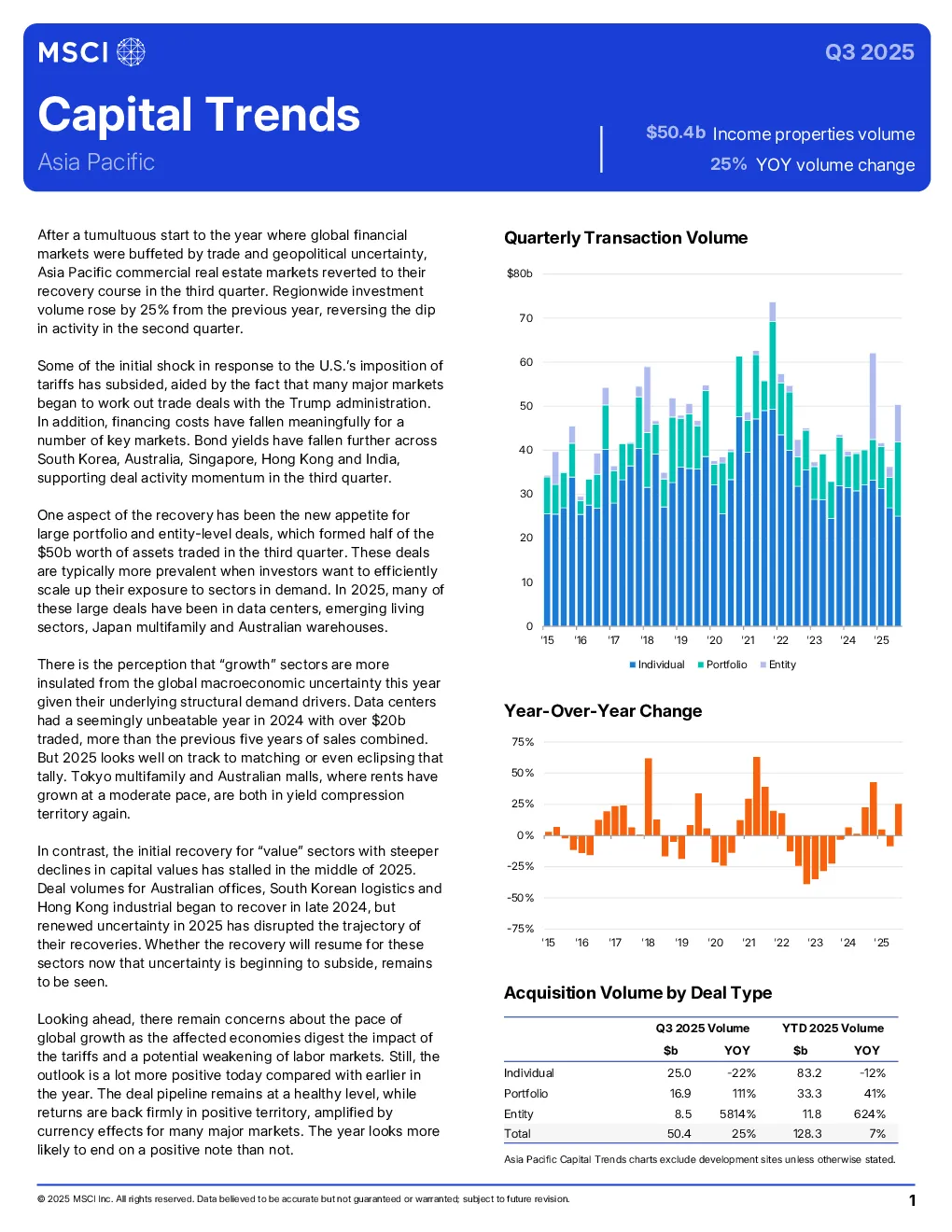
Capital Trends Income properties volumeYOY volume change$50.4b25% Asia Pacific After a tumultuous start to the year where global financialmarkets were buffeted by trade and geopolitical uncertainty,Asia Pacific commercial real estate markets reverted to their Some of the initial shock in response to the U.S.’s imposition oftariffs has subsided, aided by the fact that many major marketsbegan to work out trade deals with the Trump administration.In addition, financing costs have fallen meaningfully for a One aspect of the recovery has been the new appetite forlarge portfolio and entity-level deals, which formed half of the$50b worth of assets traded in the third quarter. These dealsare typically more prevalent when investors want to efficientlyscale up their exposure to sectors in demand. In 2025, many of There is the perception that “growth” sectors are moreinsulated from the global macroeconomic uncertainty this yeargiven their underlying structural demand drivers. Data centershad a seemingly unbeatable year in 2024 with over $20btraded, more than the previous five years of sales combined. In contrast, the initial recovery for “value” sectors with steeperdeclines in capital values has stalled in the middle of 2025.Deal volumes for Australian offices, South Korean logistics andHong Kong industrial began to recover in late 2024, but Looking ahead, there remain concerns about the pace ofglobal growth as the affected economies digest the impact ofthe tariffs and a potential weakening of labor markets. Still, theoutlook is a lot more positive today compared with earlier inthe year. The deal pipeline remains at a healthy level, while Recent TrendsSectors Asia Pacific’s office market continued its gradual but sustainedcomeback. Deal volumes rose for Japan, Singapore, SouthKorea, Hong Kong and India through the first nine months of theyear. Other than Japan, the improvement in transaction liquidity After a challenging past few years, office yields mostlyconcluded their ascent by mid-2025. A few CBD markets, likethose in Seoul and Sydney, have even begun to show signs ofyields dipping marginally. Whether they can compress muchfurther is another question altogether. Compared with the 2015-19 average, spreads to bond yields remain tight. Sydney CBD Industrial deal activity remains dampened by the ongoinguncertainty around U.S. tariffs. One major entity-level deal in thequarter stood out — the privatization of ESR by a StarwoodCapital-led consortium. Excluding this deal, however, volumewould be a third lower than last year’s levels, with slips in activity It was a similar pattern for retail, where across most of Asia, dealvolumes remained subdued through the first three quarters ofthis year. Hong Kong’s retail market has remained particularlyquiet; transaction yields reached a historic high in mid-2024 andare still rising this year. At the other end of the spectrum, Increasingly, much of the regionwide recovery has been lifted bycontinued growth in interest for the various beds sectors. Hotelinvestment surged primarily off the back of a large portfolio sold Activity also remained buoyant for the rental residential sectors.The biggest deal in the third quarter was Scape and NPS’stakeover of the Aveo senior housing portfolio in Australia;meanwhile, portfolio sales of Japan multifamily assets haverebounded again in 2025 after 2024’s slowdown. Renewedinterest from cross-border investors like GIC means that Recent TrendsCountries Across the first three quarters of 2025, all but two of AsiaPacific’s top 10 markets were ahead of last year in terms ofdeal activity. This underscores the broad-based nature of the The recovery was led by the Australian market, where volumesurged by close to 75% YOY in the third quarter. Deal activityincreased across major property types except for office, wherethe recovery has stalled. Much of the recovery was down tothe return of cross-border capital. Net capital inflows by South Korea also had a strong third quarter, with $7.6b ofinvestment, the highest figure since Q2 2022. Offices remainthe focal point: GIC’s disposal of Pangyo Tech One for $1.4b toa domestic consortium was the standout deal and two otherbillion-dollar deals contracted in the quarter. The hotel sector For Japan, deal activity appears to have plateaued after aremarkable run of growth since 2021. Momentum has stalledsince the second quarter of this year, with both volume anddeal counts dipping, but only slightly. Prior to that, each of theretail, hotel and multifamily sectors had surged to activity China took back the title of Asia Pacific’s top market in thethird quarter, but almost half of this tally came from two majordeals, neither of which signaled strength in the market. ESR’sbuyout valued the company’s shares at around half their peakpricing in 2021, while the second deal was a large portfolio ofhotels that traded under receivership. The uncertainty around Other smaller markets bounced back in the t