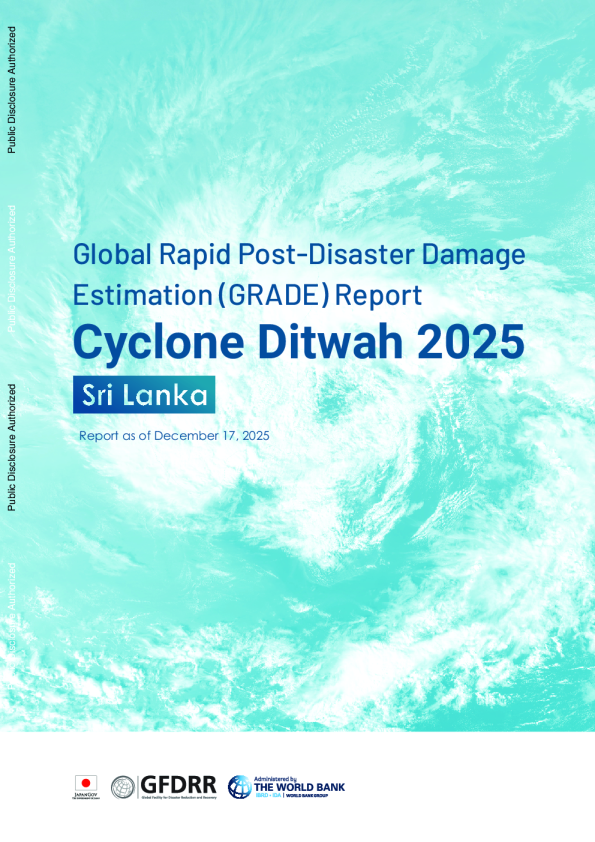
全球灾后快速损害评估(GRADE)报告:2025年斯里兰卡迪特瓦龙卷风
 AI智能总结
Cyclone Ditwah 2025Public Disclosure Authorized Report as of December 17, 2025 Disclaimer © 2025 International Bank for Reconstruction and Development / The World Bank1818 H Street NW This work is a product of the staff of The World Bank and the Global Facility for Disaster Reduction and Recovery (GFDRR) with externalcontributions. The ndings, analysis and conclusions expressed in this document do not necessarily reect the views of any individual Although the World Bank and GFDRR make reasonable efforts to ensure all the information presented in this document is correct, itsaccuracy and integrity cannot be guaranteed. Use of any data or information from this document is at the user's own risk and under nocircumstances shall the World Bank, GFDRR or any of its partners be liable for any loss, damage, liability or expense incurred or sufferedwhich is claimed to result from reliance on the data contained in this document. The boundaries, colors, denomination, and other Rights and Permissions The material in this work is subject to copyright. Because The World Bank encourages dissemination of its knowledge, this work maybe reproduced, in whole or in part, for noncommercial purposes as long as full attribution to this work is given. Cover photo: https://commons.wikimedia.org/wiki/File:Ditwah_2025-11-29_0905Z.jpg Global Rapid Post-Disaster DamageEstimation (GRADE) Report Cyclone Ditwah 2025 Sri Lanka Acknowledgments This report was prepared by a team led by Rashmin Gunasekera (World Bank's Disaster ClimateRisk Management, IDURM and the Global Facility for Disaster Reduction and Recovery, GFDRR).The team comprises James Daniell, Harriette Stone, Bramka Jano, Aaron Opdyke, JohannesBrand, Roberth Romero, Annika Maier, Andreas Schaefer, Bastian van den Bout, Judith Claassen,Mikhail Sirenko and Kerri Cox of the GFDRR's Global Program for Disaster Risk Analytics and the The GRADE team would like to thank the Government of Japan for its continued generous supportto the GRADE assessments through GFDRR and its Japan-World Bank program for Mainstreaming The team gratefully acknowledges the contribution and guidance of peer reviewers: Jian Vun(Senior Disaster Risk Management Specialist, IEAU1) and Natasha Chapplow (Disaster Risk The GRADE team is also grateful for the support of Adelaide University (University of Adelaide andUniversity of South Australia), including Tharindi Wekoon, Chamaka Karunanayake, HelaniMahapatunage, Pasindu Karunatilaka and Guna Hewa. The team acknowledges the support, contributions, and guidance of the World Bank's Sri Lanka The team gratefully acknowledges the contribution and guidance of Niels Holm-Nielsen(GFDRR/World Bank). Contributions on gender are from Zoe Trohanis, Mirtha Escobar andCarolina de los Angeles Ferrer Rincon (GFDRR/World Bank) World Bank's Map Clearance team. TheWorld Bank acknowledges the Government of Sri Lanka's leadership in completing thisassessment. The assessment beneted from close collaboration with the External Resources Abbreviations CATDATCopernicus EMSCROPGRIDSDLRDMCD-RASDRMERA5ECLACECMWFFAOFYGDPCatastrophe DATACopernicus Emergency Management ServiceGlobal gridded crop distribution/production datasetsDeutsches Zentrum für Luft- und Raumfahrt (German Aerospace Center)Disaster Management CenterDisaster-Resilience Analytics & Solutions, GPURL, World Bank GroupDisaster Risk ManagementECMWF Reanalysis 5th GenerationEconomic Commission for Latin America and the CaribbeanEuropean Centre for Medium-Range Weather ForecastsFood and Agriculture OrganizationFinancial YearGross Domestic Product WASHWFPWHOWater, Sanitation, and HygieneWorld Food ProgrammeWorld Health Organization Contents Executive SummaryVIAcknowledgmentsIIIII 14 22 Executive Summary This Global Rapid Post-Disaster Damage Estimation (GRADE) report provides a synopsis of theestimated direct physical damage in Sri Lanka due to the passage of Cyclone Ditwah.The reportis based on a rapid and remote post-disaster damage assessment which follows the established 3GRADE methodology (World Bank, 2018a) and is prepared within a short timeframe to inform earlydecision-making. It is not intended as a substitute for the detailed, sectoral, on-the-ground Cyclone Ditwah passed over the east of Sri Lanka between November 27 and 29 before moving intothe Bay of Bengal. Sustained winds of 65 km/h were recorded, and rainfall was intense, causing The damage estimates are summarized in Table ES1, and the key ndings are summarized 1. Total damage is estimated at US$4.1 billion,equivalent to approximately 4 percent of Sri Lanka's 2024gross domestic product (GDP), and 0.48 percent of the estimated capital stock of buildings and 2. Sri Lanka's 25 districts were all impacted by ooding and extreme rainfall.Kandy was the worst hitdistrict in terms of estimated damage (US$689 million), which was primarily caused by ooding and to a 3. Residential building damage, including contents, accounted for US$985