境外净资产的稳定:展望与启示
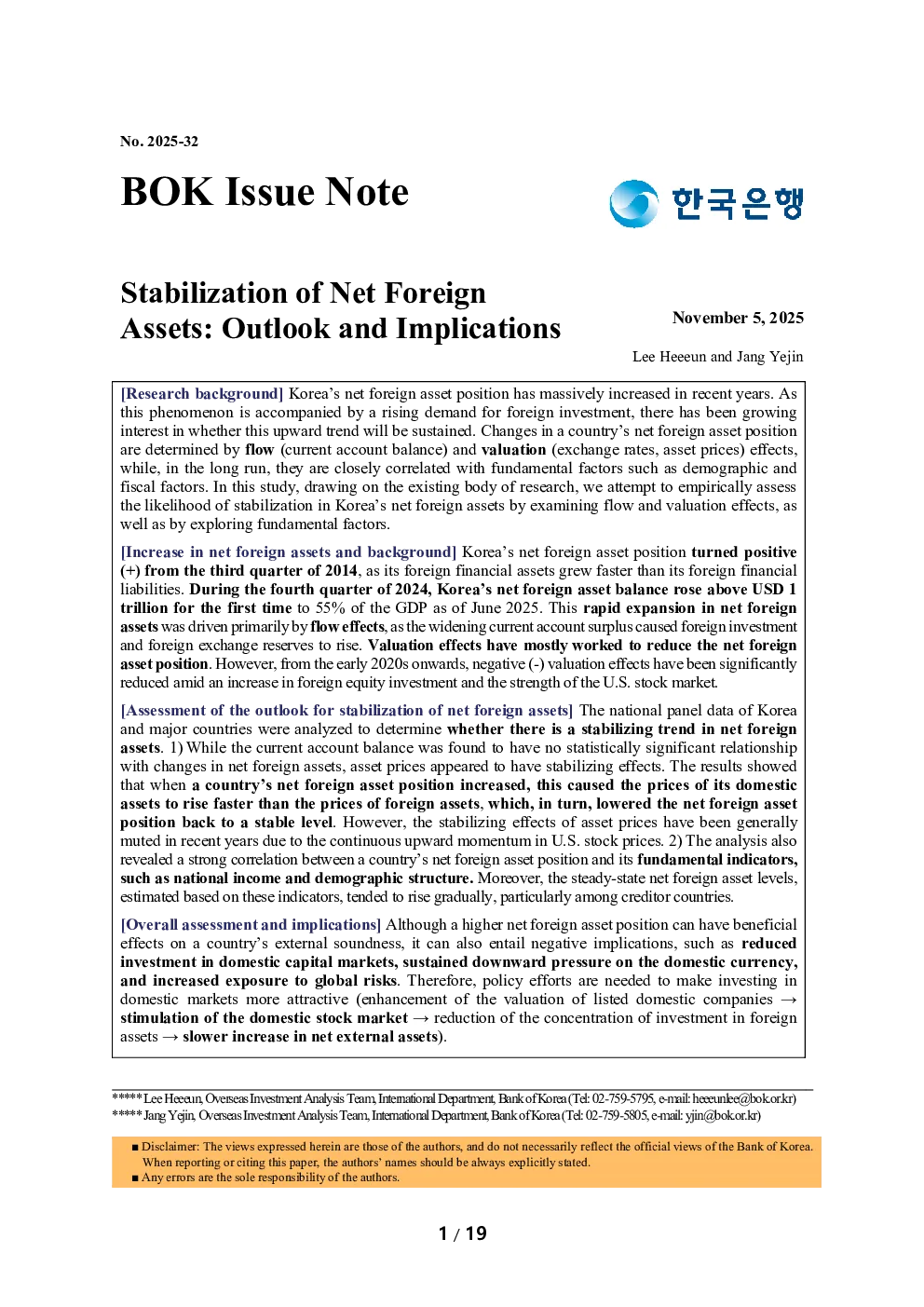
BOK Issue Note Stabilization of Net Foreign November 5, 2025 Lee Heeeun and Jang Yejin [Research background]Korea’s net foreign asset position has massively increased in recent years. Asthis phenomenon is accompanied by a rising demand for foreign investment, there has been growinginterest in whether this upward trend will be sustained. Changes in a country’snet foreign asset positionare determined byflow(current account balance) andvaluation(exchange rates, asset prices) effects,while, in the long run, they are closely correlated with fundamental factors such as demographic and [Increase in net foreign assets and background]Korea’s net foreign asset positionturned positive(+) from the third quarter of 2014, as its foreign financial assets grew faster than its foreign financialliabilities.During the fourth quarter of 2024, Korea’s net foreign asset balance rose above USD 1trillion for the first timeto 55% of the GDP as of June 2025. Thisrapid expansion in net foreignassetswas driven primarily byflow effects, as the widening current account surplus caused foreign investment [Overall assessment and implications]Although a higher net foreign asset position can have beneficialeffects on a country’s external soundness, it can also entail negative implications, such asreducedinvestment in domestic capital markets, sustained downward pressure on the domestic currency,and increased exposure to global risks. Therefore, policy efforts are needed to make investing in Ⅰ. Research Background 1.Recently, Korea has witnessed a significant rise in its net foreign assets1(hereafter, “NFA”),driven by the accumulated current account surplus and asurge in foreign portfolio investmentby residents. As a result, there has been growing interest in whether this upward trend will besustained.Whilea largeNFA position canfavorably affect a country’s income account and external 2.When assessing NFA trends, it is important to consider both factors driving changes in acountry’sNFA position(current account balance,valuation)2 and its relationship withfundamental variables that are specific to this country.3Changes in NFA are influenced by flows oftransactions stemming from current account flows (hereafter, “flows”) and valuation changes resultingfrom movements in exchange rates and asset prices (hereafter, “valuation”). Meanwhile, NFA levelsare closely correlated with the fundamental indicators of each country insofar as they are a reflection of Source: ECOS. Sources: ECOS,Bloomberg. Ⅱ. Recent Rise in NFA and Background 3.Korea’s NFA position turned positive from the third quarter of 2014 as the increase in itsforeign financial assets outstripped the growth of its foreign financial liabilities starting in 2010.During the fourth quarter of 2024, its NFA balance surged pastUSD 1 trillion for the first timeto 55% of the GDP as of June 2025.WhileKorea’s foreign financial assets jumped over seven-foldin the last 20 years (2006-2025) to surpass USD 2.7 trillion (June 2025), its foreign financial liabilities Source: ECOS. 4.Changes in NFA can be broken down into flow effects from changes in the current accountbalance and valuation effects4from changes in asset prices and exchange rates. The recent Most of the current account surplus accumulated since the 2000s, amounting to USD 1.1539 trillion,has flowed out of Korea in the form of net foreign investment,5thus increasing its NFA position.6 5.Valuation effects have mostly worked to reduce Korea’s NFA position, but the magnitude ofnegative (-) effects has been reduced recently.Negative (-) effects of valuation change on Korea’sNFA position are explained by the fact that, in the past, its foreign financial assets consisted primarilyof reserve assets and bonds, while stocks accounted for a large proportion of its foreign financialliabilities. Because of this, the increase in foreign liabilities from rising stock prices tended to greatlyexceedthe increase in foreign assets. As a matter of fact, during the 2010s, stocks represented only stock prices,7this reduced the negative (-)valuation effects of asset prices on its NFA position,witheven small positive (+) effects observed recently. Note: 1) Calculated by subtracting the current account balance-to-GDP ratio from the NFA-to-GDP ratio.Sources: ECOS,Bank of Korea.Source: ECOS. NFA Trends in Major Countries 6.The examination of NFA trends in major countries revealed significant divergence (upwardtrend) among net creditor nations.In Korea and other export-driven manufacturing economies(Japan, Taiwan, Germany, etc.), amid a continuous buildup of NFA, the trendhas steadily remained Source: ECOS. Source: ECOS. 7.By component, the increase in Japan’s NFA was led primarily by foreign direct investment(FDI), while the expansion in Taiwan’s NFA was fueled by foreign portfolio investment.Up until2010, similarly to Korea,foreign portfolio investment was the main driver of NFAgrowth in Japan.However, later when Japan’s shrinking domestic m