马绍尔群岛共和国:2025年第四条磋商新闻稿;员工报告;马绍尔群岛共和国当局的声明
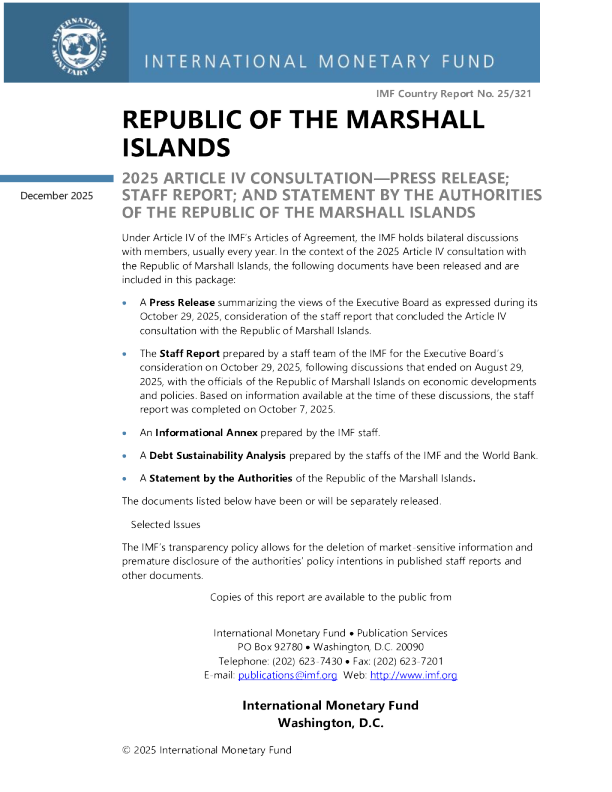
2025ARTICLE IV CONSULTATION—PRESS RELEASE;STAFF REPORT; AND STATEMENT BY THEAUTHORITIESOFTHE REPUBLIC OFTHEMARSHALL ISLANDS Under Article IV of the IMF’s Articles of Agreement, the IMF holds bilateral discussionswith members, usually every year. In the context of the2025Article IV consultation withthe Republic of Marshall Islands, the following documents have been released and areincluded in this package: •APress Releasesummarizing the views of the Executive Board as expressed during itsOctober 29, 2025,consideration of the staff report that concluded the Article IVconsultation withthe Republic of Marshall Islands. •TheStaff Reportprepared by a staff team of the IMF for the Executive Board’sconsideration onOctober 29, 2025, following discussions that ended onAugust 29,2025, with the officials ofthe Republic of Marshall Islandson economic developmentsand policies. Based on information available at the time of these discussions, the staffreport was completed onOctober 7, 2025. •AnInformational Annexprepared by the IMFstaff. •ADebt Sustainability Analysisprepared by the staffsof the IMF and the World Bank. •AStatement by theAuthoritiesofthe Republic oftheMarshall Islands. The documents listed below have been or will be separately released. Selected Issues TheIMF’s transparency policy allows for the deletion of market-sensitive information andpremature disclosure of the authorities’ policy intentions in published staff reports andother documents. Copies of this report are available to the public from International Monetary Fund•Publication ServicesPO Box 92780•Washington, D.C. 20090Telephone: (202) 623-7430•Fax: (202) 623-7201E-mail:publications@imf.org Web:http://www.imf.org International Monetary FundWashington, D.C. ©2025International Monetary Fund IMF Executive Board Concludes 2025 Article IV Consultationwith Republic of the Marshall Islands FOR IMMEDIATE RELEASE •Growth is projected to sustain a rate of 2.5 percent in FY2025 and accelerate to 4.1percent in FY2026. These reflect income tax relief measures and the carryover of delayedCompact-related spendings in FY2025 and a scheduled fiscal expansion in FY2026. •Priorities are to preserve fiscal sustainability by continuing with the strong momentum ontax reform and replacing the Universal Basic Income (UBI) scheme at the earliest feasibleopportunity with a more targeted scheme. The authorities should not proceed with theplanned global launch of a “digital sovereign bond” given the lack of pre-requisite capacityand ability to effectively mitigate associated risks. •Achieving sustainable growth will require continued diversification efforts and capacitybuilding, improvements in governance and regulatory frameworks, and enhanced climateresilience by mobilizing additional financing and promptly addressing adaptation needs. Washington, DC–December 4, 2025:The Executive Board of the International MonetaryFund (IMF) completed the Article IV Consultation for the Republic of Marshall Islands onOctober 29, 2025.1 After two years of contraction, the Republic of the Marshall Islands (RMI) economy isestimated to grow by 3 percent in FY2024, driven by a strong rebound in fisheries andincreased investment and consumption related to the Micronesian Games. This growth hasoccurred despite delays in grant disbursements related to the Compact of Free Associationwith the United States (Compact), ongoing emigration, and the end of COVID-related stimulus.Inflation, though moderating from a peak of 9.3 percent in December 2022, remained at 5.7percent by end-FY2024, above the 10-year average, mainly due to elevated electricity tariffs. Looking ahead, the new Compact significantly improves the near-term outlook. Growth isprojected at 2.5 percent in FY2025, supported by income tax relief and delayed Compactspending. Momentum is expected to accelerate to 4.1 percent in FY2026 amid scheduledfiscal expansion. Over the medium term, growth will moderate due to structural challengesand ongoing labor emigration, while inflation remains above its historical average. Uncertainty surrounding the baseline outlook is high. The elevated global risks, most notablyrising trade barriers, prolonged policy uncertainty, and volatile commodity prices, could increase the RMI’s balance of payments and fiscal pressures, raising living costs. Morefrequent natural disasters could pose a significant threat to the economy. Domestically, theexpansion of Decentralized Autonomous Organization (DAO) registry operations andpremature implementation of new largely untested policy initiatives, namely USDM1 and theUniversal Basic Income (UBI), could have adverse macro-fiscal and financial integrityimplications. Withdrawal of the last Correspondent Banking Relationship (CBR) could disrupttrade and remittance flows. Executive Board Assessment2 Executive Directors welcomed the recent growth recovery, as well as the strengthenedexternal and fiscal outlooks following the successful renewal of the Co
你可能感兴趣

马绍尔群岛共和国: 2023 年第四条磋商 — — 新闻稿 ; 工作人员报告 ; 和马绍尔群岛共和国执行主任的声明
马绍尔群岛共和国:2021年第四条磋商-新闻稿;员工报告;以及马绍尔群岛共和国执行主任的发言
玻利维亚:2022年第四条磋商-新闻稿;员工报告;玻利维亚当局的声明
圣马力诺共和国:2021 年第四条磋商-新闻稿;员工报告;和圣马力诺共和国执行主任的声明