您的浏览器禁用了JavaScript(一种计算机语言,用以实现您与网页的交互),请解除该禁用,或者联系我们。 [PitchBook]:登月计划:月球空间经济的下一阶段(英)2025 - 发现报告

登月计划:月球空间经济的下一阶段(英)2025

信息技术 2025-12-23 PitchBook ZLY
报告封面

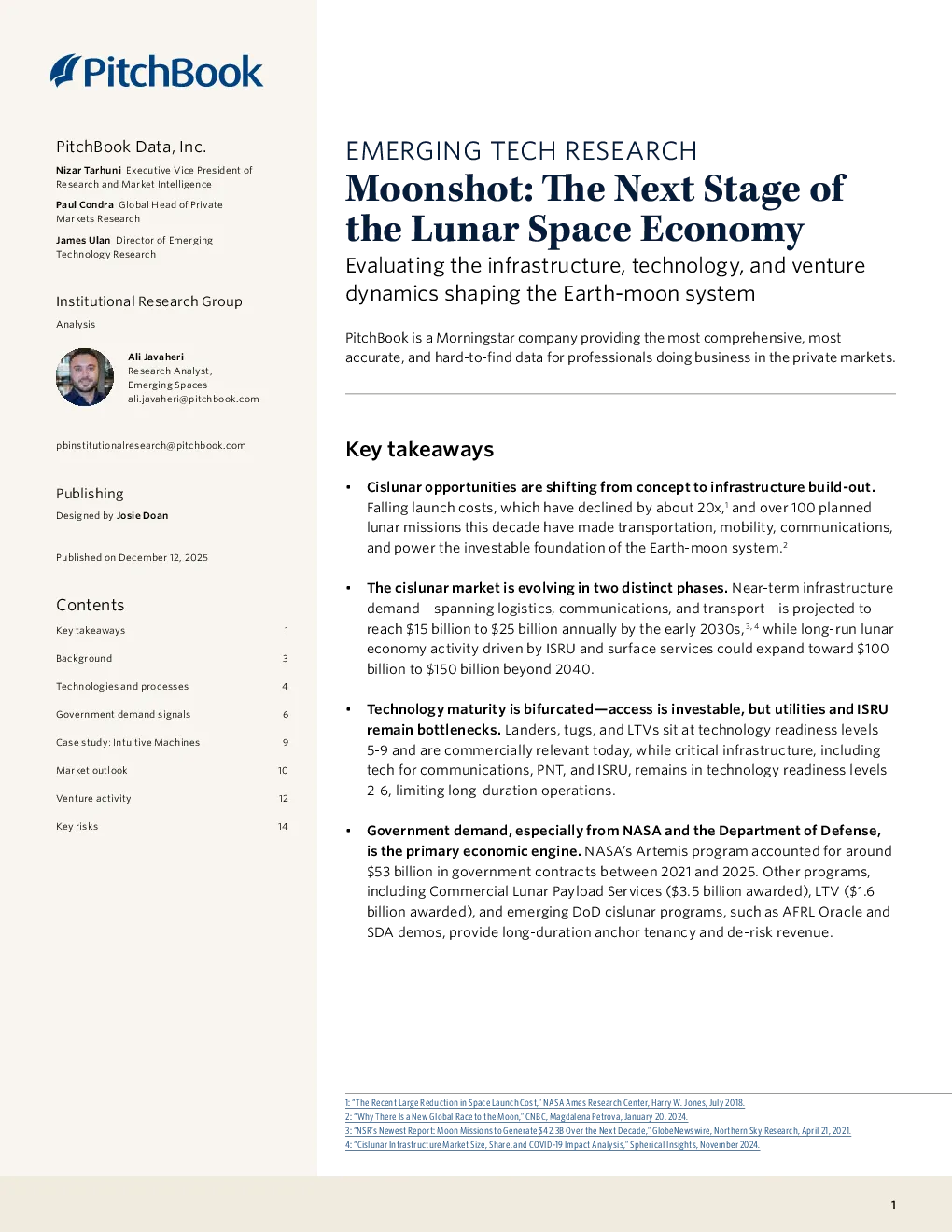
EMERGING TECH RESEARCHMoonshot: The Next Stage of PitchBook Data, Inc. the Lunar Space Economy Nizar TarhuniExecutive Vice President ofResearch and Market Intelligence Paul CondraGlobal Head of PrivateMarkets ResearchJames UlanDirector of EmergingTechnology Research Evaluating the infrastructure, technology, and venture Institutional Research Group Analysis PitchBook is a Morningstar company providing the most comprehensive, mostaccurate, and hard-to-find data for professionals doing business in the private markets. Ali JavaheriResearch Analyst,Emerging Spaces Key takeaways pbinstitutionalresearch@pitchbook.com •Cislunar opportunities are shifting from concept to infrastructure build-out. Falling launch costs, which have declined by about 20x,1and over 100 plannedlunar missions this decade have made transportation, mobility, communications,and power the investable foundation of the Earth-moon system.2 PublishingDesigned byJosie Doan Published on December 12, 2025 •The cislunar market is evolving in two distinct phases.Near-term infrastructuredemand—spanning logistics, communications, and transport—is projected toreach $15 billion to $25 billion annually by the early 2030s,3, 4while long-run lunareconomy activity driven by ISRU and surface services could expand toward $100 Contents Key takeawaysBackgroundTechnologies and processesGovernment demand signalsCase study: Intuitive MachinesMarket outlookVenture activityKey risks •Technology maturity is bifurcated—access is investable, but utilities and ISRUremain bottlenecks.Landers, tugs, and LTVs sit at technology readiness levels5-9 and are commercially relevant today, while critical infrastructure, including 14 •Government demand, especially from NASA and the Department of Defense, is the primary economic engine.NASA’s Artemis program accounted for around $53 billion in government contracts between 2021 and 2025. Other programs,including Commercial Lunar Payload Services ($3.5 billion awarded), LTV ($1.6 •VC activity is expanding but disciplined, clustering around logistics and utilities.2025 saw $1.9 billion across 114 deals (accounting for 18% of allspace-tech VC), with the median deal value rising to $3 million and valuations •Vertical integration and sovereign capital are reshaping the competitivelandscape.Intuitive Machines, Firefly, and Quantum Space’s propulsionconsolidation signal a shift toward “cislunar primes” controlling •Near-term growth is infrastructure-first; application markets remain gated.The next decade will be dominated by logistics, mobility, communications, andPNT. Higher-order applications—ISRU, resource extraction, and construction— •Key risks: binary execution, government dependency, and capital intensity. Mission failure remains existential and slow Commercial Lunar PayloadServices cadence amplifies risk. Commercial demand is still thin relative to Background Defining the cislunar economy The cislunar economy refers to the emerging set of commercial and governmentactivities taking shape across the Earth-moon system. In practical terms, this domainspans everything beyond low Earth orbit (LEO) and geostationary orbit (GEO), reachinginto highly elliptical orbits, such as the key Earth-moon Lagrange points (EML-1 andEML-2), low lunar orbit, and the lunar surface. Strategically, cislunar space functionsas a logistical bridge: It reduces mission risk, enables sustained human and robotic At the same time, the market’s trajectory is beginning to crystallize. Currentvaluation models increasingly bifurcate the sector into two phases: near-terminfrastructure build-out and long-term lunar economy utilization. In the near term(2025-2035), the addressable market for cislunar logistics, communications, andtransport services is expected to reach roughly $15 billion to $25 billion annuallyby the early 2030s. This phase is overwhelmingly shaped by contract-heavy Why now? Commercial viability is being unlocked by a convergence of technological, economic,and geopolitical forces. The biggest catalyst has been the collapse in launch costs.Access to LEO has declined by roughly 20x—from about $54,500 per kilogram on the Space Shuttle to roughly $2,700 per kilogram on Falcon 9—removing thebottleneck that historically forced every mission to rely on expensive, bespoke This acceleration is also being driven by geopolitical pressure. More than 100 lunarmissions are planned over the next decade as the US-led Artemis program andChina and Russia’s ILRS effort drive competing visions of strategic and economic demand, validating the sector and creating immediate requirements for improvedspace domain awareness to ensure safe, predictable activity in an increasingly Technologies and processes The technological backbone of the cislunar economy is defined by a wide spreadin technology readiness levels (TRLs). Systems that support initial access andshort-duration missions (TRL 5-9) are fairly mature, while the infrastructure Comme