AI智能总结
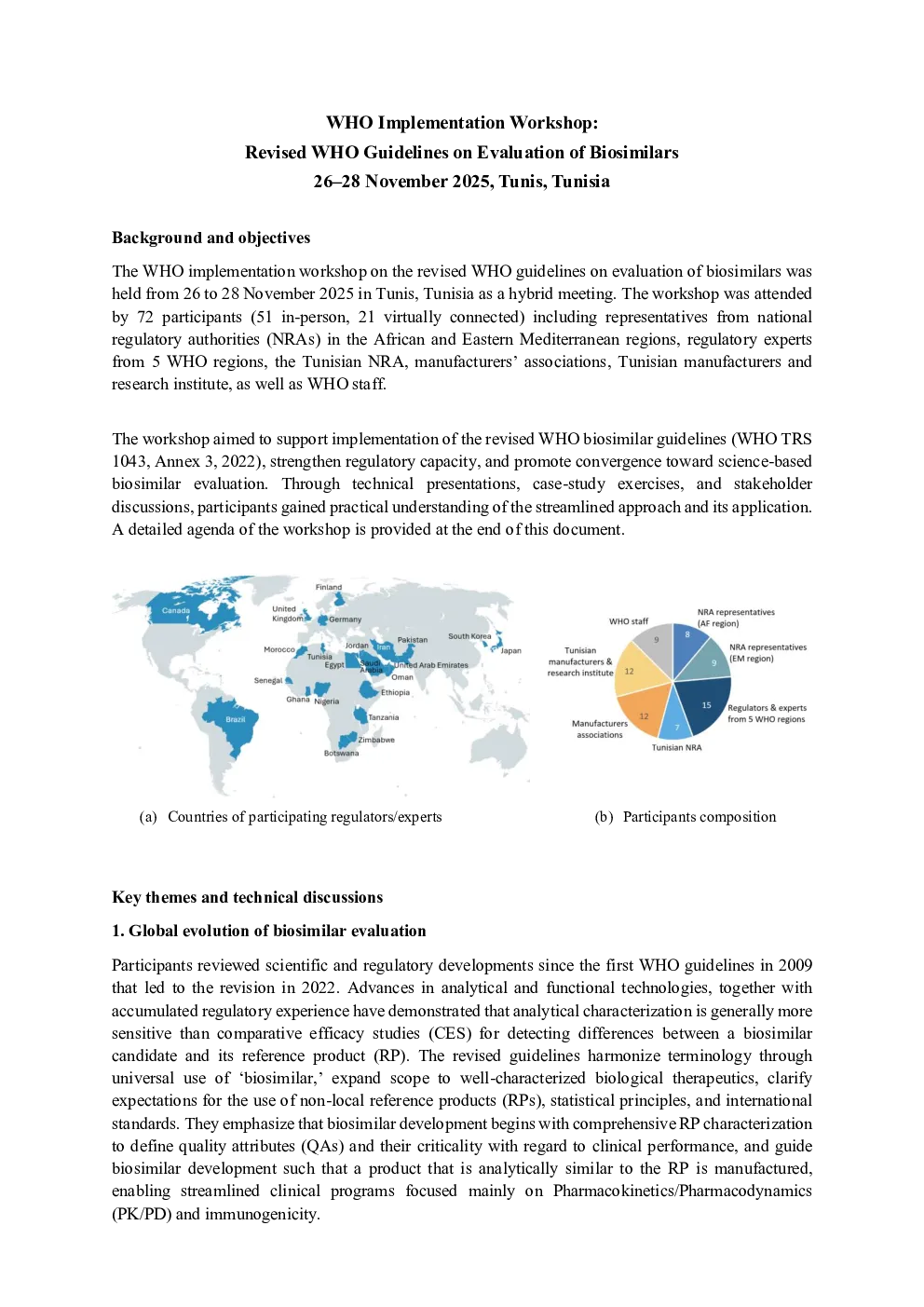
Background and objectives The WHOimplementationworkshop on the revisedWHO guidelines on evaluationofbiosimilars washeld from 26to 28 November 2025 in Tunis, Tunisiaas a hybrid meeting. The workshop was attendedby72participants(51in-person,21 virtually connected)includingrepresentativesfrom nationalregulatory authorities (NRAs) in the African and Eastern Mediterraneanregions,regulatory expertsfrom5 WHO regions,theTunisianNRA,manufacturers’ associations,Tunisianmanufacturersandresearch institute, as well asWHO staff. The workshop aimed to support implementation of therevised WHO biosimilar guidelines (WHO TRS1043, Annex 3, 2022), strengthen regulatory capacity, andpromoteconvergence toward science-basedbiosimilarevaluation.Through technical presentations,case-study exercises,and stakeholderdiscussions, participants gained practical understanding ofthestreamlined approachand itsapplication.A detailed agenda of the workshop isprovidedat the endof this document. Keythemes andtechnicaldiscussions 1. Globalevolution ofbiosimilarevaluation Participants reviewed scientific and regulatory developments since thefirstWHO guidelinesin 2009that led to therevisionin 2022. Advances in analytical and functional technologies, together withaccumulated regulatory experiencehavedemonstratedthat analytical characterization isgenerallymoresensitive than comparative efficacy studies (CES) for detectingdifferencesbetween a biosimilarcandidate and its reference product (RP). The revised guidelinesharmonize terminology throughuniversal use of‘biosimilar,’expand scope to well-characterized biological therapeutics, clarifyexpectations for the use of non-local reference products (RPs), statistical principles, and internationalstandards.Theyemphasize that biosimilar development begins with comprehensive RP characterizationto define quality attributes (QAs)and their criticality with regard to clinical performance,and guidebiosimilardevelopmentsuch thata product that is analytically similar to the RPis manufactured,enablingstreamlined clinical programs focused mainly on Pharmacokinetics/Pharmacodynamics(PK/PD)and immunogenicity. (a)Quality Evaluation Quality evaluation requires robustcharacterization of multiple RP batches to understandvariability and establish similarity rangesfor the different quality attributes.Use of sensitivephysicochemical and functional methodsincluding state-of-the-art and orthogonal methods isessentialfor RP characterization as well as for comparability studies between the RP and the biosimilar productin development.For each molecule,criticality ofQAsis ranked by relevancetoclinical performancein terms ofimpact onefficacy,PK/PD, safety, andimmunogenicity, and any differencesseenmustbescientifically justified. The guidelinesreiterate that biosimilars must meet the same quality standards asany biological product and that manufacturers must demonstrate strongproduct andprocess knowledgeto ensure consistentproductquality. (b)Nonclinical Evaluation The workshop highlighted the shift from routine animal studies to a risk-based approachrelyingprimarilyon analytical and functional data.Due to limited analytical sensitivity,in vivo studies,historically used, are now rarely needed and reserved for exceptional cases such as novel excipients.Significant differences in critical QAs cannot be compensated bynon-clinical/clinicaldata and indicatesclearlythataproduct does notmeetbiosimilarity criteria. (c)Clinical Evaluation Clinicalrequirements have evolved with CES no longer routinely required when robustanalytical and functional similarity is demonstratedfor well-characterized products with knownmechanism of action.PKstudies potentially including PD endpoints and supported by targetedimmunogenicityassessments typically provide sufficient clinical evidence.This case-by-case,evidence-based approach aligns with global regulatory convergence, including ICH M18. 2. Case Studies: Application of the Revised Principles Two case studies helped participants applysome of the concepts from the revised framework.The insulin analogue case demonstrated how analytical,functional, purity, and stability data supportsimilarity conclusionsfor biological productswith low structural complexity. The anti‑TNFα monoclonal antibody caseillustratedthe complexity of evaluating multifunctionalbiologics, focusing on glycosylation, potency, aggregation, and Fc‑effector functions.Participantsexplored the ranking ofcriticality ofQAsaccording totheirfunctionalimpact,considered when PK/PDand immunogenicity data can replace CES,andrecognizedthat major differences incriticalQAsmustbe addressedthroughmanufacturingprocessoptimization rather than clinical justification. 3.Recent issuesin biosimilar evaluation (a)Recentdevelopments WHO International Standards (IS) were highlighted for supporting assay calibration, consistency ofpotency,harmonization of bioactivity across products and post-market surveillance.Exampleshighlighted the development of WHO