泡泡玛特消费者调查报告:其核心消费者是长期收藏者还是短期潮流追随者?
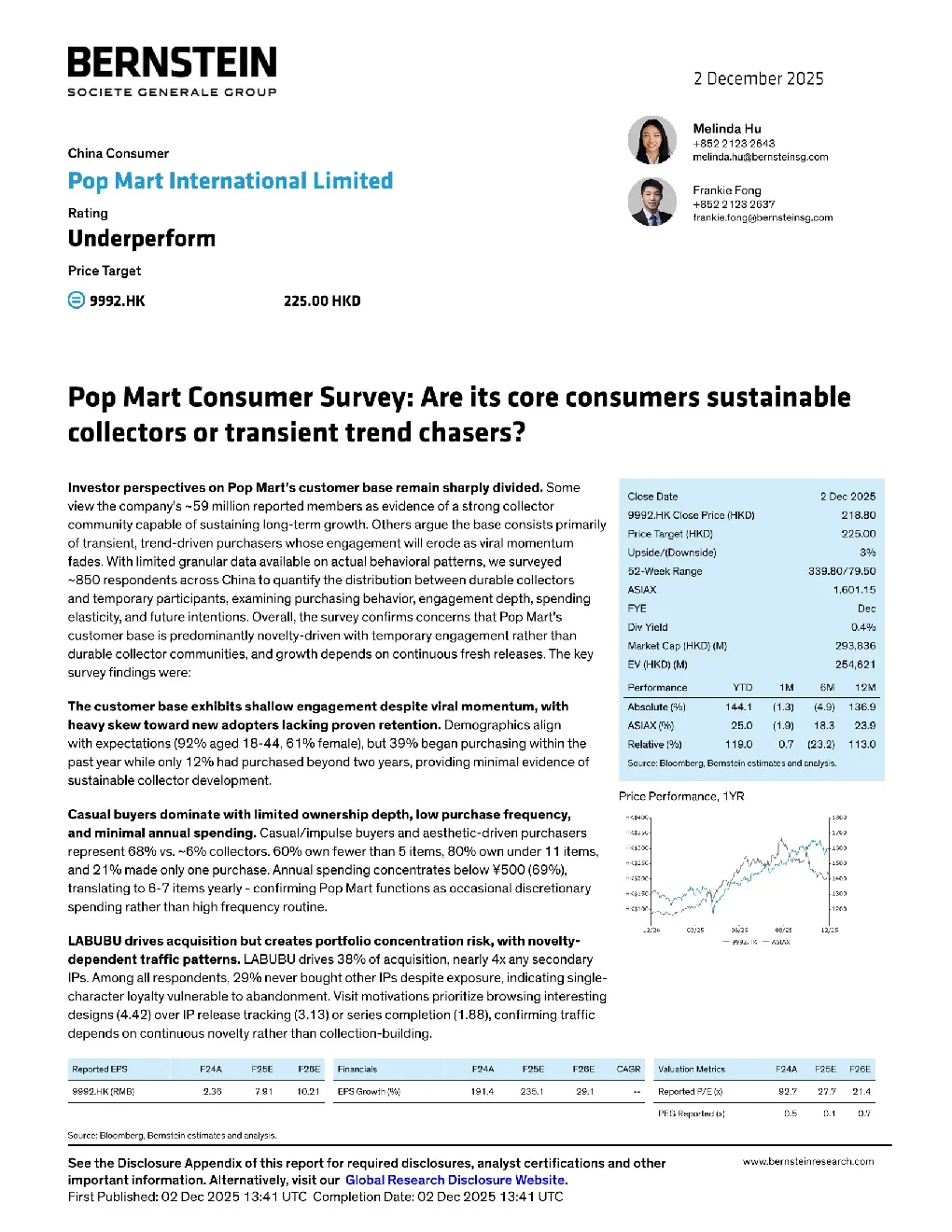
PopMartInternationalLimited Price Target PopMartConsumerSurvey:Areitscoreconsumerssustainablecollectorsortransienttrendchasers? Investor perspectives on Pop Mart's customer base remain sharply divided, Some view the comcany's ~59 milion reported members as evidence of s strcng collectorcommunity cepable of sustaining long-term grovth. Others ergue the base consists primarilyof transicnt, trend-driven purchasors whose cngagement will crode as viral momentumfades. With limitod granular data available on actual behavioral patterns, we surveyed850 respondents acrass China to quantify the distribution betveen durable collectorselasticity, and future intentions. Overall, the survey confirms concerns that Pop Mart'scustomer base is predominantly novelty-driven with temporary engagement rather thandurable collector communities, snd growth depencis on continuous fresh releeses. The keysurvey findings were: The customer base exhibits shallow engagement despite viral momentum, withheavy skew toward new adopters lacking proven retention. Dernographics alignwith expeclaltions (92% aged 18-44, 61% female), but 39%s began purchasing within thepast year while only 12% had purchased beyond tvo years, providing minirnal evidence ofsustsinable collector development Casual buyers dominate with limited ownership depth, low purchase frequency,and minlmal annual spendlng- Cesual/imoulse buyers end eesthetic-driven purchasersrepresent 68% vs, ~6% collectors, 60% own fewer than 5 items, 80% own under 11 itams,and 21% made cnly one purchase. Annual spcnding concentrates below *50C (69%):translating to B-7 items yearly - confirming Pop Mart functions as accasionial discretionaryspending rather than high frequerncy routine LABUBU drives acquisition but creates portfolio concentration risk, with novelty-dependent traffic patterns, LABUBU drives 38% of acquisition, neariy 4x any secondaryIPs. Among all respondents, 29% never lbought otherIPs clespite exosure,indicating single-character loyelty vulnerable to abendonment, Visit motivations prioritize browsing interestingdesigrs (4.42) over IP release tracking (a.13) or series completion (1.B8), confirming trafficdepends pn continucus novelty rather than collectian-buildirg- Spending intentions show modest growth expectations with meaningful churnrisk, driven more by engagement erosion. 61% cxpect to incrcase spencing, 26%plan to decrease spending, while 13% plani complete exit within twelve rnonths. Growthconcentrates in rnodest 10-20% projections (47%) vs. 3% anticipating 50%+ expansion.Among those reducing spend, engagement factors (novelty wom of, osing IP interest.For those incre8sing, new rele6ses drive 39%, discovering new IPs motivates 26%, 8ndsxecution ratiher than natural engagemert deepening Scarcity strategy generates secondary market activity but creates availability friction, Whenitems are unavailable, 18%a abandon purchases while 45%s substitute withinthe ecosystem. Interestingly, there is heavy reliance on cross-IP substitution (2s.79%) whenLABUBU isn't svailsble, customers aren't developing authentic multi-IP preferences butrather eccepting avsilable altemetives, Blind box fomat reteins 65% positive sentiment,thougih 47% find it *fun lbut frustrating" vs, 18% genuinely excited. InvestmentImplications We rate Pop Mert underperform DETAILS SURVEYINTENTION Imvestor perspectives on Pop Mart's customer base remain sharply divided. Some view the company's ~59 million repcrtedmermbers ss evidence of a strong collector cornrmunity capable of sustaining long-term growth. Others argue the base consistsprimarily of transient, trenc-driven purchasers whose engagement will erocle ss viral momentum fades. With limited granulsrciata. svailelole on actual behavioral petterns, we surveyec ~850 respondents across China to quentify tie clistribution lbetweenfuture intentions The survey investigates five dimensions IP versus Brand Loyalty: Whelher purchase decisions slem from specifi: characler allachmenl or broader brand afirily toThis includes visit motivations to assess whether traffic is character-driven or plstformcriven. • Scarcity Response Behavior: How customers resct to product unevailability, whether they accept secondary marketpremiums, substitute within Pop Mart's portfolio, weitfor restocks, or ebandon purcheses to understend both purche.seurgency levels and tolerance for supply constreints. + Customer Segmentation and Lifetime Value: Distribution patterns acrass purchase frequency, volume, and annualspending to distinguish high-value collectors frorm low-ergagernent occasional buyers, ccmbined vith stated futurespending intenticns and underlying molivastionial drivers that predict relenltion versus attrition risk. • Format Tolerance and willingness to Pay: Customer acceptance of blind box mechanics vs. preference for guaranteedselection, clentifying friction points in the randomized format and measuring premium payment wilingness for certainty.exclusivity, or