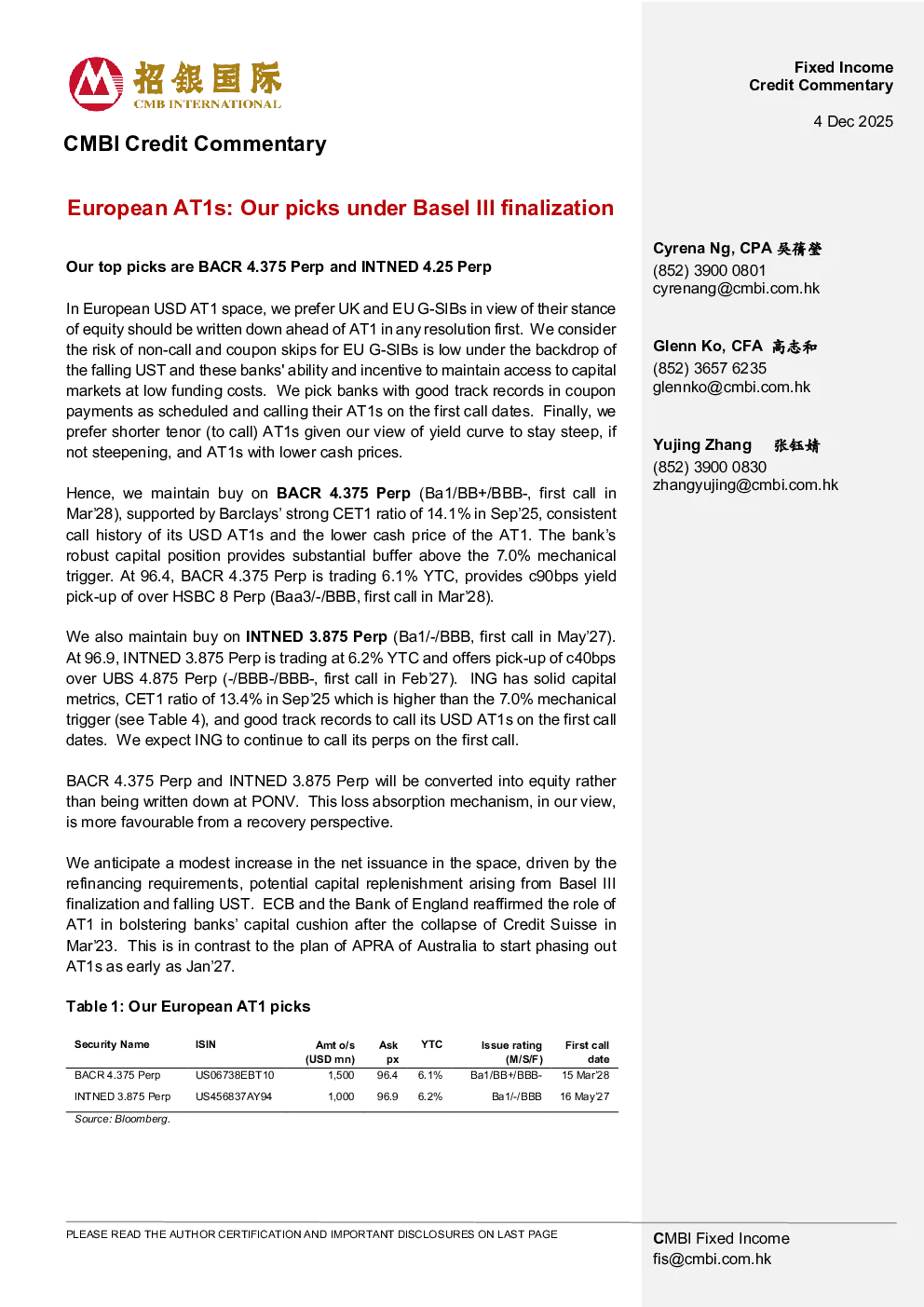
CMBI Credit Commentary European AT1s:Our picksunder Basel III finalization Cyrena Ng, CPA吳蒨瑩(852) 3900 0801cyrenang@cmbi.com.hk Our top picks areBACR 4.375 Perp and INTNED 4.25 Perp In European USDAT1 space, wepreferUK and EU G-SIBsin view of their stanceof equity should be written down ahead of AT1 in any resolution first.We considerthe risk of non-call and coupon skips for EU G-SIBs is lowunder the backdrop ofthe falling USTandthesebanks'abilityandincentive to maintain accessto capitalmarkets at lowfunding costs.Wepickbanks with good track records in coupon Glenn Ko, CFA高志和(852) 3657 6235glennko@cmbi.com.hk Yujing Zhang张钰婧(852)3900 0830zhangyujing@cmbi.com.hk Hence,we maintain buy on BACR 4.375 Perp(Ba1/BB+/BBB-, first call inMar’28), supported by Barclays’ strong CET1 ratio of 14.1% inSep’25,consistentcall historyof its USD AT1sand the lower cash price of the AT1. The bank’srobust capital position provides substantial buffer above the 7.0% mechanicaltrigger. At96.4, BACR 4.375 Perpis trading 6.1% YTC, providesc90bps yield We also maintain buy onINTNED 3.875 Perp(Ba1/-/BBB, first call in May’27).At96.9, INTNED 3.875 Perp is trading at 6.2% YTC and offers pick-up ofc40bpsoverUBS 4.875Perp(-/BBB-/BBB-, first call in Feb’27).INGhas solidcapitalmetrics, CET1 ratio of 13.4% inSep’25 which is higher than the 7.0% mechanicaltrigger(see Table4), andgood track records to call itsUSDAT1son the first call BACR 4.375Perp and INTNED 3.875 Perpwill be converted intoequity ratherthanbeingwrittendown at PONV. This loss absorption mechanism, in our view, We anticipate a modest increase in the net issuance in thespace, driven by therefinancing requirements,potentialcapital replenishment arising from Basel IIIfinalizationand falling UST. ECB and the Bank of England reaffirmed the role ofAT1 in bolstering banks’ capital cushion after the collapse of Credit Suisse in BACR We maintain buy on BACR 4.375 Perp, supported by Barclays’strong capital adequacy(CET 1 ratio of 14.1% inSep’25), which provides asufficientbufferoverthe 7% mechanical trigger. Barclays’ consistent call history for itsUSD AT1 also underpinsourhigh confidence in future call.At96.4, BACR 4.375 Perp is trading at YTC of6.1%. Barclays is a globalsystemically importantbank (G-SIB) with businessesspanningacross retail, wholesale, andinvestment banking.Barclay’s achieved ROTE of 12.3% in 9M25, increased from 11.5% in 9M24.As ofSep’25,Barclays’ CET1 ratio was 14.1%, within its 2025-26 internal target of 13-14%, and higher than the regulatoryrequirement of 12.2%.Barclaysalsomaintainedastrong TLAC/RWA ratioand MREL/RWA ratio of 35.8%. These BACR 4.375 Perp contains both mechanical and statutory loss-absorption features. Itwill beconverted if Barclays’fully-loaded CET1 falls below 7%. Statutory powers allow the Bank of England to exercise bail-in or trigger conversionat the point of non-viability or resolution, regardless of whether the mechanical trigger is breached. In our view,the The UK Special Resolution Regime (SRR) empowers the Bank of England, as the resolution authority, to interveneearly and stabilize failing banks through mechanisms such as bail-in. The SRR can only be invoked when fourconditions are met: a firm is failing or likely to fail; recovery actions are unlikely to restore viability; resolution isnecessary in the public interest; and objectives cannot be met as effectively through insolvency. In such resolution In Nov’25, S&P upgraded BACR 4.375 Perp by two notches to BB+ from BB-, as a part of S&P portfolio review onEuropean banks’ hybrid instruments where S&P viewed these instruments faced lower default risk than previously INTNED Wemaintain buy on INTNED 3.875 Perp, anchored by ING’ssolidcapital adequacy and track recordsof redeemingAT1 bonds at their first call dates. ING reported a robust CET1 ratio of13.4% in Sep’25, well above the 7%mechanical trigger. This mitigated the risk of contractual loss-absorption in the near term. At 96.9, INTNED 3.875 INGis a G-SIB, ithasdiversified retail and wholesale bankingoperationsacross Europe, and as a systemicallyimportant Dutch institution, its resolution would be managed by the Single Resolution Board (SRB) and DeNederlandsche Bank (DNB). Under the Dutch regime, AT1 bonds are subject to both contractual triggers andstatutory bail-in, ranking behind equity but ahead of Tier 2 and senior debt in loss absorption. If ING’s consolidatedCET1 ratio falls below 7% or the bank reaches the point of non-viability as designated by authorities, INTNED 3.875 InSep’25, ING’s asset quality improved with the NPL ratiofell to 1.5% from 1.7% in Dec’24, placing it at the low endof its historical range since 2017.ING’sCET 1 ratio was 13.4%as of Sep’25, slightly down from 13.6% as of Dec’24after the Basel IIIfinalization implementedfrom 1 Jan’25,while stillabove its own internal targetrangeof13.0%.INGreported TLAC/RWA ratio of 23.4% and MREL/RWA ratio of 28.0%as of Sep’25, above theTLACrequirement Basel 3