绘制未来技能:阿拉伯联合酋长国与美国之间的基准分析
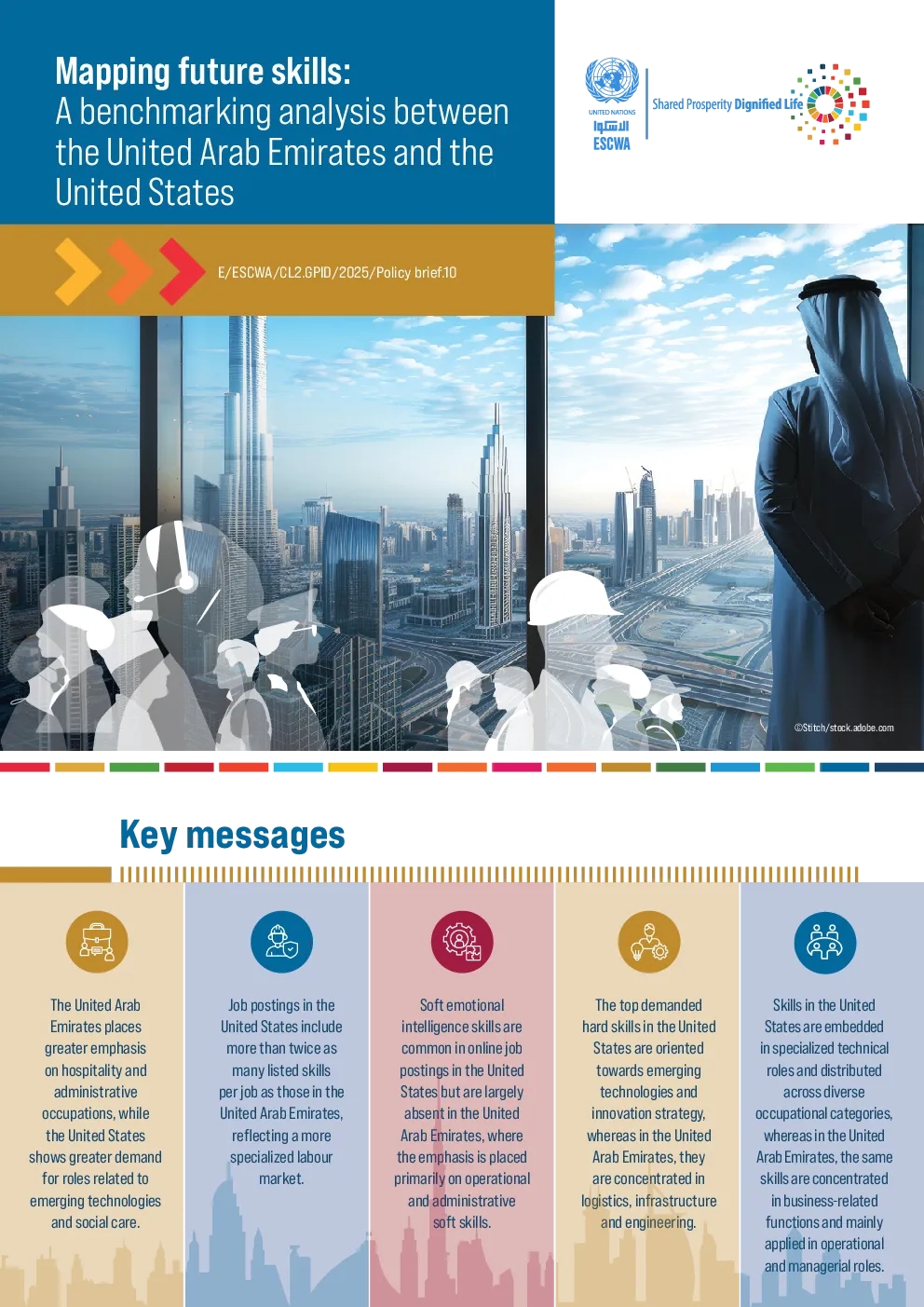
E/ESCWA/CL2.GPID/2025/Policy brief.10 Key messages The United ArabEmirates placesgreater emphasison hospitality andadministrativeoccupations, whilethe United Statesshows greater demandfor roles related toemerging technologiesand social care. The top demandedhard skills in the UnitedStates are orientedtowards emergingtechnologies andinnovation strategy,whereas in the UnitedArab Emirates, theyare concentrated inlogistics, infrastructureand engineering. Soft emotionalintelligence skills arecommon in online jobpostings in the UnitedStates but are largelyabsent in the UnitedArab Emirates, wherethe emphasis is placedprimarily on operationaland administrativesoft skills. Job postings in theUnited States includemore than twice asmany listed skillsperjob as those in theUnited Arab Emirates,reflecting a morespecialized labourmarket. Skills in the UnitedStates are embeddedin specialized technicalroles and distributedacross diverseoccupational categories,whereas in the UnitedArab Emirates, the sameskills are concentratedin business-relatedfunctions and mainlyapplied in operationaland managerial roles. From regional prototype to global benchmark The purpose of this policy brief is to anticipate future skill demandin the Arab region. The United Arab Emirates was selected as thefocal country for this benchmarking analysis for two reasons:first, it has one of the region’s most dynamic economies, withsignificant investments in services, logistics, infrastructureand innovation, making it a relevant case for exploring futuretrajectories; and second, it has the most comprehensive datacoverage in the ESCWA Skills Monitor, allowing for a robust,evidence-based comparison. This choice is further reinforcedby the country’s ongoing transition from a service-oriented toa knowledge-based economy, with a strong focus on artificialintelligence (AI) and digital transformation. Central to this vision isthe United Arab Emirates Strategy for Artificial Intelligence 2031,which seeks to position the country as a global leader in artificialintelligence by integrating it across key sectors, includinghealthcare, education, transport and energy.1 Rather than attempting to forecast trends directly, the analysisbenchmarks the United Arab Emirates against a frontiereconomy, namely the United States of America. The UnitedStates labour market serves as a valuable reference point forthe future, as it is more advanced, specialized and innovation-driven, providing insights into the skills that are likely to gainprominence as Arab economies continue to diversify andmodernize. By contrasting the United Arab Emirates with the United States,this policy brief offers a clear picture of existing skill demanddifferences as well as a forward-looking perspective on howlabour markets in the Arab region may evolve. Benchmarking occupational demand Comparing the top 50 most demanded job titles ineach country highlights structural differences, overlapping occupations, and labour market priorities unique toeach context.2 Veterinary technician Several in-demand occupations in the United Arab Emirates areabsent from the United States top 50, reflecting a labour marketshaped by a service-oriented economy, a large expatriate workforce,tourism-led growth, a robust property sector and economic freezones. Hospitality roles such as receptionist, chef and kitchenassistant are facilitated by the extensive network of hotels, resortsand entertainment venues in the United Arab Emirates. Demand forreal estate agents, shop managers, cashiers and logistics managersreflects the growth of the property and retail sectors, with realestate transactions in Dubai increasing by 20 percent between2023 and 2024, driven by service-led megaprojects. The country’s40+ free zones also attract international companies, generatingstrong demand for administrative and human resources functions,including visa processing, payroll and compliance. By contrast, theabsence of administrative roles among the top occupations in theUnited States reflects the impact of automation and sector-specificdeclines. Employment for secretaries and administrative assistantsis projected to increase by just 1 percent between 2023 and 2033,with positions such as legal secretaries expected to decline by5 percent and most general administrative roles remaininglargely unchanged. The United States labour market exhibits a strong demandfor digital and technology-oriented roles that are largelyabsent among the top 50 occupations in the UnitedArab Emirates. The growing demand for positions suchas software analyst, data scientist and cloud engineerreflects this trend, with long-term projections indicatingthat employment in computer and information technology(IT) occupations are expected to grow well above theaverage rate of 4 percent between 2023 and 2033. Thereis also a growing demand for healthcare and social serviceprofessions, reflecting an aging population and increasedattention to mental health, trauma recovery, a