您的浏览器禁用了JavaScript(一种计算机语言,用以实现您与网页的交互),请解除该禁用,或者联系我们。[GSMA]:2024年的电信行业:值得关注的趋势 - 发现报告

2024年的电信行业:值得关注的趋势

信息技术2024-01-03GSMA还***
AI智能总结
查看更多
2024年的电信行业:值得关注的趋势

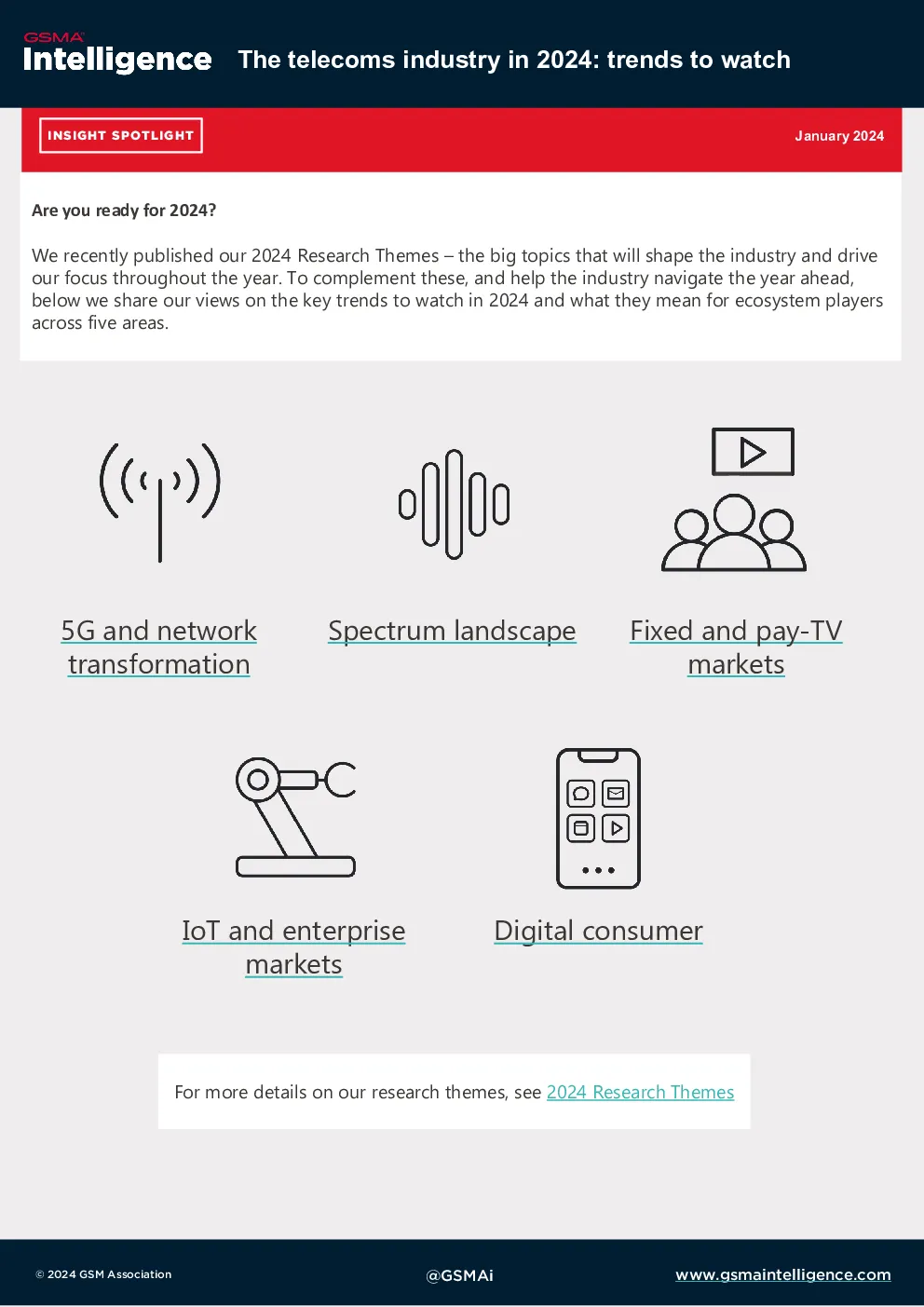
The telecoms industry in 2024: trends to watch INSIGHT SPOTLIGHT Are you ready for 2024? We recently published our 2024 Research Themes – the big topics that will shape the industry and driveour focus throughout the year. To complement these, and help the industry navigate the year ahead,below we share our views on the key trends to watch in 2024 and what they mean for ecosystem players Fixed and pay-TVmarkets Spectrum landscape For more details on our research themes, see2024 Research Themes 5G and network transformation:five trends to watch in 2024 INSIGHT SPOTLIGHT To help navigate the year ahead, we are releasing aseries of reports that highlight the key trends to watchin 2024 and the implications for ecosystem players.The analysis covers five key areas: 5G and networktransformation; spectrum; IoT and the wider enterprise Throughout 2023, we have analysed importantdevelopments and innovation spanning all areas of thetelecoms industry and wider digital ecosystem. How willthe industry evolve in 2024? Which trends will continue Trends to watch 5G-Advanced, with suppliers playing their part to kickstart anew round of 5G investment. This will all take place as 6Gstandards and technology visions come into view, making Generative AI: operators navigate a steep learning curve With generative AI making headlines for most of 2023, it is easyto forget that ChatGPT was only launched in November 2022.For most users, including operators, generative AI is still a newphenomenon. Most of 2023 was spent getting up to speed onthe topic, including potential use cases, technical requirements,supplier capabilities and easy wins. This learning process will Network APIs: the mobile ecosystem rallies to support5Gmonetisation Based on work from hyperscalers and network infrastructuresuppliers, GSMA Intelligence predicted network API exposurewould be a theme for 2023. With operators representing almosttwo thirds of global mobile connections signed up to theGSMA’s Open Gateway initiative less than a year after launch,this prediction was accurate. In 2024, much is at stake; 5Gmonetisation remains a top priority for operators, and network Open RAN: deployment finally moves into a higher gear The last few months of 2023 saw a handful of high-profile openRAN endorsements. Ericsson announced its support for thetechnology. Tier-one operators announced new open RANsupply contracts: Verizon (Samsung and Ericsson), AT&T(Ericsson) and NTT (Nokia). While operators in Europe andAsia have been active for some time, momentum with NorthAmerican operators and network infrastructure incumbents Cloud and edge: hype gives way to productivity Telco-cloud partnerships used to be headline news, marking ashift from how operators traditionally built and operatednetworks. Such partnerships are now commonplace, and telcoshave largely come to accept cloud – including edge cloud – asan integral part of their network strategies. This focus will not goaway in 2024. However, the acceptance of cloud’s value should 5G next: standalone, 5G-Advanced and 6G battle formindshare In 2021,44% of operatorssaid that they planned to deploy 5Gstandalone (5G SA) within two years. Fast forward to 2023 and,while progress on 5G SA has been gaining momentum, theprediction did not come to pass. Operators are now expressingsimilarly optimistic views on the deployment timing for 5G- Implications Mobile operators Solution suppliers •Generative AI – drive into teams.The only way for anyorganisation (including operators) to understand thegenerative-AI applications that will deliver value is to builda broad understanding of the technology. This means •Generative AI – sell the monetisation promise. Operators are currently focused on internal use cases forgenerative AI, such as network troubleshooting, threatdetection and improved customer care. This is a naturalplace to start; operators will know their own operations and •Open RAN – resolve internal issues.While opennetworking technologies are the top network technologypriority for operators, uncertain internal ownership remainsthe second biggest obstacle to open RAN deployment.Diverse stakeholders will need to work together to roll out •Open RAN – play nicely.Open RAN is such a broad termand technology movement that it is entirely possible for asolution supplier to comply with open RAN specificationsbut not actually be interoperable with other vendors. Toclaim support for open RAN while guarding incumbency, •5G – leverage the ‘5G winter’.With the first wave of 5Gspending complete in many front-runner markets, majornetwork infrastructure vendors are lamenting the naturalslowdown in 5G spend. This puts operators in a prime •5G – ease the transition.In prioritising future 5Ginvestment, there is a natural progression; SA RAN andcore set the stage for 5G-Advanced, which should serve asa bridge to 6G in the 2030+ timeframe. While operators willwant to drive their own agendas, helping them understand •API expo