您的浏览器禁用了JavaScript(一种计算机语言,用以实现您与网页的交互),请解除该禁用,或者联系我们。[未知机构]:无人机编队飞行:复杂环境中作战的策略、挑战与应用 - 发现报告

无人机编队飞行:复杂环境中作战的策略、挑战与应用

国防军工2025-10-31-未知机构张***
AI智能总结
查看更多
无人机编队飞行:复杂环境中作战的策略、挑战与应用

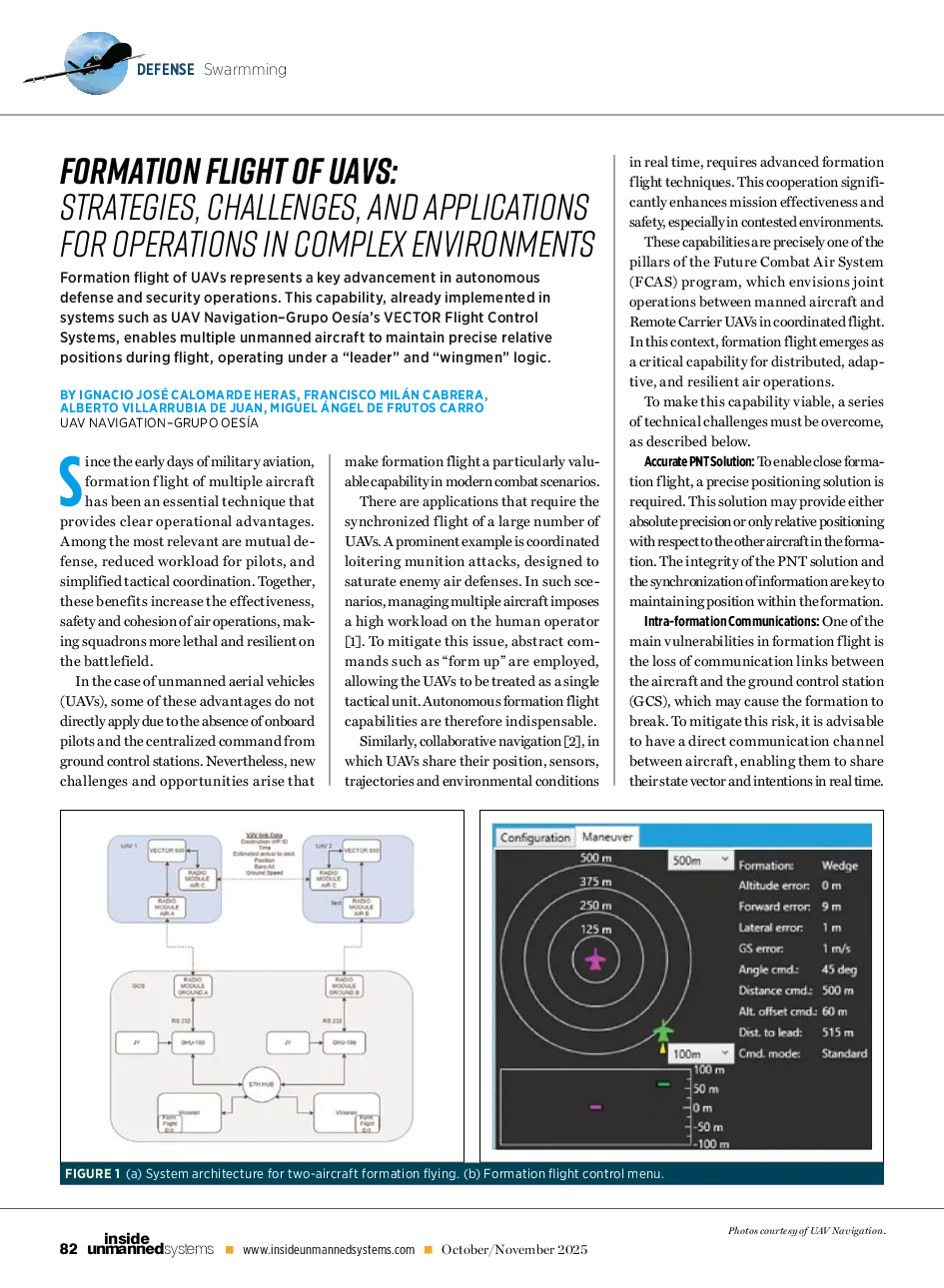
in real time, requires advanced formationflight techniques. This cooperation signifi-cantly enhances mission effectiveness and These capabilities are precisely one of thepillars of the Future Combat Air System(FCAS) program, which envisions jointoperations between manned aircraft and Formation flight of UAVs represents a key advancement in autonomousdefense and security operations. This capability, already implemented insystems such as UAV Navigation–Grupo Oesía’s VECTOR Flight Control BY IGNACIO JOSÉ CALOMARDE HERAS, FRANCISCO MILÁN CABRERA,ALBERTO VILLARRUBIA DE JUAN, MIGUEL ÁNGEL DE FRUTOS CARROUAV NAVIGATION–GRUPO OESÍA To make this capability viable, a seriesof technical challenges must be overcome, make formation flight a particularly valu-able capability in modern combat scenarios. AccuratePNTSolution:To enable close forma-tion flight, a precise positioning solution isrequired. This solution may provide eitherabsolute precision or only relative positioning There are applications that require thesynchronized flight of a large number ofUAVs. A prominent example is coordinatedloitering munition attacks, designed tosaturate enemy air defenses. In such sce-narios, managing multiple aircraft imposes provides clear operational advantages.Among the most relevant are mutual de-fense, reduced workload for pilots, andsimplified tactical coordination. Together,these benefits increase the effectiveness, Intra-formation Communications:One of themain vulnerabilities in formation flight isthe loss of communication links betweenthe aircraft and the ground control station In the case of unmanned aerial vehicles(UAVs), some of these advantages do notdirectly apply due to the absence of onboardpilots and the centralized command from Similarly, collaborative navigation [2], inwhich UAVs share their position, sensors, Alternatively, non-cooperative local-ization methods can be used, basedon onboard sensors such as camerasor radar systems, allowing each UAV Relative Guidance and Control:Theguidance and control system mustbe specifically designed to operatein relative mode, taking into account FIGURE 2(a) Initial approach to formation. (b) Flight in formation. with the ground control station. Thefunctional architecture of the systemis shown inFigure 1.a. rendezvous point [3]. OperationalEnvelopeProtection:Each aircraftmustrespectbothitsowndynamiclimitations cated interface from which differentformation types, such as “wedge”or “fighting wing,” can be selectedand activated. This interface alsoenables monitoring of aircraft be-havior through a visual menu(Figure Coordinated Emergency Maneuvers:Thesystem must incorporate synchronized FIGURE 3(a) Wedge formation command window(b) Calculation of formation offsets. tion, the aircraft’s speed control(Equation2)receives a command calculated from the concludes with a discussion of the results sition, the system evaluates whether the longitudinal error between the aircraft’sposition and the target position in the for- MATERIALS AND METHODS intentions through a dedicated vehicle-to-vehicle (V2V) communication network.Thanks to this architecture, once the initialcommand to enter formation is issued, the mation(Figure 3.a),the input parameters include an altitude offset, a formation angle, The leader’s positions are stored in a them exceeds these limits due to a naviga-tion error or system failure, an automaticevasive maneuver is triggered. This maneu-ver consists of deviating the heading 30° to interference, such as free-space laserlinks. Additionally, the incorporationof non-cooperative relative navigation Arenosillo Test Center), providing a con-trolled and safe environment for validation methods, based on computer vision, will During these tests, the system’s capa-bility to maintain stable formations wasconfirmed, even during dynamic ma-neuvers and leader changes. Functional Furthermore, each UAV continuouslymonitors the status of its critical systems(health monitoring). If it detects that it nolonger meets the minimum requirements REFERENCES (1)Hocraffer, C. S. Nam, “A meta-analysisof human-system interfaces in unmannedaerial vehicle (UAV) swarm management,”Applied Ergonomics, vol. 58, pp. 66–80, These results demonstrate the feasi-bility of operating multiple UAVs in closeformation in a safe, autonomous, robustmanner, validating the system as an opera- (2)A. Ahmad, D. B. Licea, G. Silano, T.Baca, M. Saska, “PACNav: A collectivenavigation approach for UAV swarmsdeprived of communication andexternal localization,” Bioinspiration & RESULTS AND DISCUSSION To validate the formation flight maneuver,tests were carried out both in simulationand in real f light. In the first phase, aHardware-in-the-Loop (HIL) environ- CONCLUSIONS The system developed by UAV Navigation–Grupo Oesía has proven to be a safe, effi-cient, operational solution for the formationf light of unmanned aerial vehicles. Thetests conducted, both in simulation and (3)I. J. Calom