解码退休:详细了解纳税申报表上报告的退休分配(pdf)
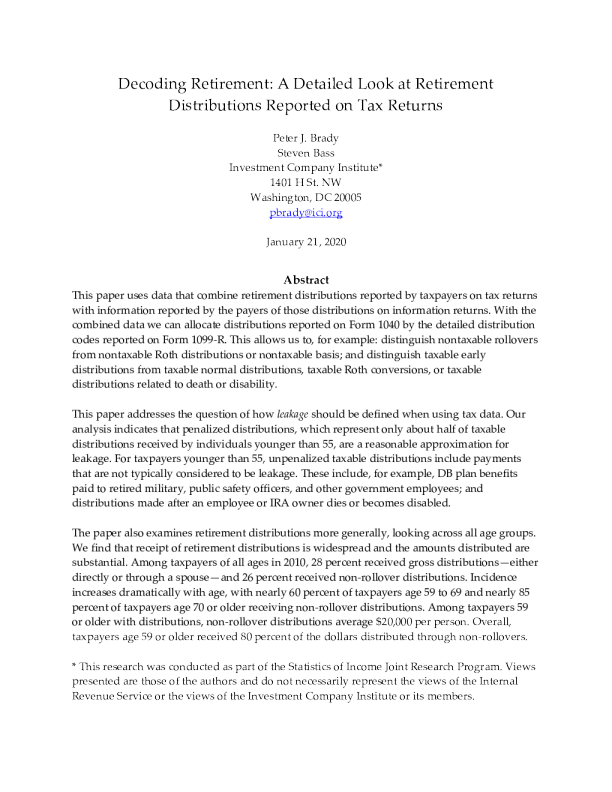
Peter J. BradySteven BassInvestment Company Institute*1401 H St. NWWashington, DC 20005pbrady@ici.org January 21, 2020 Abstract This paper uses data that combine retirement distributions reported by taxpayers on tax returnswith information reported by the payers of those distributions on information returns. With thecombined data we can allocate distributions reported on Form 1040 by the detailed distributioncodes reported on Form 1099-R. This allows us to, for example: distinguish nontaxable rolloversfrom nontaxable Roth distributions or nontaxable basis; and distinguish taxable earlydistributions from taxable normal distributions, taxable Roth conversions, or taxabledistributions related to death or disability. This paper addresses the question of howleakageshould be defined when using tax data. Ouranalysis indicates that penalized distributions, which represent only about half of taxabledistributions received by individuals younger than 55, are a reasonable approximation forleakage. For taxpayers younger than 55, unpenalized taxable distributions include paymentsthat are not typically considered to be leakage. These include, for example, DB plan benefitspaid to retired military, public safety officers, and other government employees; anddistributions made after an employee or IRA owner dies or becomes disabled. The paper also examines retirement distributions more generally, looking across all age groups.We find that receipt of retirement distributions is widespread and the amounts distributed aresubstantial. Among taxpayers of all ages in 2010, 28 percent received gross distributions—eitherdirectly or through a spouse—and 26 percent received non-rollover distributions. Incidenceincreases dramatically with age, with nearly 60 percent of taxpayers age 59 to 69 and nearly 85percent of taxpayers age 70 or older receiving non-rollover distributions. Among taxpayers 59or older with distributions, non-rollover distributions average $20,000 per person. Overall,taxpayers age 59 or older received 80 percent of the dollars distributed through non-rollovers. * This research was conducted as part of the Statistics of Income Joint Research Program. Viewspresented are those of the authors and do not necessarily represent the views of the InternalRevenue Service or the views of the Investment Company Institute or its members. Decoding Retirement: A Detailed Look at Retirement Distributions Reported on Tax Returns 1. Introduction This paper uses data that combine retirement distributions reported by taxpayers on taxreturns with information reported by the payers of those distributions on information returns.Retirement distributions include both IRA distributions (reported on line 15 of Form 1040) anddistributions from pensions and annuities (reported on line 16 of Form 1040), with pensiondistributions encompassing payments from both defined benefit (DB) pension plans anddefined contribution (DC) pension plans. With the combined data we can allocate distributionsreported on Form 1040 by the detailed distribution codes reported on Form 1099-R. This allowsus to, for example: distinguish nontaxable rollovers from nontaxable Roth distributions ornontaxable basis; and distinguish taxable early distributions from taxable normal distributions,taxable Roth conversions, or taxable distributions related to death or disability. The goal of this research is to better understand the income generated by employer plans,IRAs, and tax-deferred insurance products. To this end, we examine the composition ofretirement distributions by the age of the taxpayers who receive them. We look at both rollover-type distributions (which simply transfer accumulations from one retirement vehicle to another)and non-rollover distributions;1both IRA distributions and distributions from pensions andannuities; and nontaxable, taxable, and penalized distributions. In addition, we break down thebroad categories of distributions using the detailed codes reported on Form 1099-R. This paper is related to the literature onleakage—that is, early withdrawals from retirementaccounts used for non-retirement purposes. Although not always referred to asleakage, concernthat pre-retirement distributions from employer-sponsored retirement plans and IRAs were notbeing preserved for retirement date back to the 1980s.2The topic has been analyzed using bothhousehold survey data3and administrative tax data.4 Decoding Retirement: A Detailed Look at Retirement Distributions Reported on Tax Returns This paper addresses the question of howleakageshould be defined when using tax data.Amromin and Smith (2003) analyzes penalized distributions.5In contrast, Argento, Bryant, andSabelhaus (2013) definesleakageas any taxable distribution received by taxpayers younger than55.6The estimated magnitude ofleakagefrom the later paper have been widely cited.7Inaddition, a more recent study—Goodman, et al. (2019)—effectively adopts the same definitionforleakage, focusing on both pen