核对1040表和1099-R表数据(pdf)
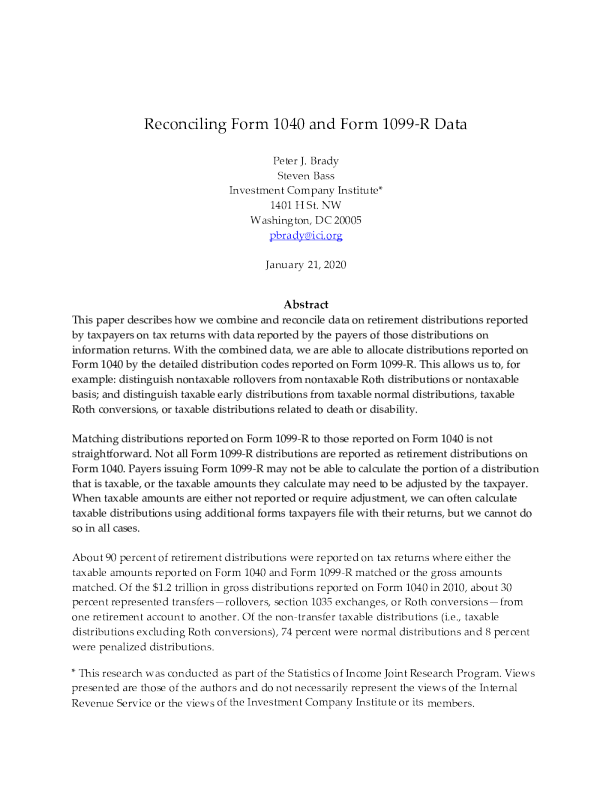
Peter J. BradySteven BassInvestment Company Institute*1401 H St. NWWashington, DC 20005pbrady@ici.org January 21, 2020 Abstract This paper describes how we combine and reconcile data on retirement distributions reportedby taxpayers on tax returns with data reported by the payers of those distributions oninformation returns. With the combined data, we are able to allocate distributions reported onForm 1040 by the detailed distribution codes reported on Form 1099-R. This allows us to, forexample: distinguish nontaxable rollovers from nontaxable Roth distributions or nontaxablebasis; and distinguish taxable early distributions from taxable normal distributions, taxableRoth conversions, or taxable distributions related to death or disability. Matching distributions reported on Form 1099-R to those reported on Form 1040 is notstraightforward. Not all Form 1099-R distributions are reported as retirement distributions onForm 1040. Payers issuing Form 1099-R may not be able to calculate the portion of a distributionthat is taxable, or the taxable amounts they calculate may need to be adjusted by the taxpayer.When taxable amounts are either not reported or require adjustment, we can often calculatetaxable distributions using additional forms taxpayers file with their returns, but we cannot doso in all cases. About 90 percent of retirement distributions were reported on tax returns where either thetaxable amounts reported on Form 1040 and Form 1099-R matched or the gross amountsmatched. Of the $1.2 trillion in gross distributions reported on Form 1040 in 2010, about 30percent represented transfers—rollovers, section 1035 exchanges, or Roth conversions—fromone retirement account to another. Of the non-transfer taxable distributions (i.e., taxabledistributions excluding Roth conversions), 74 percent were normal distributions and 8 percentwere penalized distributions. * This research was conducted as part of the Statistics of Income Joint Research Program. Viewspresented are those of the authors and do not necessarily represent the views of the InternalRevenue Service or the views of the Investment Company Institute or its members. Reconciling Form 1040 and Form 1099-R Data 1. Introduction In this paper, we analyze all taxpayers with evidence of retirement distributions in 2010. Bytaxpayers with evidence of retirement distributionswe mean any taxpayer who in tax year 2010either: (1) reported distributions on line 15 (IRA distributions) or line 16 (pensions and annuities) ofForm 1040; or (2) received a Form 1099-R (Distributions from Pensions, Annuities, Retirement orProfit-Sharing Plans, IRAs, Insurance Contracts, etc.) This paper describes the data that we use; explains how we reconciled the two data sourceswhen the information did not match; reports the incidence of form types; reports the prevalenceof matching between the two forms, in terms of both the number of individuals and theaggregate dollar amounts; and reports the incidence and amount of distributions by detailedcode. 2. Description of the Data The data we use combine two components: (1) tax return data and (2) information return data. The tax return data are the 2010 Individual and Sole Proprietor (INSOLE) file. This file is usedby the IRS Statistics of Income (SOI) Division to produce its annualIndividual Income Tax ReturnsComplete Reportpublication. It is also used by the Joint Committee on Taxation (JCT) and theDepartment of Treasury Office of Tax Analysis (OTA) as the basis for their microsimulationmodels. The 2010 INSOLE is a probability sample from the 143 million individual income tax returns(Forms 1040, 1040A, and 1040EZ, hereafter simply referred to asForm 1040) filed by US citizensand residents in 2011.1The sample consists of 308,946 tax returns and includes informationreported on Form 1040, as well as information from associated Schedules (such as Schedule SE, Reconciling Form 1040 and Form 1099-R Data which is used to calculate self-employment tax) and Forms (such as Form 6251, which is used tocalculate the alternative minimum tax). In addition to the 2010 INSOLE, we incorporate data from various information returns, whichallow us to allocate some income reported on joint tax returns filed by married couples toindividual taxpayers, and which may provide information not reported on Form 1040. Theinformation returns used in this study include Form 1099-R and Form 5498 (IRA ContributionInformation).2 2.1 Retirement Income Data The focus of this paper is on distributions from pensions, annuities, and IRAs, which arereported to the IRS by taxpayers on Form 1040, and reported to the IRS and taxpayers byentities issuing the distribution payments on Form 1099-R.3 On Form 1040,4taxpayers report: IRA distributions on line 15a (gross) and line 15b (taxable)Distributions from pensions and annuities on line 16a (gross) and line 16b (taxable) On Form 1099-R,5payers (entities that issue the payments) report: Gross distributions in b