猴痘临床管理海报系列补充信息:眼部介入
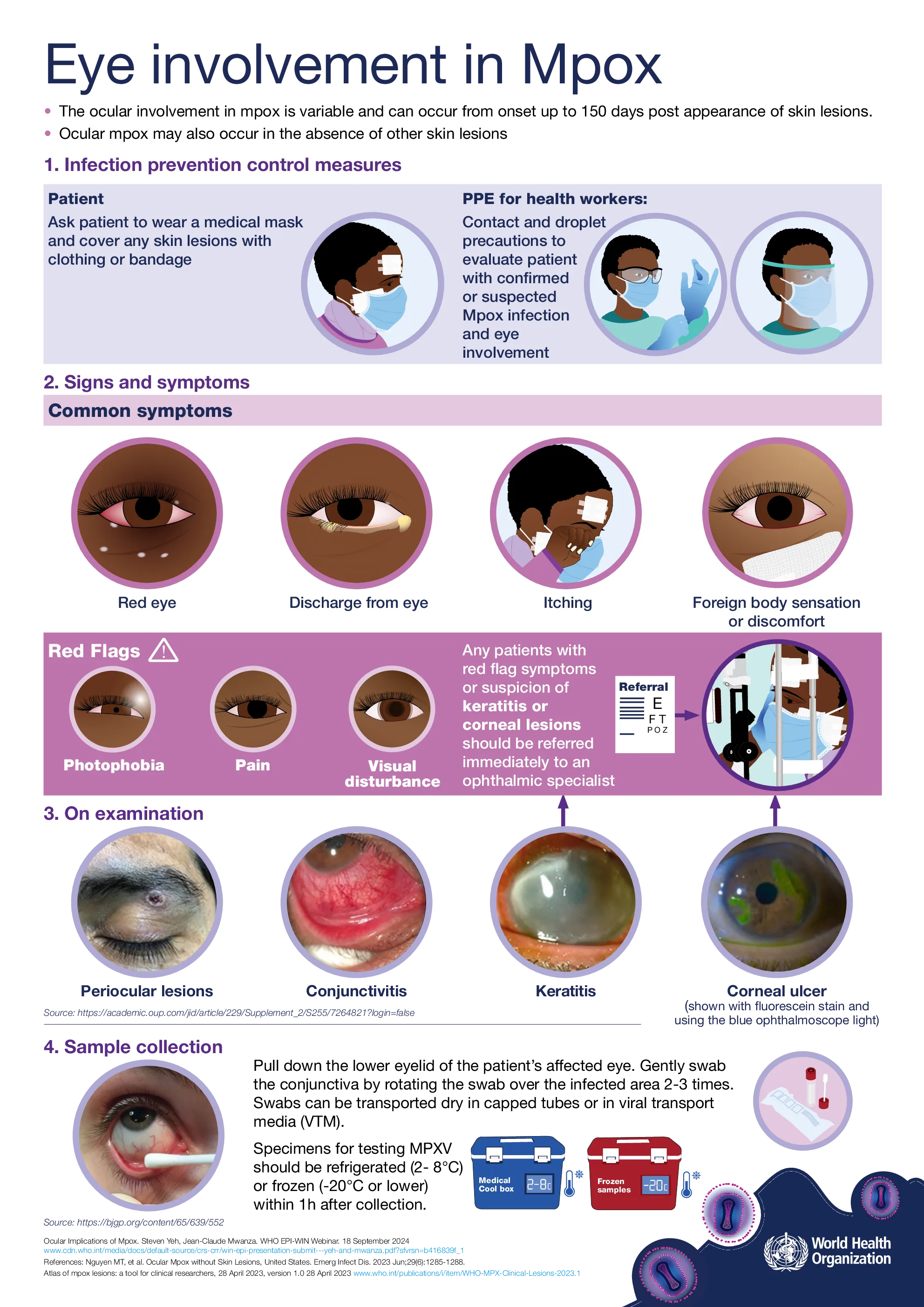
•The ocular involvement in mpox is variable and can occur from onset up to 150 days post appearance of skin lesions.•Ocular mpox may also occur in the absence of other skin lesions 1. Infection prevention control measures PPE for health workers: Patient Ask patient to wear a medical maskand cover any skin lesions withclothing or bandage Contact and dropletprecautions toevaluate patientwith confirmedor suspectedMpox infectionand eyeinvolvement 2. Signs and symptoms Common symptoms Red Flags! Any patients withred flag symptomsor suspicion ofkeratitis orcorneal lesionsshould be referredimmediately to anophthalmic specialist ReferralEF TP O Z 3. On examination Corneal ulcershown with fluorescein stain and (using the blue ophthalmoscope light) Source: https://academic.oup.com/jid/article/229/Supplement_2/S255/7264821?login=false 4. Sample collection Pull down the lower eyelid of the patient’s affected eye. Gently swabthe conjunctiva by rotating the swab over the infected area 2-3 times.Swabs can be transported dry in capped tubes or in viral transportmedia (VTM). Specimens for testing MPXVshould be refrigerated (2- 8°C)or frozen (-20°C or lower)within 1h after collection. Source: https://bjgp.org/content/65/639/552 Eye involvement in Mpox 5. Treatment Empiric treatment in absence of ophthalmic specialist Not touching or rubbing theaffected eye with lesions to avoidspread of infection to oppositeeye or other individuals Lubrication (eye drops, artificial tears) and wash with saline solution. Topical Antibiotics (e.g.moxifloxacin 0.5%eye drops) Vitamin A supplementation tomalnourished children if vitaminA deficiency is suspected ordiagnosed Avoid ointments or eye dropswith STEROIDS (may prolongthe presence of MPXV in oculartissue)4 If symptoms worsen or signs ofkeratitis/corneal damage,referrer to an ophthalmicspecialist7 Follow up The patients should be followedup in 3-5 days intervals until theeye is fully healed Supplementary informationforMpox clinicalmanagement poster series:eye involvement Methods This product has been developedas part of theClinical management and infectionprevention and control for mpox: livingguideline andfinalised during theMpoxglobalmeeting onoptimizing standards of care (OSoC), held in Nairobi,Kenya, 10–12th June2025.The contents wereunderpinned byevidence reviews presented in the guideline, andexpert review of the contents to ensure clinical relevance and accessibility.Full details ofthe deliberations are available in the main guidelinehttps://app.magicapp.org/#/guideline/10286/section/232778. Acknowledgements WHO staff(alphabetical order):•Janet Diaz (Safe and Scalable Care Unit,World Health Organization, Geneva, Switzerland);•Rashidatu Fouad(WHO Regional Office for Africa, Brazzaville, Republic of the Congo);•Marta Lado (Health Emergencies Programme, World Health Organization, Geneva,Switzerland);•John Masina(World Health Organization Regional Emergency Hub,Nairobi,Kenya);•Jamie Rylance(Safe and Scalable Care Unit,World Health Organization, Geneva,Switzerland); Guidance development group:Seehttps://app.magicapp.org/#/guideline/10286/section/232743for a full list of participants in the guidance development group. External expert reviewers:•Steven Yeh,University of Nebraska Medical Center,United States of America •Jean-Claude Mwanza,University of North Carolina,United States of America Conflictsof interest Full conflict of interestdetails are available athttps://app.magicapp.org/#/guideline/10286/section/236716.All participantsto the guidance development meeting completedconflict of interestdeclarations.The WHOtechnical team reviewed these, and determined nosignificant conflicts for this work. References •World Health Organization. Clinical management and infection prevention and controlfor mpox: living guideline, May 2025.https://iris.who.int/bitstream/handle/10665/381567/B09434-eng.pdf•World Health Organization,Yeh S, MwanzaJC. WHO EPI-WINwebinar,18/09/2024.www.cdn.who.int/media/docs/default-source/crs-crr/win-epi-presentation-submit---yeh-and-mwanza.pdf•Nguyen MT, Mentreddy A,Schallhorn J, Chan M, Aung S, Doernberg SB, Babik J, MilesK, Yang K, Lydon E, Minter DJ, Gonzales J, Shantha J, Doan T, Seitzman GD. IsolatedOcular Mpox without Skin Lesions, United States. Emerg Infect Dis. 2023;29(6):1285-1288.https://doi.org/10.3201/eid2906.230032•World Health Organization.Atlas of mpox lesions: a tool for clinical researchers. 2023https://iris.who.int/bitstream/handle/10665/366569/WHO-MPX-Clinical-Lesions-2023.1-eng.pdf•Rodriguez-Badillo, P. Mpox-Related Ophthalmic Disease: A RetrospectiveObservational Study in a Single Center in Mexico The Journal of Infectious Diseases,Volume 229, Issue Supplement_2, 15 April 2024, Pages S255–S259.https://doi.org/10.1093/infdis/jiad372•Hoffman, J.Gonococcal conjunctivitis: the importance of good quality conjunctivalswabshttps://bjgp.org/content/65/639/552 Copyright Allincludedimages have been accepted to be s