猴痘临床管理海报系列补充信息:液体管理
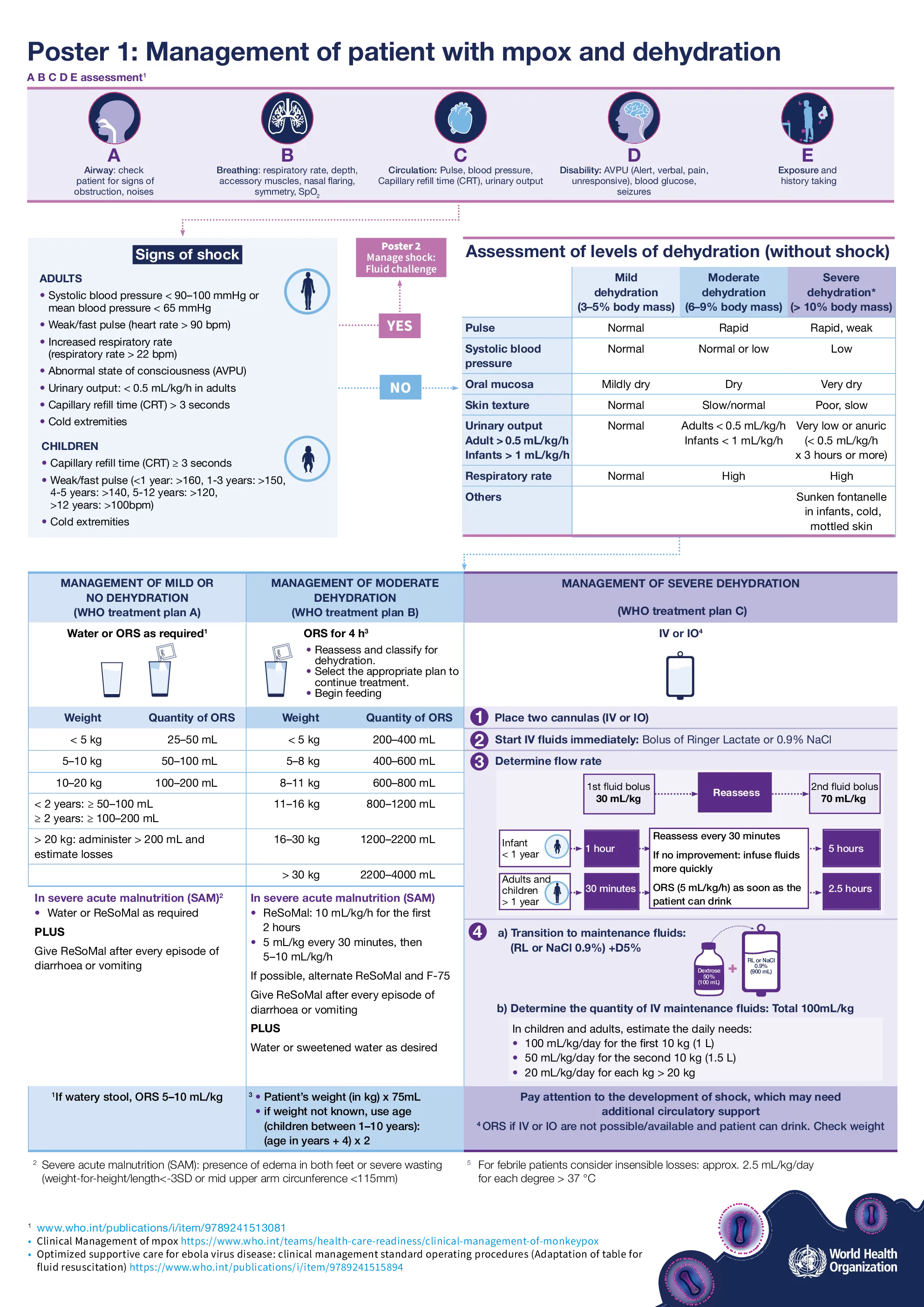
Monitoring Supplementary informationforMpox clinicalmanagement poster series:fluidmanagement Methods This product has been developedas part of theClinical management and infectionprevention and control for mpox: livingguideline andfinalised during theMpoxglobalmeeting onoptimizing standards of care (OSoC), held in Nairobi,Kenya, 10–12th June2025.The contents wereunderpinned byevidence reviews presented in the guideline, andexpert review of the contents to ensure clinical relevance and accessibility.Full details ofthe deliberations are available in the main guidelinehttps://app.magicapp.org/#/guideline/10286/section/232778. Acknowledgements WHO staff (alphabetical order):•Janet Diaz (Safe and Scalable Care Unit,World Health Organization, Geneva, Switzerland);•Rashidatu FouadKamara(WHORegional Office for Africa, Brazzaville, Republic of theCongo);•Marta Lado(Health Emergencies Programme, World Health Organization, Geneva,Switzerland);•John Masina (World Health Organization Regional Emergency Hub, Nairobi, Kenya);•Jamie Rylance(Safeand Scalable Care Unit,World Health Organization, Geneva,Switzerland); Guidance development group:Seehttps://app.magicapp.org/#/guideline/10286/section/232743for a full list of participants in the guidance development group. External expert reviewers: •DrWilliam Fischer,Associate professor of Medicine in the division of pulmonarydisease and critical care medicine.Co-directorof the viral haemorrhagic feverresearch program University of North Carolina at Chapel Hill.•DrHansJoerg Lang, Paediatric critical care advisor, ALIMA, Lecturer Heiderlberginstitute of Global Health Conflicts of interest Full conflict of interestdetails are available athttps://app.magicapp.org/#/guideline/10286/section/236716.All participantsto the guidance development meeting completedconflict of interestdeclarations.The WHOtechnical team reviewed these, and determined nosignificant conflicts for this work. References •Optimized supportive care for ebola virus disease: clinical management standardoperating procedures. Geneva: World HealthOrganization; 2019.(https://iris.who.int/bitstream/handle/10665/325000/9789241515894-eng.pdf)•Clinical management of patients with viral haemorrhagic fever(2016). Geneva: WHO.(http://apps.who.int/iris/bitstream/handle/10665/205570/9789241549608_eng.pdf)•Lamontagne F et al. (2018). Evidence-based guidelines for supportive care of patientswith Ebola virus disease. Lancet. 391(10121):700–708.https://doi.org/10.1016/s0140-6736(17)31795-6•Pocket book of hospital care for children (2013). Geneva: WHO.(https://www.who.int/maternal_child_adolescent/documents/9241546700)•Paediatric emergency triage, assessment and treatment: care of critically ill children(2016). Geneva: WHO(http://apps.who.int/iris/bitstream/handle/10665/204463/9789241510219_eng.pdf)•MSFclinicalguidelines: Diagnosis and treatment manual. Dehydration chapter.(https://medicalguidelines.msf.org/en/viewport/CG/english/dehydration-62194197.html) Copyright Allincludedimages have been accepted to be sharedwith WHO, withpermissionstopublish them granted from the copyright holder.