是时候结束定价接力赛了
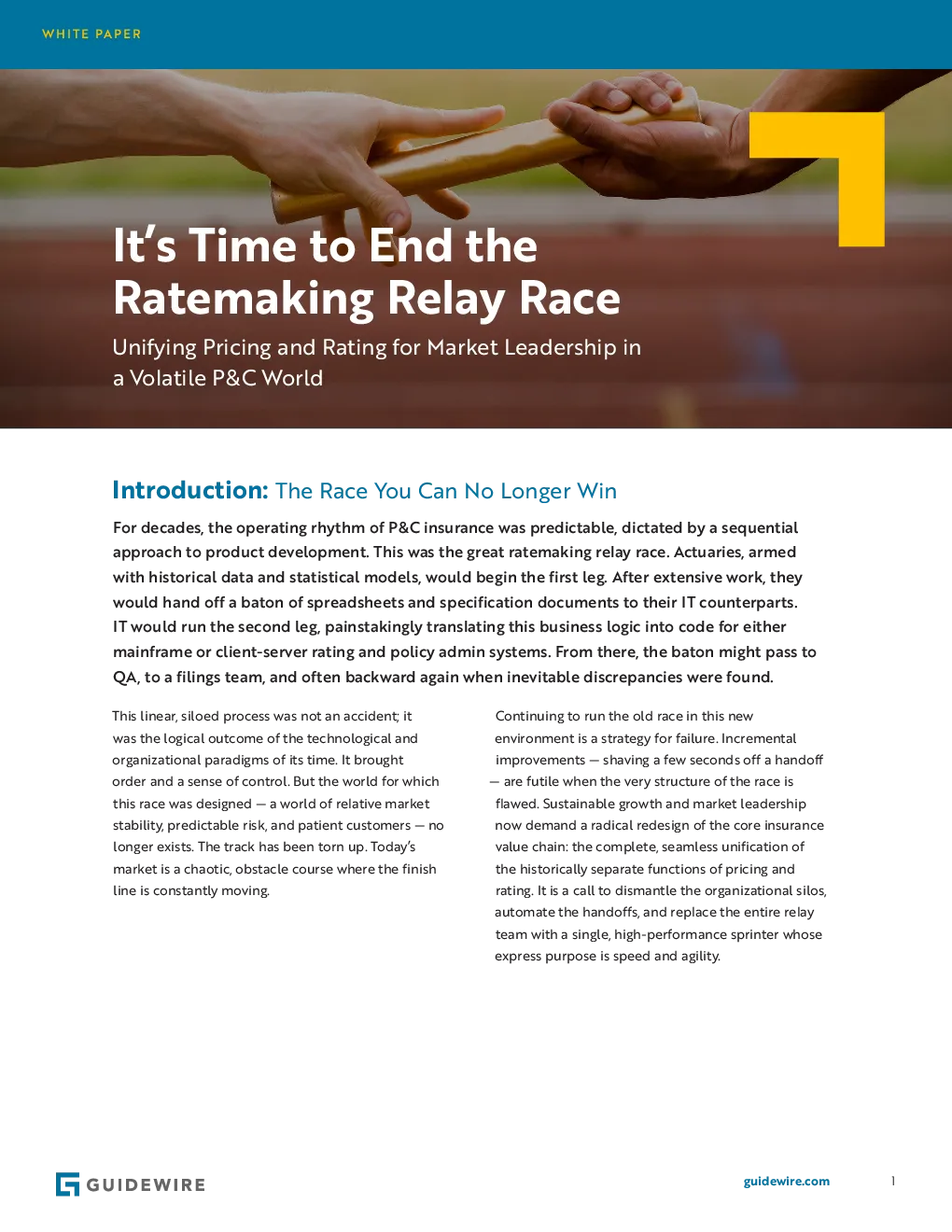
It’s Time to End theRatemaking Relay Race Unifying Pricing and Rating for Market Leadership ina Volatile P&C World Introduction:The Race You Can No Longer Win For decades, the operating rhythm of P&C insurance was predictable, dictated by a sequentialapproach to product development. This was the great ratemaking relay race. Actuaries, armedwith historical data and statistical models, would begin the first leg. After extensive work, theywould hand off a baton of spreadsheets and specification documents to their IT counterparts.IT would run the second leg, painstakingly translating this business logic into code for eithermainframe or client-server rating and policy admin systems. From there, the baton might pass toQA, to a filings team, and often backward again when inevitable discrepancies were found. Continuing to run the old race in this newenvironment is a strategy for failure. Incrementalimprovements — shaving a few seconds off a handoff— are futile when the very structure of the race isflawed. Sustainable growth and market leadershipnow demand a radical redesign of the core insurancevalue chain: the complete, seamless unification ofthe historically separate functions of pricing andrating. It is a call to dismantle the organizational silos,automate the handoffs, and replace the entire relayteam with a single, high-performance sprinter whoseexpress purpose is speed and agility. This linear, siloed process was not an accident; itwas the logical outcome of the technological andorganizational paradigms of its time. It broughtorder and a sense of control. But the world for whichthis race was designed — a world of relative marketstability, predictable risk, and patient customers — nolonger exists. The track has been torn up. Today’smarket is a chaotic, obstacle course where the finishline is constantly moving. The Pressure Cooker:Four Converging Forces Breaking the Old Model The legacy operating model is not failing due to a single cause; it’s been broken by the combined,compounding pressure of four market-altering forces. Understanding each is critical toresponding effectively to the situation. 1.The Expectation Economy: The Amazon-ingof Insurance 3.The Talent Crisis: The War for Brainpower The insurance industry is facing a demographic cliff.A generation of seasoned experts is retiring, with 50%of the current insurance workforce expected to retireby 2036.1And the next generation of top-tier talent—data scientists, actuaries, developers, and productmanagers—is being aggressively courted by industriesperceived as more modern and dynamic. Theseprofessionals have little patience for archaic processes.They do not want to spend their careers manuallyreconciling spreadsheets, wrestling with brittle legacycode, or waiting in an endless queue for yet anotherdepartment to complete its portion of a project. Anoutdated, friction-filled operating model is no longerjust a functional drag; it’s a significant liability in thewar for the talent required to compete and win. Today’s policyholders, both personal and commercial,benchmark their experience not against otherinsurers, but against the seamless, personalized, andon-demand services of tech giants. They expect tobe able to get a quote in seconds, customize theircoverage, and see their good behavior (like safedriving) rewarded with lower premiums. This demandfor product agility is where the relay race model failsmost spectacularly. Launching an innovative productlike usage-based insurance (UBI), a parametric policyfor a specific event, or an embedded offering witha retail partner is a monumental undertaking in asiloed environment. The rigid, hard-coded nature oflegacy rating systems turns product developmentinto a multi-year slog, ceding the future of insuranceto more nimble competitors. 4.The Climate Catalyst: From Predictable to Perilous The foundation of actuarial science—the law of largenumbers and the stability of historical data—has beenprofoundly undermined by climate change. We haveentered an era of unprecedented volatility wherea “100-year storm” is no longer a statistical anomalybut a recurring headline. This isn’t just a challenge forpersonal property lines; it affects commercial auto(hail damage), agriculture (drought and flood), andbusiness interruption claims across geographies. Thestatic, annual rate review cycle is obsolete. Survivalnow requires a dynamic risk posture, with the abilityto ingest new climate models, adjust geographicfactors, and deploy surgical rate changes with aspeed that is simply impossible when your process ismeasured in months. 2.The Economic Squeeze: The Erosion of Rate AdequacyThe global economy has unleashed its own waveof volatility. Inflation of social and medical costs,combined with persistent supply chain disruptions foreverything from lumber to auto parts, has renderedhistorical loss cost projections unreliable. A ratefiled based on last year’s data could be inadequatebefore it even gets approved. This economic p