您的浏览器禁用了JavaScript(一种计算机语言,用以实现您与网页的交互),请解除该禁用,或者联系我们。[安永]:中国大陆和香港的金融业内部审计监管政策和活动——2025年第三季度 - 发现报告

中国大陆和香港的金融业内部审计监管政策和活动——2025年第三季度

金融2025-10-23安永J***
AI智能总结
查看更多
中国大陆和香港的金融业内部审计监管政策和活动——2025年第三季度

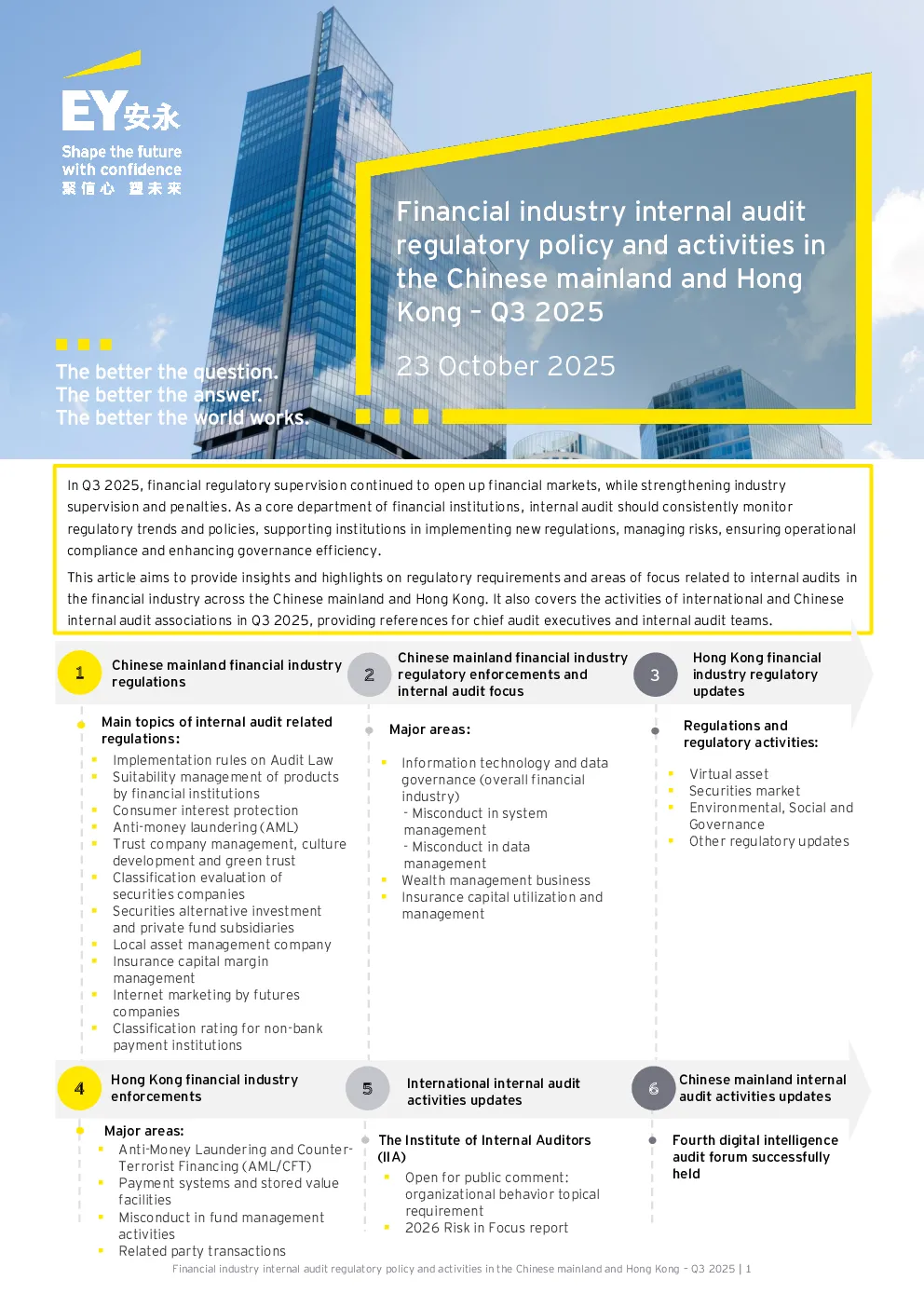
23 October 2025 In Q3 2025, financial regulatory supervision continued toopen upfinancial markets, while strengthening industrysupervision and penalties. As a core department of financial institutions, internal auditshould consistently monitorregulatory trends and policies,supportinginstitutions in implementing new regulations, managing risks, ensuring operationalcompliance and enhancing governance efficiency. This article aims to provide insights and highlights on regulatory requirements and areas of focus related to internal auditsinthe financial industry across the Chinese mainland and Hong Kong. It also covers the activities of international and Chineseinternal audit associations in Q3 2025, providing references for chief audit executives and internal audit teams. Main topics of internal audit relatedregulations: Major areas: ▪Implementation rules on Audit Law▪Suitability management of productsby financial institutions▪Consumer interest protection▪Anti-money laundering (AML)▪Trust company management,culturedevelopment andgreen trust▪Classification evaluation ofsecurities companies▪Securities alternative investmentand private fund subsidiaries▪Local asset management company▪Insurance capital marginmanagement▪Internet marketing by futurescompanies▪Classification rating for non-bankpayment institutions ▪Information technology and datagovernance (overall financialindustry)-Misconduct in systemmanagement-Misconduct in datamanagement▪Wealth management business▪Insurance capital utilization andmanagement ▪Virtual asset▪Securities market▪Environmental, Social andGovernance▪Other regulatory updates Major areas: The Institute of Internal Auditors(IIA) 1. Chinese mainland financial industry regulations In Q3 2025,the National Financial Regulatory Administration (NFRA), People’s Bank of China (PBOC), China SecuritiesRegulatory Commission (CSRC), China Trustee Association and other organizations have issued new regulations or self-regulatory rules for local asset management companies, securities and subsidiaries, trust companies, futures companies,paymentinstitutions and other sectors. These updates also covered anti-money laundering (AML), culture development,green finance and consumer rights protection to further improve the regulatory framework. Key regulations related to internal audit, as well as areas that internal audit teams should focus on in the Chinese mainlandin Q3 2025, are shown as below: Suitability management of products by financial institutions ▪In July, to regulate the suitability management of products by financial institutions and to protect the lawful rights andinterests of financial consumers, NFRA issued theMeasures for the Suitability Management of Products by FinancialInstitutions.The Measures clarify the scope and responsibilities for product suitability management in financialinstitutions, require financial institutions to classify investment products of different risk levels with dynamicmanagement, differentiate management of insurance products of different categories and strengthen supervision. Theabove requirements are all the key highlights that the internal audit department should focus on when conductinginternal audit. Trust company management, culture development andgreen trust Culture development: ▪In July,to promote high-quality development of the trust industry, the China Trustee Association issued theGuidelinefor trust culture development in trust companies,to further align with the leading practices of compliance culturedevelopment in the financial markets of Europe, the United States and Hong Kong. The Guideline requires trustcompanies to strengthen internal audit work and ensure trust culture development is integrated into the internalaudits of corporate governance, operations and management, internal controls, risk management. In addition, trustcompanies should assess whether internal policies, procedures, business operations and internal control mechanismsalign with the trustee's position, identify deficiencies and remediate in a timely manner to ensure all policies,procedures and processes meet the requirements of a well-developed trust culture. Green Trust: ▪In July, to guide trust companies in developing green trusts, the China Trustee Association issued the Green TrustGuideline. The Guideline requires the trust companies to include the review of implementation of green trust businessinto the internal control and complianceinspections, andconduct regular internal audit on green trusts. ▪Meanwhile, the China Trustee Association released theEnvironmental, Social and Governance (ESG) DisclosureGuideline for Trust Industry,which requires trust companies to disclose the adopted policies, measures andperformance in areas such as corporate governance framework, ESG governance, trust culture development, internalcontrol management, risk management, compliance management, anti-corruption and integrity, business ethics andreputation management. The specific di