AI智能总结
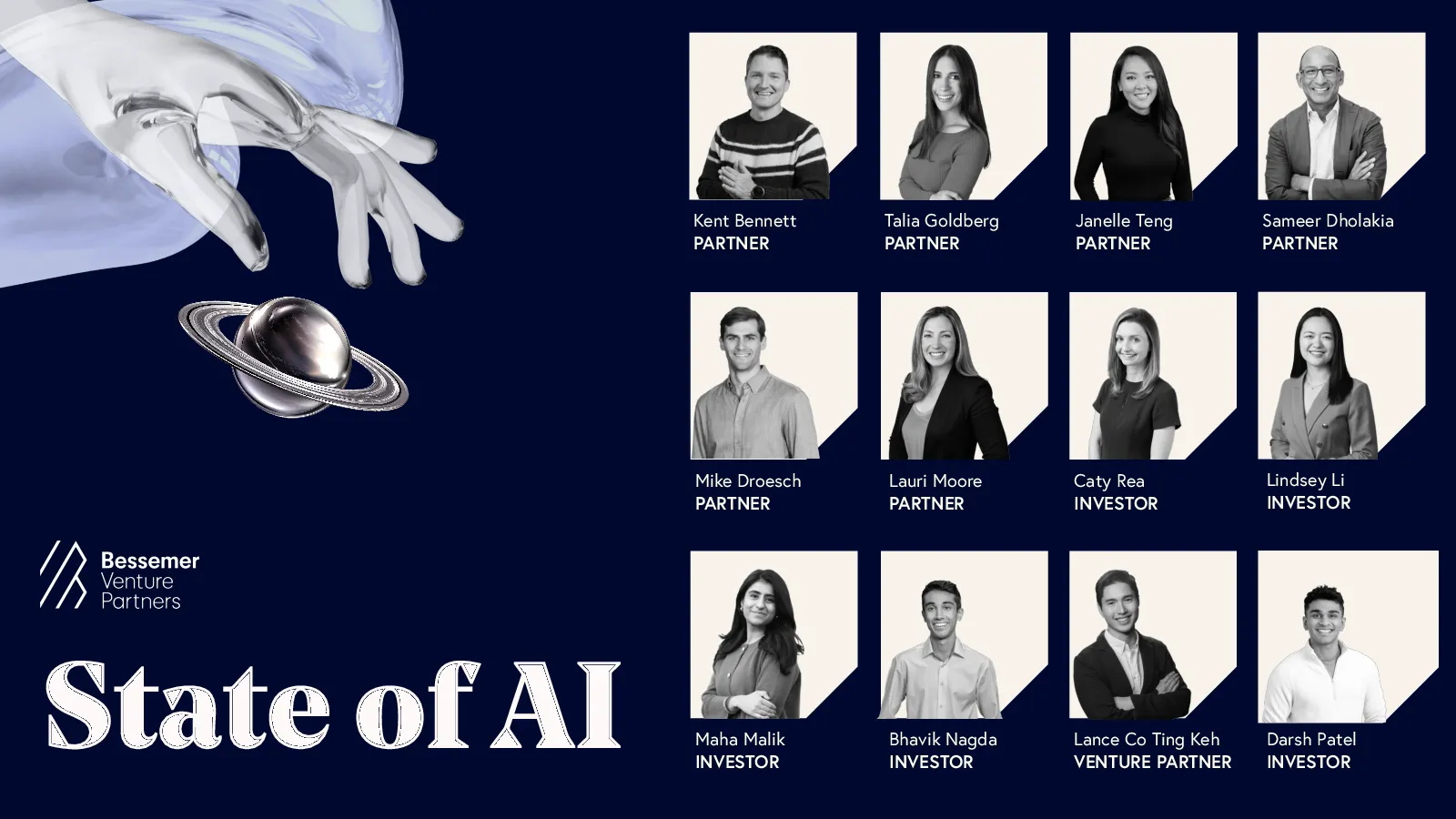
Janelle TengPARTNER Kent BennettPARTNER Sameer DholakiaPARTNER Lauri MoorePARTNER Caty ReaINVESTOR Lindsey LiINVESTOR Mike DroeschPARTNER StateofAI Bhavik NagdaINVESTOR Maha MalikINVESTOR Lance Co Ting KehVENTURE PARTNER Darsh PatelINVESTOR The new $100M ARR growthcurve for AI startups AVERAGE RATESOF GROWTH SUPERNOVAS Year 1-$40MARRYear 2-$125M ARR SHOOTING STARS Year 1-$3M ARRYear 2-$12M ARRYear 3-$40MARRYear 4-$103M ARR CLOUD CENTAUR On average, the topprivate cloud companiesreach $100M ARR in< 7 years. AI benchmarks: Supernovas vs. Shooting Stars What great AI startups look like in 2025 Predictions PREDICTION 1 The browser will emergeas a dominant interfacefor agentic AI As agentic AI matures, the browser is emerging as thedominant interface—not just for navigation, but forend-to-end autonomous execution. Unlike voice, browsers offer a contextual, ambient surfaceembedded in daily workflows. Tools like Comet and Diapreview a future where AI runs natively at the operatinglayer—automating tasks, reasoning across tabs, andexecuting high-level user intent. We expect new AI-native browsers from OpenAI, Google,and others to push this frontier. The next browser warsare already underway. PREDICTION 2 2026 will be the yearofgenerative video 2024 was the breakout year for generative images, 2025 forvoice—and 2026 is shaping up to be video’s moment.Advancesin model quality (Veo 3, Sora, Kling, Marey) andfalling costs are collapsing video’s complexity barrier,drivingmainstream adoption. Wealso expect the next 12 months to clarify the marketstructure for generative video:Do large labs win it all? Willopen-source catchup? Are there advantages to real-timeand low latency use cases? From cinematic storytelling to customer engagement,generative video is poised to reshape entertainment,marketing, education, and beyond. PREDICTION 3 Evals and data lineage willbecome a critical catalyst forAI product development Mostcompanies still can’t assess model performance in theirreal-world contexts. Public benchmarks fall short—missingnuance around workflows, compliance, and business-critical use. Enterprises don’t just want performance—they want confidence.That requires reproducible evaluation tailored to their own dataand risk profile. As model performance converges, the real edgeis knowing when, where, and why your model works. That’swhy in2025 and2026evals will go private, grounded, andtrustworthy—and enterprise AI deployment will accelerate.Startupsthat make evals explainable, scalable, and production-ready will power the next wave of enterprise AI adoption. PREDICTION 4 A new AI-native socialmedia giant could emerge Major shifts in consumer technology have historically pavedthe way for new social giants. PHP enabled Facebook. Mobilecameras made Instagram possible. Advances in mobile videopropelled TikTok. It’s hard to imagine that the new capabilities enabled bygenerative AI won’t lead to a similar breakout. Whatever shape it takes,advancementsin voice interaction,long-term memory, and image and video generation are clearfuel for the next social media breakout. The winning platformmight launch with a mainstream splash or emerge from a nichecommunity before rapidly expanding into a full-fledgedecosystem. PREDICTION 5 The incumbents strikeback as AI M&A heats up After two years of rapid disruption by AI-native startups, theenterprise giants are striking back—not by rebuilding fromscratch, but by acquiring the capabilities they need to catch up. In2025 and 2026, we expect to see a surge in M&A activity asincumbents move aggressively to buy their way into the AI era. Founder takeaways:•Expect strategic interest. If you're building domain-specific or infra-layer AI, legacy players may come knocking.•Be defensible. Strong moats, traction, and embeddedworkflows = leverage.•Know where incumbents lag—fill the gap faster, and you'reinvaluable. What foundersneed to know Top takeaways for founders Two AI startup archetypes are winning:On average,Supernovashit ~$100M ARRin 1.5 years—but often with fragile retention and thin margins;Shooting Starsgrowlike stellar SaaS: $3M to $100M over 4 years, with strong PMF and healthy margins. Memoryand context are the new moats:The most defensible products will remember, adapt, andpersonalize. Persistent memory and semantic understanding create emotional and functional lock-in. Systems of action are replacing systems of record:AI-native apps don’t just store data—theyact on it. Don’t bolt AI onto legacy software—reimagine the entire workflow. Start with an AI wedge:Solve a narrow, high-friction problem (e.g., legal research,sales notes). Deliver 10x value fast—then expand. The browser is your canvas:Agentic AI is shifting to the browser layer—now a programmableenvironment where agents observe and execute. Build for this surface; it’s the new operating layer. Top takeaways for founders Private, continuous evaluation is mission-critical:Public ben