2024年新加坡私人住房市场发现隐藏的宝石-勿洛
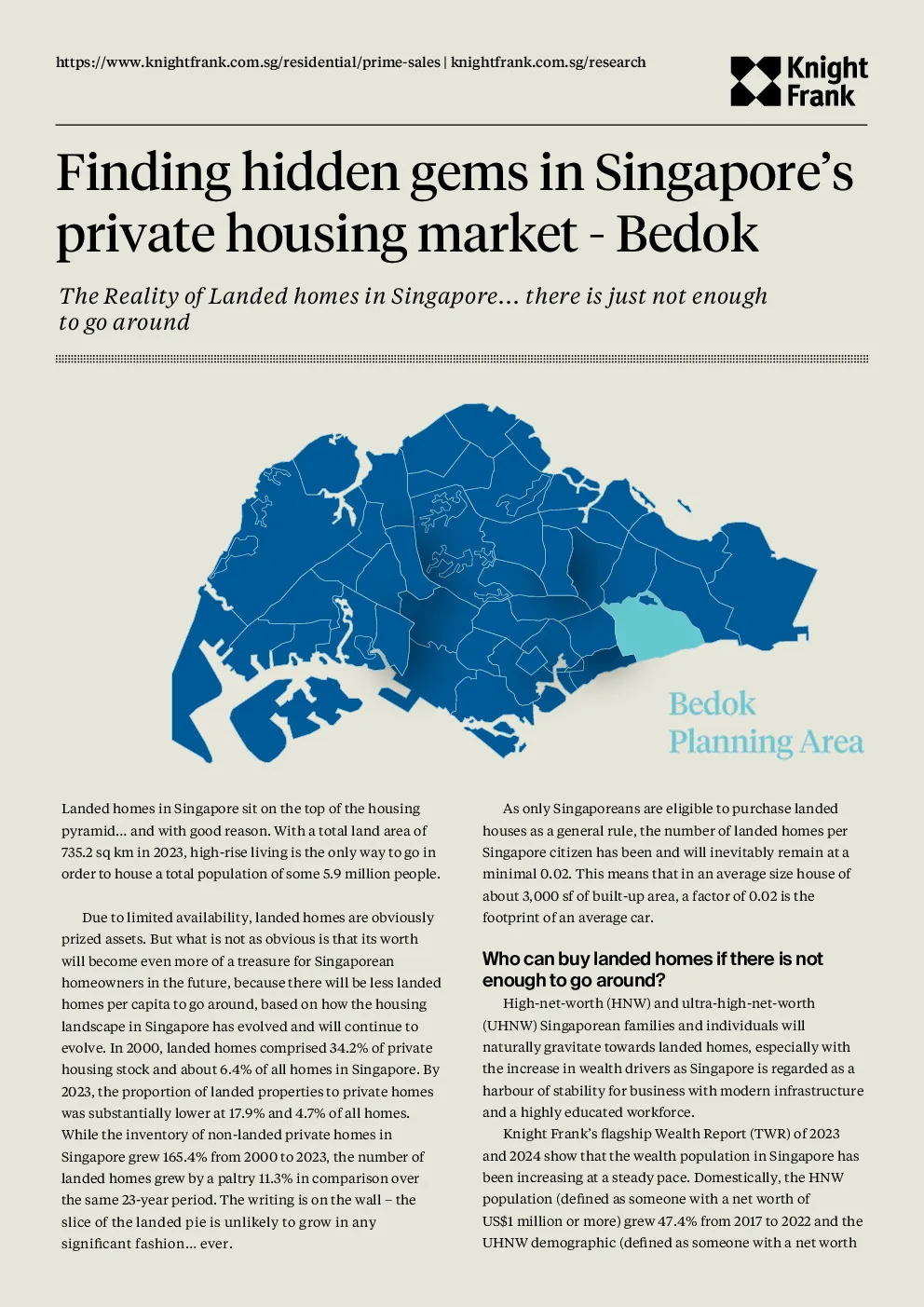
The Reality of Landed homes in Singapore... there is just not enoughto go around As only Singaporeans are eligible to purchase landedhouses as a general rule, the number of landed homes perSingapore citizen has been and will inevitably remain at aminimal 0.02. This means that in an average size house ofabout 3,000 sf of built-up area, a factor of 0.02 is thefootprint of an average car. Landed homes in Singapore sit on the top of the housingpyramid… and with good reason. With a total land area of735.2 sq km in 2023, high-rise living is the only way to go inorder to house a total population of some 5.9 million people. Due to limited availability, landed homes are obviouslyprized assets. But what is not as obvious is that its worthwill become even more of a treasure for Singaporeanhomeowners in the future, because there will be less landedhomes per capita to go around, based on how the housinglandscape in Singapore has evolved and will continue toevolve. In 2000, landed homes comprised 34.2% of privatehousing stock and about 6.4% of all homes in Singapore. By2023, the proportion of landed properties to private homeswas substantially lower at 17.9% and 4.7% of all homes.While the inventory of non-landed private homes inSingapore grew 165.4% from 2000 to 2023, the number oflanded homes grew by a paltry 11.3% in comparison overthe same 23-year period. The writing is on the wall – theslice of the landed pie is unlikely to grow in anysignificant fashion… ever. Who can buy landed homes if there is notenough to go around? High-net-worth (HNW) and ultra-high-net-worth(UHNW) Singaporean families and individuals willnaturally gravitate towards landed homes, especially withthe increase in wealth drivers as Singapore is regarded as aharbour of stability for business with modern infrastructureand a highly educated workforce. Knight Frank’s flagship Wealth Report (TWR) of 2023and 2024 show that the wealth population in Singapore hasbeen increasing at a steady pace. Domestically, the HNWpopulation (defined as someone with a net worth ofUS$1 million or more) grew 47.4% from 2017 to 2022 and theUHNW demographic (defined as someone with a net worth of US$30 million or more) increased 50.9% in the same period. Between 2022 and 2023, the UHNW population moved upanother 4.0% and is projected to increase 15.7% in the five-year stretch from 2023 to 2028. With the wealth population in Singapore set to increase as globally and regionally mobile families take the route tobecoming naturalised citizens, stabilised long-term demand for landed property can only increase against what is essentiallynear stagnant growth in landed home supply – cementing the status of these homes as an attractive investment for capitalpreservation and appreciation. owner occupier demand. After 2021, the pace of sales easedback to normalised levels with 326 units sold for a total ofS$1.5 billion in 2022 and 226 units for S$1.1 billion in 2023. Where to buy? Why Bedok? Thus, landed housing in Singapore is as good as asure thing as far as investment products areconcerned. The trouble for buyers is getting theirhands on one of these. Prospective landed homebuyers are usually drawn to the landed homes in theprime postal districts 10 and 11. However, landedhomes can be found all over the island… the trick isto find a location where there is a growth story andwhere the local neighbourhood has its own uniquecharacter. Like a mix of the mature and the new… Bedok Planning Area is the largest among all 55planning areas in terms of resident population size at279,510 and by number of dwellings with 108,143public and private homes. In what is mostly aHousing & Development Board (HDB) area, there arepockets of private non-landed projects and landedlocales, where landed homes comprise about 11.5% ofthe total housing stock (Exhibit 1). While the pace of landed transactions in Bedok hascooled from 2021, prices of all landed housing types(detached, semi-detached and terrace) have consistentlybeen on the increase in the past ten years, with occasionaltemporary declines (Exhibit 3). Price increases for landedhomes are inevitable given the scarcity. However, buyersand investors can take heart that short of a cataclysmicdisaster of extinction level proportions, these home priceswill almost always enjoy a natural price buoyancy, againdue to the fixed supply of landed homes. Exhibit 1: Breakdown of Housing Stockin Bedok Planning Area as at Q2 2024 Additionally, landed prices in the Bedok Planning Arearemained below the average islandwide landed price for allSingapore in the past ten years, providing a bit moreaffordability for potential landed homebuyers. The key Landed property sales volume in Bedok PlanningArea has generally been stable in the past ten yearssince 2015 with an average of 250 to 350 transactionseach year (Exhibit 2). However in 2021, thispredictable pattern was broken as there was a surgeof interest that resulted in 627 landed sales with acorresponding