Bernstein-全球储能:美国ESS需求能否抵消韩国电池制造商的电动汽车疲软-20250916【19页】
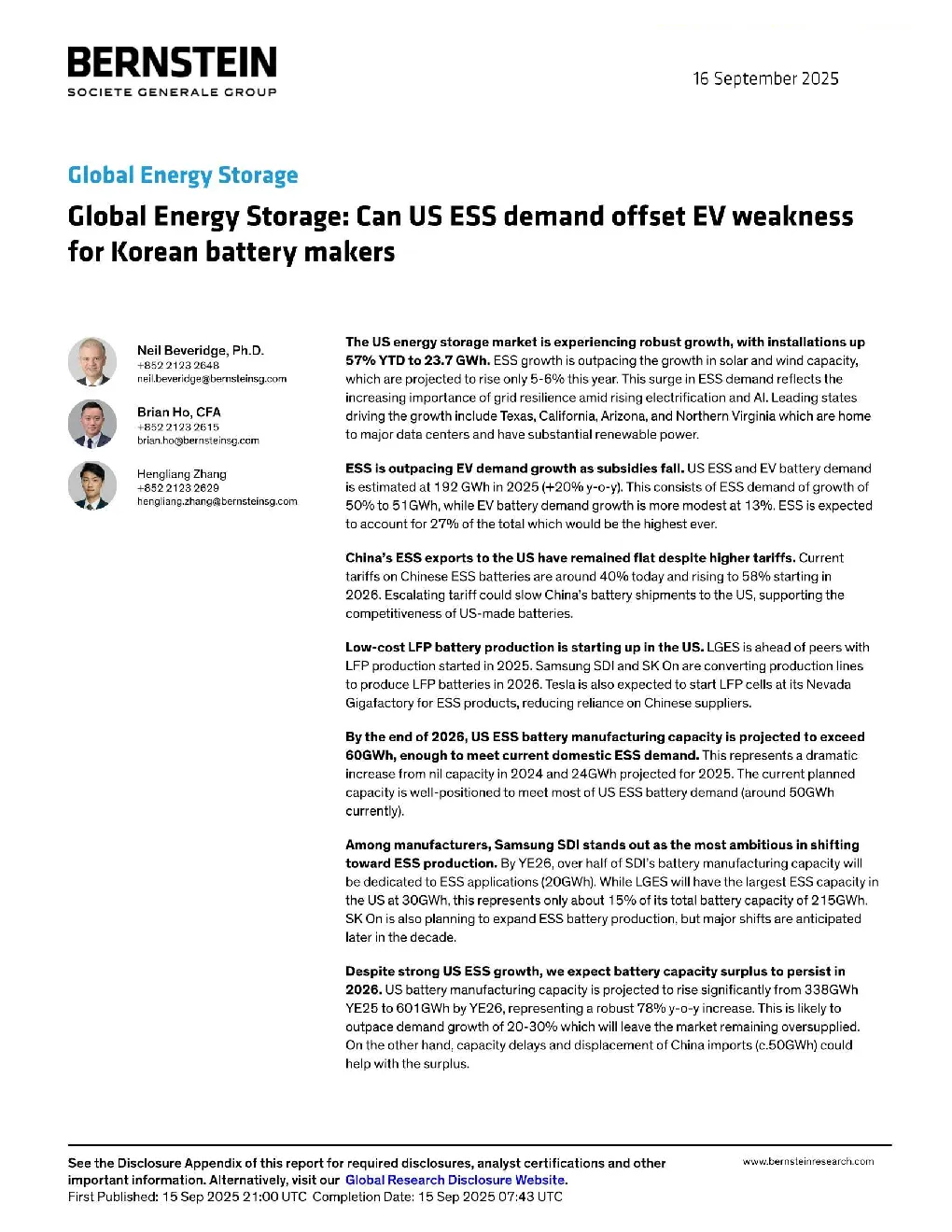
GlobalEnergyStorage:CanUSESSdemandoffsetEVweaknessforKoreanbatterymakers The US energy storege market is experiencing robust growth, with installetions up57% YTD to 23.7 GWh. ESS growth is outpacing the growth in.soler and winc capacity,which are prajected to rise cnly 5-Ba this year. This surge in ESS demand refects theincreasing importance of grid resilience arnid rising eleclrificalion and Al. Leading statesdriving the growth inciude Texas, California, Arizenz, and Northern Virginia which are horneto major data centers and have substsntisl renewable power. Neil Beveridge, Ph.D.+852 2123 2548neltwvcricgesbensteirsg.com Brian Ho, CFA+602 2123 2816brie.hcccbarnsteinsg.com ESS is outpacing EV demand growth as subsidies fall, US ESS and EV battery demand50% to 51GWh, while EV bettery clemand growth is more modest at 13%, ESS is expectedis estimated at 192 GWwh in 2025 (+20% y-o-y). This consists of ESS demand of growth ofto account for 27% of the total which would be the highest cver. Hengiarg Zharghengliargzhanggtamsteinsgcam China's ESS exports to the US have remained flat despite higher tariffs. Current2026. Escalating tariff could slow China's battery shipments to the US,supporting thelariffs on Chinese ESS balleries are around 40% loday and rising to 58%s slarling incompetitiveness of US-made bstteries. Low-cost LFP battery productlon Is startlng up In the US, LGES Is shesd of peers withLFP productio1 sterted in 2025. Samsung SDl and SK On are convertins production linesto produce LFP batteries in 2026, Tesle is also expected to start LFP cells etits Nevade By the end of 2026, US ESS battery manufacturing capacity is projected to exceed6OGWh, enough to meet current domestic ESS demand, This represents a dramaticcapscity is vell-positioned to meet most of US ESS battery demand (around 5CGWhcurrently). Among manufacturers, Samsung SDI stands out as the most ambltious in shiftingtoward ESS production, By YE26, over helf of SDI's battery manufacturing capecity willbe dedicated to ESS applications (2OGWh), While LGES will have the largest ESS capacity inthe US at 30GWh, this represents anly about 153s ofits total battery capacity cf 215GWhSK Cn is also planning to expand ES5 batery prcduction, but major shifls are anticipatedlater in the cecade Despite strong US ESS growth, we expect battery capacity surplus to persist in2026, US battery manufecturing capecity is projected to rise significantly from 338GWhYE25 to 601GWh by YE26, representing a robust 78% y-0-y incre8.se, This is likely tooutoace demand growth of 20-30% which will leave the market remaining oversuppliod.On the other hand, capacity delays and displacement of China imports (c.50GWh) couldhelp with the surplus. BERNSTEINTICKERTABLE INVESTMENTIMPLICATIONS The US bettery market has not turned out es expected. EV domand hes not taken cff as many including ourselves hed expectec.On the other hand, battery demand for ESS is growving rapidly, with installations up 57%s this ycar. On our estinates, the ESSmarket cpuld be as big as the US EV market is today. This is clearly an opporfunity for Korean battery makers, which althoughprotected from Chinese cornpetition by high tarifls, have experienced much lower utilizaltion rates, given the ccwnturn in EVdemand. With all the Korean battery companies, re-ccnfiguring produetion lines to manufacture LFP batteries for ES5, this willhelp growth. Even if EV growth remsins subclued, we expect 150-200GWh of demnd growth from ESS over the next 5 years.which would double the size of the bsttery market. Whether it is enough to turnaround mergins for Korean battery makers nextyear remeins unclear, but the longer tem out cok besed on ESS is inmproving and could be an opportunity for investors wiling tolook longcr torm, We rate LGES nd Samsurg SDlas Market-Perform. DETAILS USESSGROWTHISBEINGDRIVENBYDATACENTERSANDGRIDSTABILITY The US battery erergy storage system market is experiencing significant growth this year, bulding on an already strcngexpansion in 2024. US ESS installations are up 57%s belveen Jaruary to July at 23.7Gwh, Athough renewable energyinvestments face challeniges from rellbacks ct tax incentives and higher tariffs for renewable energy technologies, the grid-scsle ESS sector remains unaffected for the time being. As electrification drives up energy dema/nd in the US, ensuring gridresilience becomes increasingly vital. Batteries is playing a pivotal role in addressing this challenge to complementing bothtreclitional end renewable energy sources, Year to dete, the states with the highest growth in insteallations include Arizona, Californie, Texes, North Virginia, Ideho, Indiana,Oregon, and Oklahoma. Notably, many of these states host major data centers that demand a relieble, contiruous power supplyto operate 24/7. Celifomie boest the largest ESS flaet driven by high reneweble goals, grid stability, and stete policies thet support ESS funding.Arizone and Tex8s ranks 8s next two largest use