野村-中国电动汽车电池:来自固态电池专家电话会议的要点-20250911【3页】
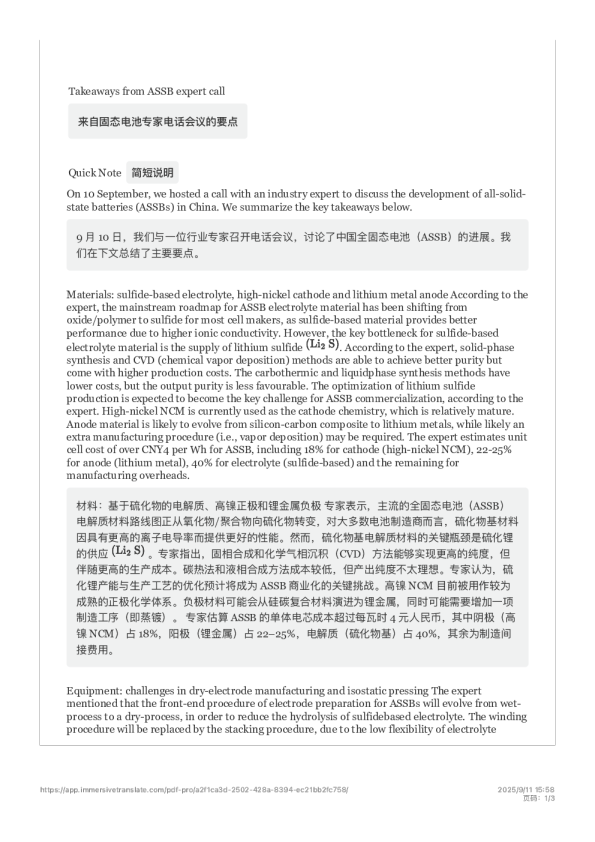
来⾃固态电池专家电话会议的要点 Quick Note简短说明 On 10 September, we hosted a call with an industry expert to discuss the development of all-solid-state batteries (ASSBs) in China. We summarize the key takeaways below. 9⽉10⽇,我们与⼀位⾏业专家召开电话会议,讨论了中国全固态电池(ASSB)的进展。我们在下⽂总结了主要要点。 Materials: sulfide-based electrolyte, high-nickel cathode and lithium metal anode According to theexpert, the mainstream roadmap for ASSB electrolyte material has been shifting fromoxide/polymer to sulfide for most cell makers, as sulfide-based material provides betterperformance due to higher ionic conductivity. However, the key bottleneck for sulfide-basedelectrolyte material is the supply of lithium sulfide. According to the expert, solid-phasesynthesis and CVD (chemical vapor deposition) methods are able to achieve better purity butcome with higher production costs. The carbothermic and liquidphase synthesis methods havelower costs, but the output purity is less favourable. The optimization of lithium sulfideproduction is expected to become the key challenge for ASSB commercialization, according to theexpert. High-nickel NCM is currently used as the cathode chemistry, which is relatively mature.Anode material is likely to evolve from silicon-carbon composite to lithium metals, while likely anextra manufacturing procedure (i.e., vapor deposition) may be required. The expert estimates unitcell cost of over CNY4 per Wh for ASSB, including 18% for cathode (high-nickel NCM), 22-25%for anode (lithium metal), 40% for electrolyte (sulfide-based) and the remaining formanufacturing overheads. 材料:基于硫化物的电解质、⾼镍正极和锂⾦属负极专家表示,主流的全固态电池(ASSB)电解质材料路线图正从氧化物/聚合物向硫化物转变,对⼤多数电池制造商⽽⾔,硫化物基材料因具有更⾼的离⼦电导率⽽提供更好的性能。然⽽,硫化物基电解质材料的关键瓶颈是硫化锂的供应。专家指出,固相合成和化学⽓相沉积(CVD)⽅法能够实现更⾼的纯度,但伴随更⾼的⽣产成本。碳热法和液相合成⽅法成本较低,但产出纯度不太理想。专家认为,硫化锂产能与⽣产⼯艺的优化预计将成为ASSB商业化的关键挑战。⾼镍NCM⽬前被⽤作较为成熟的正极化学体系。负极材料可能会从硅碳复合材料演进为锂⾦属,同时可能需要增加⼀项制造⼯序(即蒸镀)。专家估算ASSB的单体电芯成本超过每瓦时4元⼈⺠币,其中阴极(⾼镍NCM)占18%,阳极(锂⾦属)占22–25%,电解质(硫化物基)占40%,其余为制造间接费⽤。 Equipment: challenges in dry-electrode manufacturing and isostatic pressing The expertmentioned that the front-end procedure of electrode preparation for ASSBs will evolve from wet-process to a dry-process, in order to reduce the hydrolysis of sulfidebased electrolyte. The windingprocedure will be replaced by the stacking procedure, due to the low flexibility of electrolyte materials. The isostatic pressing procedure will be added to improve the solid-to-solid contactbetween the layers of materials, which is relatively challenging currently to achieve uniformthickness under pressure of. The pouch cell form factor is preferred for ASSBs,because: 1) higher energy density can be achieved; and 2) less volume expansion for solid-stateelectrolyte. The expert estimates unit equipment spending of at least CNY350-400mn per GWhfor ASSB production at the current stage. 设备:⼲法电极制造和等静压⼯艺的挑战专家提到,为了减少硫化物基电解质的⽔解,ASSB的电极前段制备⼯序将由湿法⼯艺演变为⼲法⼯艺。由于电解质材料柔性较低,绕线⼯序将被叠⽚⼯序取代。将增加等静压⼯序以改善材料层之间的固态接触,⽬前在压⼒下实现厚度均匀性相对具有挑战性。囊式电池外形更适合ASSB,原因是:1)可实现更⾼的能量密度;2)固态电解质的体积膨胀较⼩。专家估算,⽬前阶段ASSB产线的单位设备投⼊⾄少为每GWh 3.5–4亿元⼈⺠币。 Competition landscape and outlook for commercialization 竞争格局与商业化前景 The expert noted that the material supply and manufacturing procedure for ASSBs are still lessmature, despite a relatively visible roadmap. Most of the players are still in the pilot productionstage, and the sample product is less satisfactory with low cell capacity (e.g., 20-30Ah) and lesscompetitive energy density (e.g.,), compared with traditional lithium-ion batteriesor semi-solid-state batteries, in terms of price-performance ratio. ASSBs still have shortfalls suchas a slower charging rate and a lower cycle life, leading to challenges in certain downstreamapplications. The expert believes that it will still take time for ASSB technology to reach massproduction, while most players are in similar stages of ASSB technology development. For coreequipment, such as dryelectrode preparation and isostatic laminator, the expert mentioned thatdomestic equipment vendors already have the production capabilities, while the performance ofdomestic isostatic laminators is still less favourable. 专家指出,尽管路线图较为清晰,固态电池(ASSB)的材料供应和制造⼯艺仍不够成熟。⼤多数参与者仍处于试点⽣产阶段,样品产品令⼈不甚满意,电池容量偏低(例如20–30Ah),能量密度在性价⽐⽅⾯也不及传统锂离⼦电池或半固态电池(例如)。ASSB在充电速度较慢和循环寿命较低等⽅⾯仍存在不⾜,导致在某些下游应⽤中⾯临挑战。专家认为ASSB技术实现量产仍需时⽇,⽽⼤多数参与者在ASSB技术发展的阶段相近。对于关键设备,如⼲电极制备机和等静压压合机,专家提到国内设备⼚商已具备⽣产能⼒,但国内等静压压合机的性能仍然不够理想。 Research Analysts研究分析员 Global EV Batteries & Materials 全球电动汽⻋电池与材料 ethan.zhang@nomura.com+85222522157Ethan Zhang - NIHK