您的浏览器禁用了JavaScript(一种计算机语言,用以实现您与网页的交互),请解除该禁用,或者联系我们。[Krungsri Research]:微芯片植入:人类增强的新前沿 - 发现报告

微芯片植入:人类增强的新前沿

AI智能总结
查看更多
微芯片植入:人类增强的新前沿

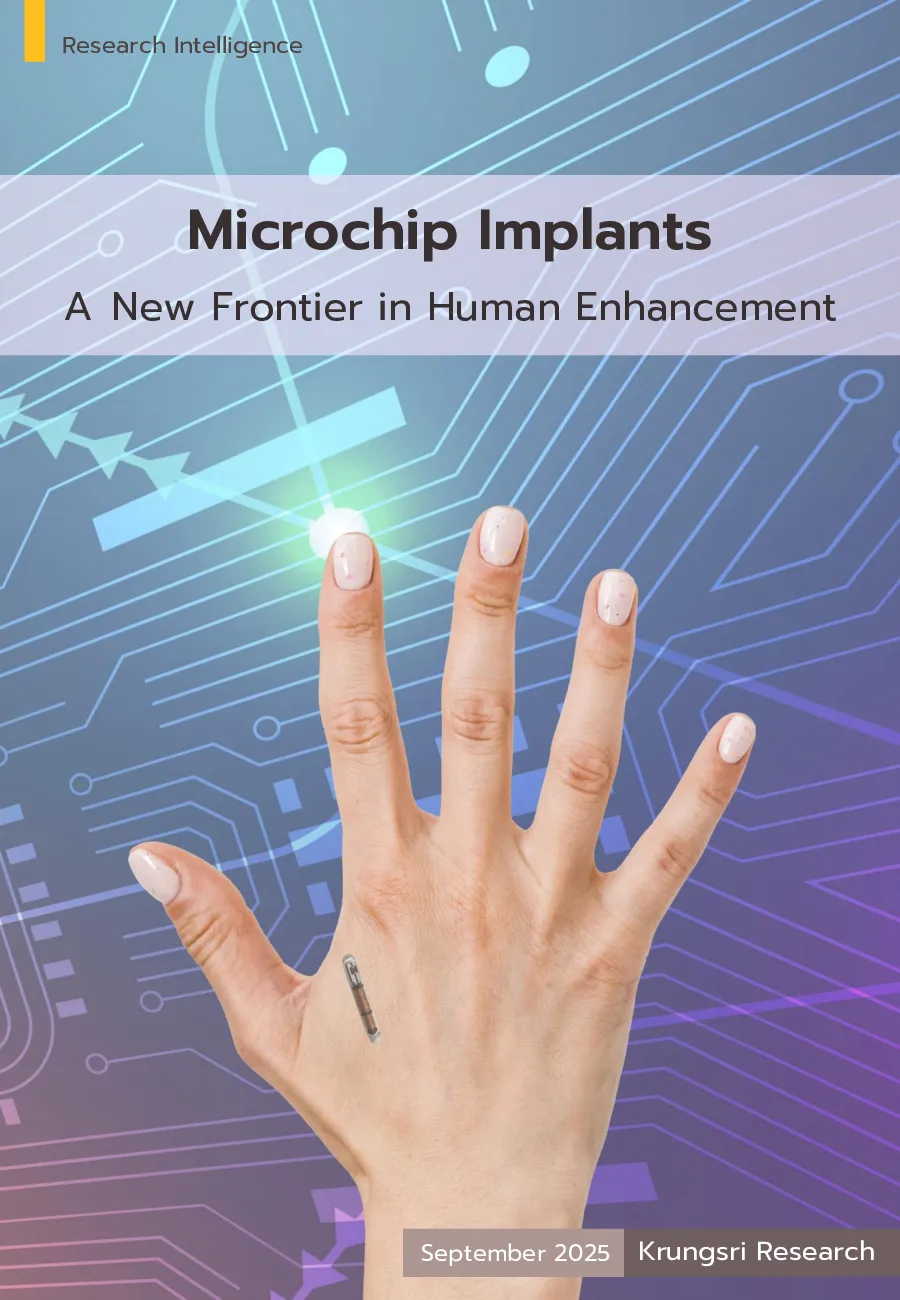
ANew Frontier in Human Enhancement Exploring theHuman EnhancementTrend Subdermal Microchip Implantation:From Past to Present HowSubdermal Microchip Tech Works Use Cases of RFID Chip Implants 10 Benefits for the Financial Sector 12 14 Usage Concerns and Human Dignity Krungsri Research View References17 Unlessexplicitly stated otherwise,this publication and all material therein isunder the copyright ofKrungsri Research. As such, the reuse, reproduction, oralteration of this text or any part thereof is absolutely prohibited without priorwrittenconsent.This report draws on a wide range of well-established andtrustworthysources,but Krungsri Research can make no guarantee of theabsolute veracity of the material cited. Moreover,KrungsriResearch will not beheld responsible for any losses that may occur either directly or indirectly fromany use towhich this report or the data contained therein may be put.Theinformation,opinions,and judgements expressed in this report are those ofKrungsriResearch, but this publication does not necessarily reflect the opinionsof Bank ofAyudhya Public Company Limited or of any other companies withinthe same commercial group. This report is an accurate reflection of the thinkingand opinions ofKrungsriResearch as of the day of publication, but we reservethe right to change those opinions without prior notice. For research subscription, contactkrungsri.research@krungsri.com Introduction In the 21st century, the concept of human enhancement has garnered significant attention,drivingtheintegration of diverse scientific disciplines and propelling implantable devices to the forefront ofinnovation. These technologies act as a bridge between human biological systems and digital platforms,representing a major global shift with profound implications. One of the most prominent examples of thistrend is subdermal microchip implantation, which aims to expand human capabilities—both physically andinformationally. Although microchip implantation is not a novel technology, it has long been utilized in various domainssuch as animal tracking, medical data storage, and military applications. Today, however, it is increasinglyentering the realm of everyday life, particularly in Western societies. Individuals are opting to implantmicrochips for a range of purposes, including identity verification, contactless payment, and emergencyaccess to health information. Despite its growing adoption, this technology faces several ethical and societal challenges. Concernsinclude privacy risks, unauthorized surveillance, safety and health implications, and the inadequacy ofexisting legal frameworks to keep pace with rapid technological advancement. Nathanon Ratanathamwat Dr. Pimnara Hirankasi Head of Research Division and Chief Economistpimnara.hirankasi@krungsri.com+662 296 6457 Senior Analystnathanon.ratanathamwat@krungsri.com+662 296 6389 Exploring the Trend of HumanEnhancement Enhancing Human Potential through ‘Biohacking’ Biohackingrefers to a structured process in which individuals experiment with modifying theirbodies and behaviors using knowledge, inventions, or technologies from various scientific disciplines, withthe aim of enhancing physical and mental performance, improving health, and unlocking greater humanpotential. This practice can be broadly categorized into two approaches:invasive physical interventions,which involve penetrating the body through methods such as injections, implants, surgeries, or geneticmodifications, andnon-invasive physical interventions, which enhance human capabilities without physicalintrusion, including the use of wearable technologies, dietary control, and mental training. Human Enhancement through Biohacking Systems Biological Interventions for Human Enhancement Invasive biohacking methods—those that involve direct physical intervention—can be grouped into fourmain categories based on the type of biological modification: 1)Subdermal entryinvolves implanting small devices under the skin, such as microchips, which arecommonly used for identification, access control, and payment systems. These devices are classifiedas passive technologies because they do not rely on internal power sources like batteries, insteadfunctioning through external scanners or readers that activate them when needed. 2)Peripheral sensory integrationrefers to the enhancement of sensory perception through implanteddevices designed to augment or expand human capabilities. Examples include cochlear implants thatimprove hearing, subdermal magnets that vibrate or stimulate nerves in response to nearby magneticfields—enabling users to perceive otherwise invisible phenomena—and vibration compasses thatprovide directional feedback through subtle vibrations. Collectively, these technologies work toenhance or introduce entirely new sensory experiences for the user. 3)Central nervous system interfacesare the most complex and high-risk form of human bodyintervention compared to others, as i