AI智能总结
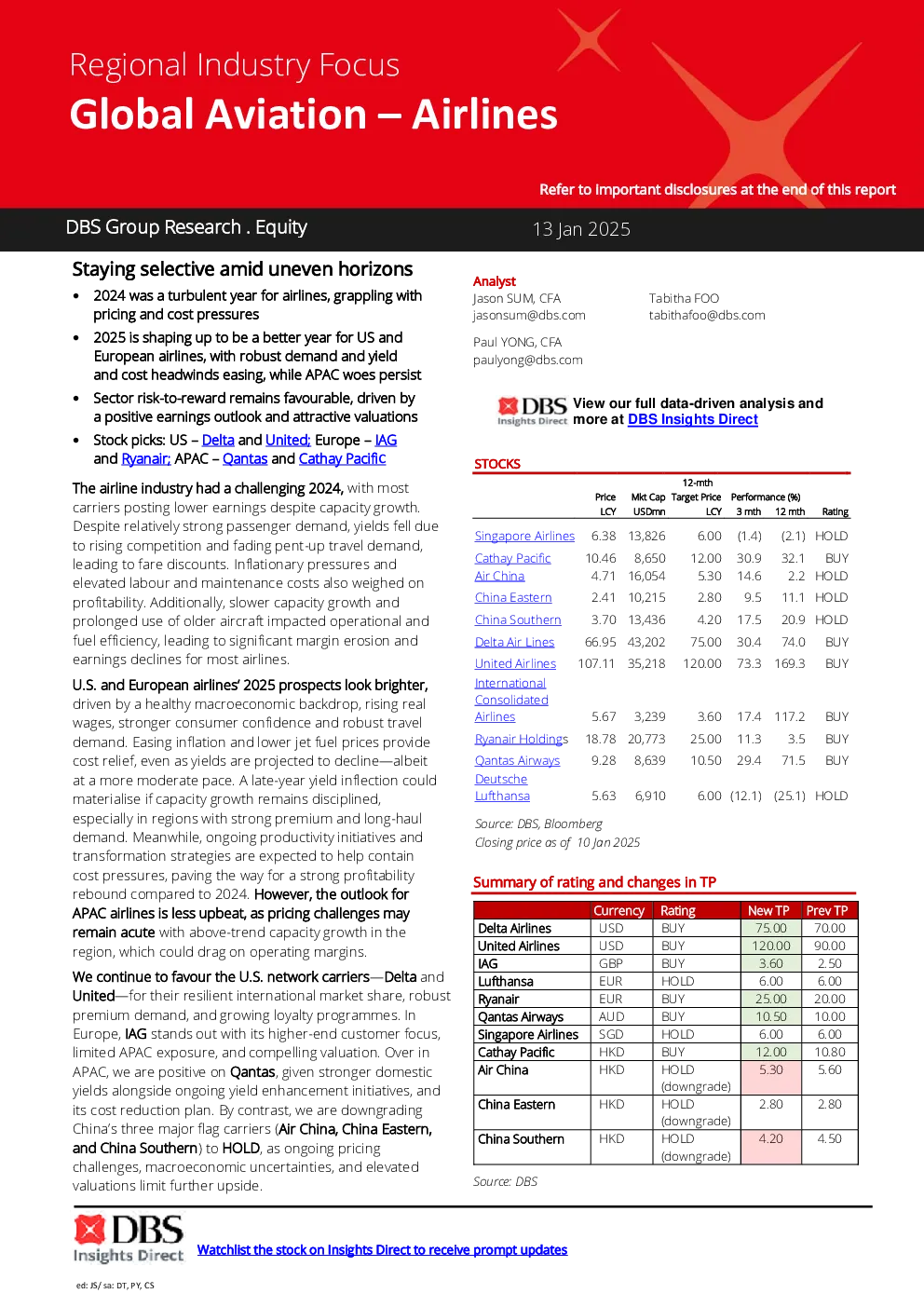
DBS Group Research . Equity 13 Jan 2025 Staying selective amid uneven horizons Analyst •2024 was a turbulentyearforairlines,grappling withpricing and cost pressures •2025 is shaping up to be a better yearfor US andEuropean airlines, withrobustdemandandyieldand cost headwindseasing, while APAC woes persist•Sector risk-to-reward remains favourable,drivenbya positive earnings outlook and attractive valuations•Stock picks: US–DeltaandUnited;Europe–IAGandRyanair;APAC–QantasandCathay Pacific Jason SUM, CFATabitha FOOjasonsum@dbs.comtabithafoo@dbs.com Paul YONG, CFApaulyong@dbs.com View our full data-driven analysis andmore atDBS Insights Direct The airline industry had a challenging 2024,with mostcarriers posting lower earnings despite capacity growth.Despite relatively strong passenger demand, yields fell dueto rising competition and fading pent-up travel demand,leading to fare discounts. Inflationary pressures andelevated labour and maintenance costs also weighed onprofitability. Additionally, slower capacity growth andprolonged use of older aircraft impacted operational andfuel efficiency, leading to significant margin erosion andearnings declines for most airlines. U.S. and European airlines’ 2025 prospects look brighter,driven by a healthy macroeconomic backdrop, rising realwages, stronger consumer confidence and robust traveldemand. Easing inflation and lower jet fuel prices providecost relief, even as yields are projected to decline—albeitat a more moderate pace. Alate-year yield inflection couldmaterialise if capacity growth remains disciplined,especially in regions with strong premium and long-hauldemand. Meanwhile, ongoing productivity initiatives andtransformation strategies are expected to help containcost pressures, paving the way for a strong profitabilityrebound compared to 2024.However, the outlook forAPAC airlines is less upbeat, as pricing challenges mayremain acutewith above-trend capacity growth in theregion, which could drag on operating margins. We continue to favour the U.S. network carriers—DeltaandUnited—for their resilient international market share, robustpremium demand, and growing loyalty programmes. InEurope,IAGstands out with its higher-end customer focus,limited APAC exposure, and compelling valuation. Over inAPAC, we are positive onQantas, given stronger domesticyields alongside ongoing yield enhancement initiatives, andits cost reduction plan. By contrast, we are downgradingChina’s three major flag carriers (Air China, ChinaEastern,and China Southern) toHOLD, as ongoing pricingchallenges, macroeconomic uncertainties, and elevatedvaluations limit further upside. ed:JS/ sa:DT, PY, CS APAC still trails the other regions in passenger traffic and capacity recovery Growth in passenger traffic hasslowedglobally; APAC yet toclose the gap.Global passenger traffic, measured inrevenue-passenger-kilometres (RPK), fully recovered to pre-pandemic levels in Feb-24and reached 107% of 2019 levelsinNov-24. However,y/ygrowth has deceleratedto high-single digitsin recent months,amid easing pent-up traveldemand and lower passenger capacity growth.Domestictraffichadfully recovered by Mar-23 and hasbeentrendinghigher, led by China and India,whileinternational travelsurpassedpre-pandemic levelsin May-24but hasremained relatively stablesince.APAC remainedthe onlyregion whereinternational passenger traffic still below pre-pandemic levels,just 0.5% short of a full recovery in Nov-24. This was primarilyattributedto the slow return ofChineseoutboundtourists (94% of 2019 levels in Oct-24),given the weaker yuan and macroeconomic uncertainties. Recovery in international passenger capacity variesbyregions.Transatlantic routes remain among the fastest- recovering major segments, driven by strong travel demandbetween the US and Western Europe, although growth hasmoderated y/y due to a high base. In contrast, while growthon APAC routeswashigherin 2024, thiswaslargely due toa lower basefrom a later reopening. The region continuesto lag others, as capacity from APAC to North Americaremains constrained by strict flight quotas betweentheUSand China, and capacity from Western Europe to APAC isalso limited by the Russian airspace ban. Many Europeancarriers, including Lufthansa and British Airways, havereduced flights to Chinaasthey are unable to effectivelycompete against the Chinese carriers that can overflyRussia. Uneven recovery across APAC.International passengercapacityhassurpassed pre-pandemic levels in India,Singapore, Taiwan, and Indonesia, even though overalltourist arrivals in the regionwasbelow 2019 levels in mostcountries. Outbound travel demand has been particularlystrong in Singapore, reaching 108% of 2019 levels in Oct-24.Incontrast, Japan’s outbound travel has suffered due toa weak yen, holding volumes at just 70% of pre-pandemicfigures. In Taiwan, inbound and outbound tourism haverecovered to 72% and 93% of 2019 levels, respectively,butthe countryis benefittingfrom robust transit demand