黄金ETF流量:2025年7月
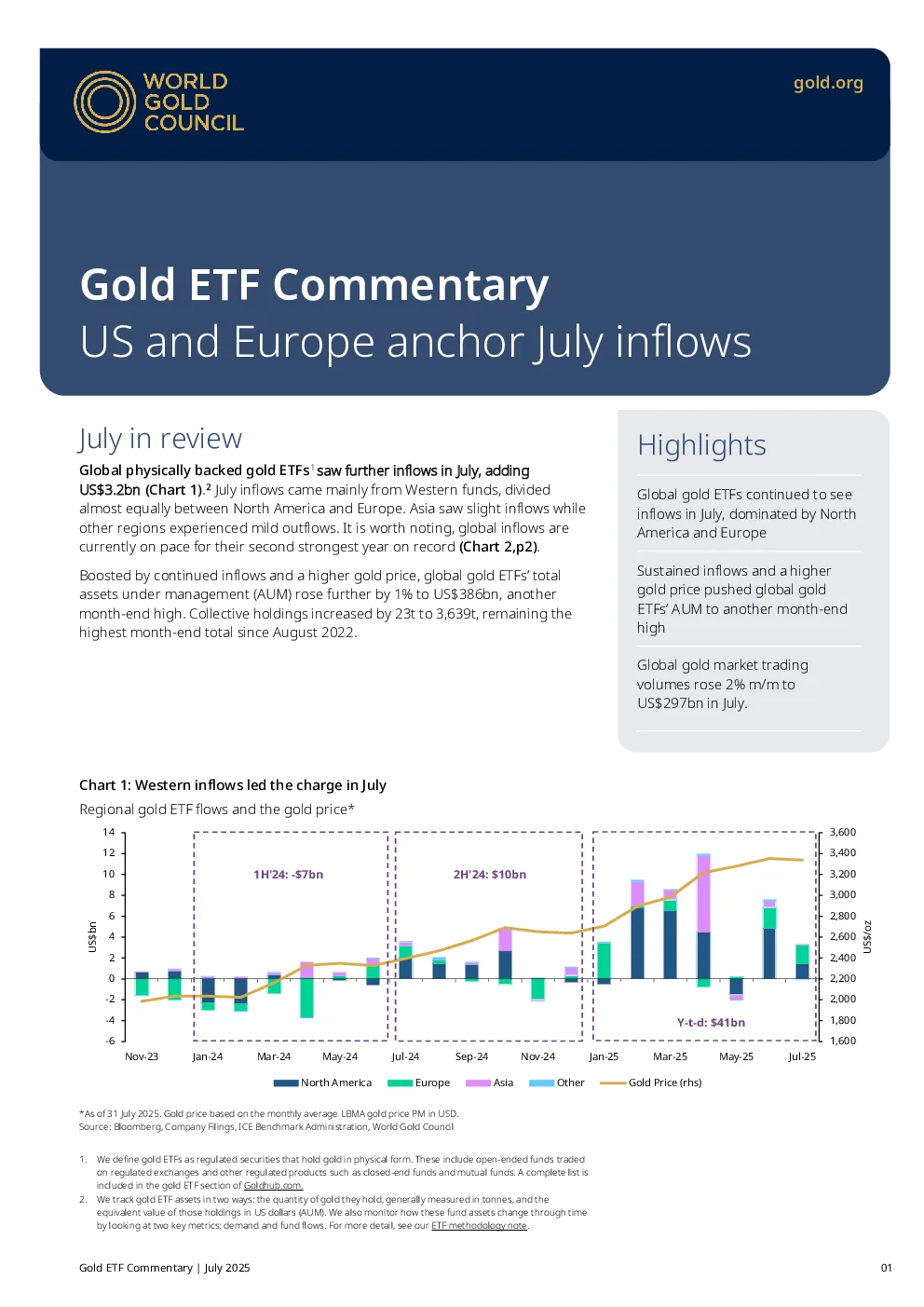
July in review Highlights Global physically backed gold ETFs1saw further inflows in July, addingUS$3.2bn(Chart1).2July inflows came mainly from Western funds, dividedalmost equally between North America and Europe. Asia saw slight inflows whileother regions experienced mild outflows. It is worth noting, global inflows arecurrently on pace for their second strongest year on record(Chart2,p2). Global gold ETFs continued to seeinflows in July, dominated by NorthAmerica and Europe Sustained inflows and a highergold price pushed global goldETFs’ AUM to another month-endhigh Boosted by continued inflows and a higher gold price, global gold ETFs’ totalassets under management (AUM) rose further by 1% to US$386bn, anothermonth-end high. Collective holdings increased by 23t to 3,639t, remaining thehighest month-end total since August 2022. Global gold market tradingvolumes rose 2% m/m toUS$297bn in July. Meanwhile in Germany, Bund yields kept rising, drivenmainly by the country’s surging spending plans, which arepushing up borrowing, and expectations that the ECB maybecome less dovish.6Such factors have increased localinvestors’ opportunity cost of holding gold, contributing tothe region’s July loss. Regional overview North America attracted US$1.4bn in July, bringing y-t-dinflows to US$22bn, on pace for its second-strongestannual performance.3While flows remained positive, theydid slow m/m. We attribute this to a short-term rebound inthe dollar and a rise in rates, as expectations for future Fedcuts continue to be pushed further out. Asian funds saw a mild increase of US$93mn in July, ledby Japan.China saw outflows amid local investors’ improvingrisk appetite – the CSI300 stock index saw its strongestmonth since last September as the country’s Q2 growthexceeded expectations. In contrast, Japan (US$215mn) andIndia (US$156mn) continued to record inflows.And funds inother regions registered modest outflows of US$95mn inJuly. Some investors likely took profits and rotated into equities,especially as recent trade announcements from Japan andthe EU lifted risk appetite. However, we’re also seeingspeculative stocks gain traction,4which could point to frothyconditions remerging. Still, the trajectory of US-China tradenegotiations will likely remain one of the dominant drivers offuture market sentiment. Chart 2: Global flows on pace for second strongest yearon record Continued inflows into gold-backed ETFs are likely to besupported as signs that tariff effects trickle through moremeaningfully to growth and/or inflation. Annual net cumulative flows broken down by month* European funds saw their third consecutive monthlyinflow in July, attracting US$1.8bn.The UK once againdominated inflows while German funds lost the most. Gold’soutsized strength in British pounds (GBP) attracted localinvestors: weaker-than-expected economic data and thecooling labour market, among other factors, kept the localcurrency on a back foot and contributed to rising safe-havendemand. Switzerland and France also witnessed notableinflows in the month. Further supporting investor interest insafe-haven assets such as gold ETFs were US tariffuncertainty – beforea trade dealwas reached on 27 July –and growth concerns in the region. This was reflected in apick-up in physical bar and coin demand, which saw theregional demand more than double y/y to 28t in Q2.5 6.Germany is said to plan massive military buildup, doubling defense budget by 2029, 28July. Total net longsin COMEX gold futures rose 12% m/m to676t in July, with Money Managers increasing their net longpositions by 4%.8 Volumes edged higher In July,gold market trading volumesreachedUS$297bn/day on average, 2.3% higher m/m.7OTCactivities averaged US$154bn/day in July, 2% higher thanJune. Although July OTC volumes were below the H1 averageof US$165bn/day, they remained well above the 2024average of US$128bn/day. Exchange-traded volumes alsorose, averaging US$137bn per day, led by a notable increasein COMEX activities. But global gold ETFs’ trading activitiesfell 15% m/m to US$4.9bn/day yet far exceeding the 2024average of US$2.9bn per day. While there has been evidence of some profit-taking in priormonths, positioning now appears to have reset – givingfutures investors room to rebuild exposure. We explore thisshift in greater detail in our latest monthlyGold MarketCommentary. Average daily trading volumes by segment in US$bn* World Gold Council Research We are a membership organisation that champions the rolegold plays as a strategic asset, shaping the future of aresponsible and accessible gold supply chain. Our team ofexperts builds understanding of the use case andpossibilities of gold through trusted research, analysis,commentary and insights. Jeremy De Pessemier, CFAAssetAllocation Strategist Johan PalmbergSenior Quantitative Analyst Kavita ChackoResearch Head, India Krishan GopaulSenior Analyst, EMEA We drive industry progress, shaping policy and setting thestandards f