黄金ETF流量:2025年6月
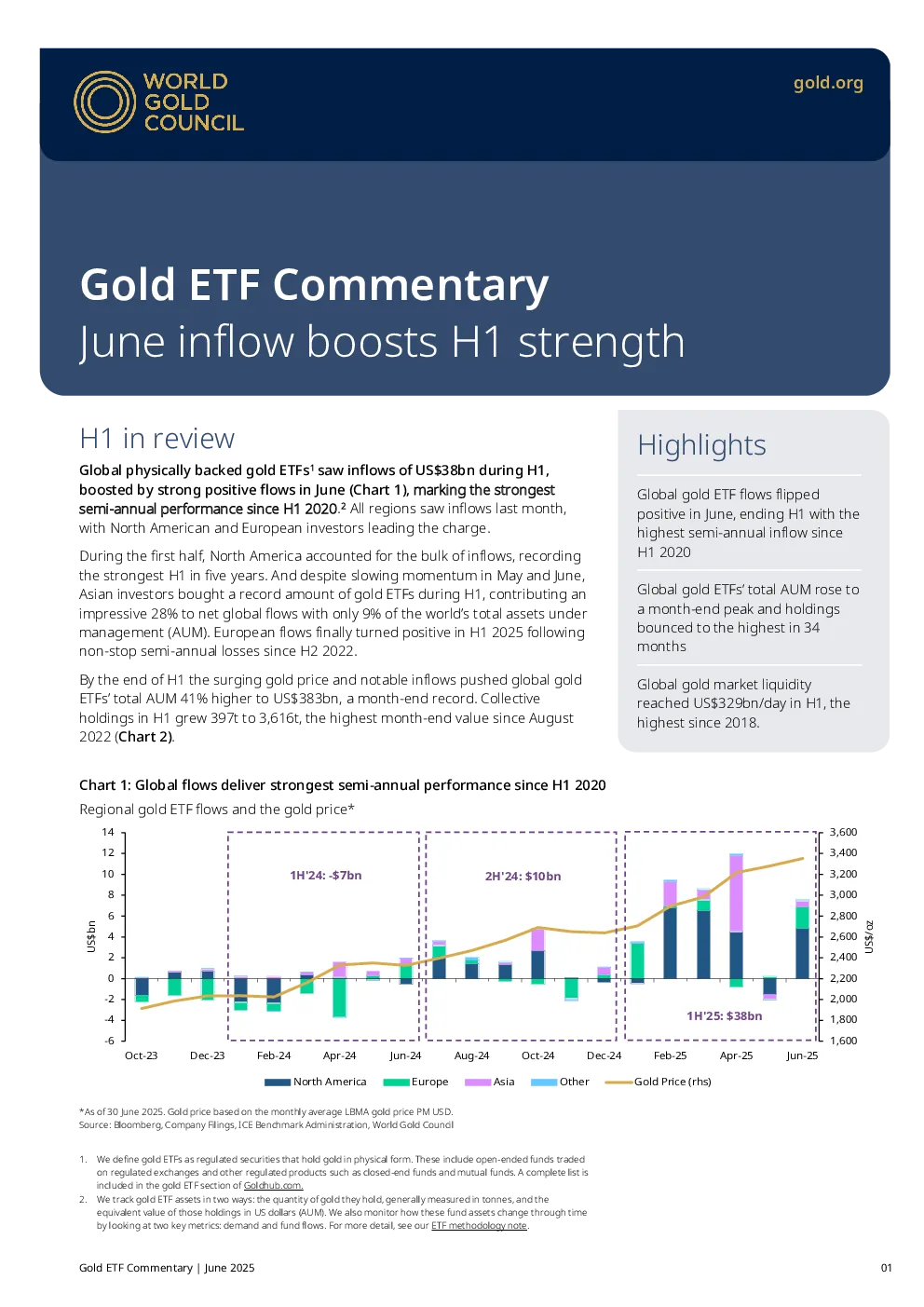
H1 in review Highlights Global physically backed gold ETFs1saw inflows of US$38bn during H1,boosted by strong positive flows in June (Chart1),marking thestrongestsemi-annual performance since H1 2020.2All regions saw inflows last month,with North American and European investors leading the charge. Global gold ETF flows flippedpositive in June, ending H1 with thehighest semi-annual inflow sinceH1 2020 During the first half, North America accounted for the bulk of inflows, recordingthe strongest H1 in five years. And despite slowing momentum in May and June,Asian investors bought a record amount of gold ETFs during H1, contributing animpressive 28% to net global flows with only 9% of the world’s total assets undermanagement (AUM). European flows finally turned positive in H1 2025 followingnon-stop semi-annual losses since H2 2022. Global gold ETFs’ total AUM rose toa month-end peak and holdingsbounced to the highest in 34months By the end of H1 the surging gold price and notable inflows pushed global goldETFs’ total AUM 41% higher to US$383bn, a month-end record. Collectiveholdings in H1 grew 397t to 3,616t, the highest month-end value since August2022 (Chart2). Global gold market liquidityreached US$329bn/day in H1, thehighest since 2018. Regional gold ETF flows and the gold price* Japan recorded inflows for the ninth consecutive month(US$198mn, US$1bn H1), possibly driven by elevatedinflationary concerns – particularly when the rice pricesurged.6China only saw mild inflows in the month(US$137mn) as trade tensions eased and the local gold pricemoderated.7Nonetheless, China’s H1 inflows of US$8.8bn(85t) were unprecedented amid spiking trade risks with theUS, growth concerns and the surging gold price. Regional overview North America attracted US$4.8bn in June – the strongestmonthly inflow since March – bringing total H1 inflows toUS$21bn. Spiking geopolitical risks amid the Israel-Iranconflict boosted investor demand for safe-haven assets andsupported inflows into North American gold ETFs. Althoughit held rates steady in June, the US Fed continued to expressconcerns about slowing growth and rising inflation.3Marketsare now pricing in three rate cuts by the end of 2025 and anadditional two in 2026. Funds listed in other regions attracted US$148mn in June,pushing H1 inflows to US$661mn. Australia and SouthAfrica were the main contributors, both during the monthand in H1. It is worth noting that Australian gold ETF AUMand holdings reached respective month-end peaks in June. The investor response has been swift: US Treasury yieldsdeclined, and the dollar continued to weaken. Persistentpolicy uncertainty and ongoing fiscal concerns are likely toremain an overhang on the market, which in turn could helpsupport gold ETF demand in the near to medium term. European inflows continued for a second month, addingUS$2bn in June – the strongest since January – and liftingthe region’s H1 total to US$6bn. The UK led inflows in themonth; althoughthe Bank of England kept rates unchangedat its June meeting, the stance was generally dovish.4Combined with weaker growth, easing inflation and thecooling labour market, investors raised their bets on futurerate cuts. This resulted in local yields declining and pushedup gold’s allure. Meanwhile, the eighth cut from theEuropean Central Bank5, uncertainties surrounding growth,and rising geopolitical risks generally, contributed to goldETF demand in several major markets. Asian flows flipped positive in June, albeit only mildly atUS$610mn, ending at US$11bn – a record amount for anyH1 period. India led inflows in June, likely supported by risinggeopolitical risks in the Middle East. Total net longsin COMEX gold futures fell 23% to 586t inH1 but notably rebounded 6.5% m/m in June.9 Volumes reached recordlevels in H1 Money managers reduced their long positions by 28% overthe first six months. But it is worth noting that during Junewe saw positions increase by 11% m/m, to 406t. This waslikely supported by consolidation in the gold price, providinginvestors with a window of opportunity to begin rebuildingpositions. Gold market trading volumes averaged US$329bn/dayduring the first half, the highest semi-annual value on ourrecord.8But June saw a decline in volumes (-20% m/m), likelyimpacted by a short-term equity market rally and fadingmomentum for gold. OTC in H1 increased to US$165bn/day; well above its 2024average of US$128bn/day. Exchange-traded volumes alsosaw a sizeable increase through the first half of the year,averaging US$159bn/day, driven by increased activity onCOMEX and the Shanghai Futures Exchange. Meanwhile,trading volumes of global gold ETFs continued to gainstrength in H1, particularly from North America and Asia,which averaged US$4.3bn/day and US$0.9bn/day,respectively. Average daily trading volumes by segment in US$bn* World Gold Council Research We are a membership organisation that champions the rolegold plays as a strategic asset, shaping the futur