AI智能总结
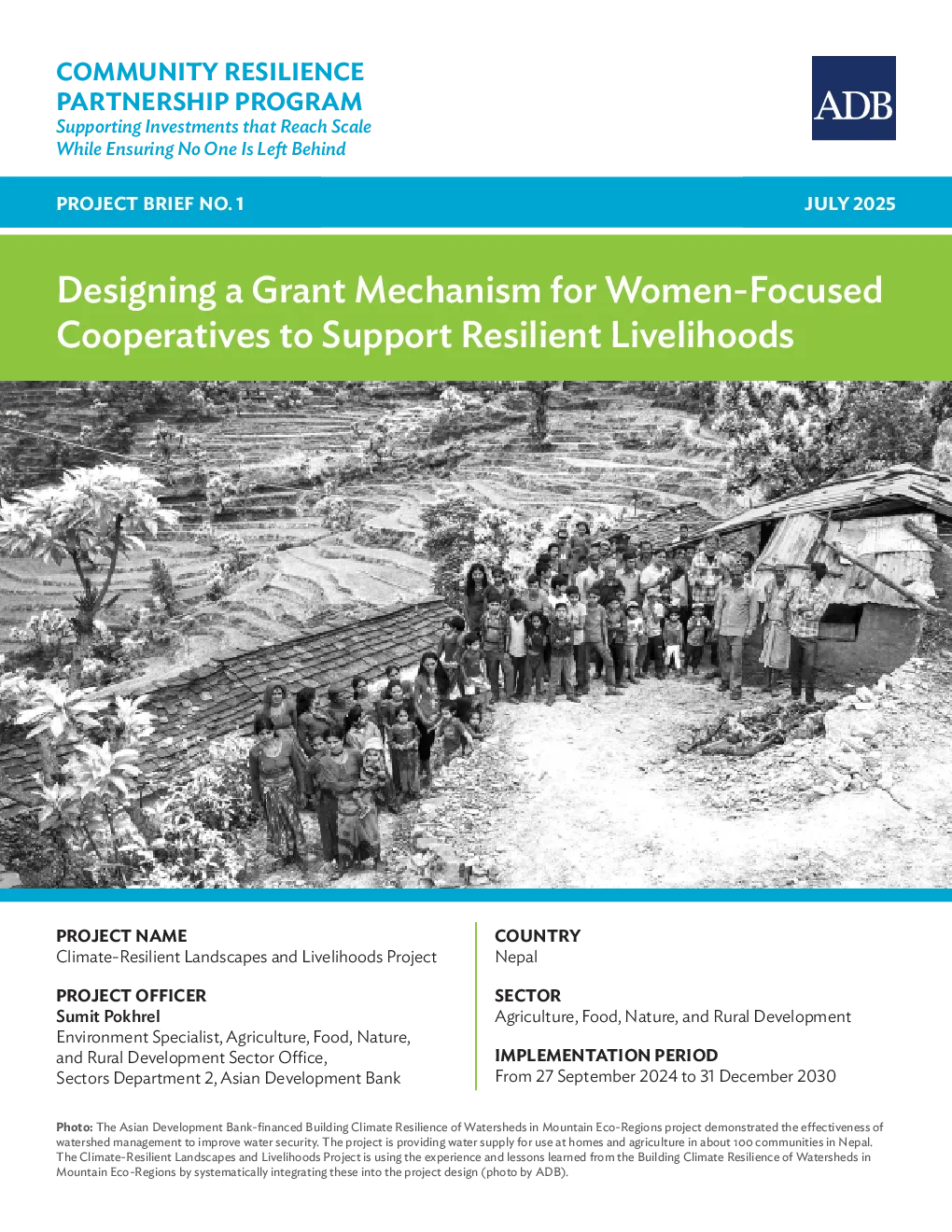
While Ensuring No One Is Left Behind Designing a Grant Mechanism for Women-FocusedCooperatives to Support Resilient Livelihoods COUNTRYNepal PROJECT NAMEClimate-Resilient Landscapes and Livelihoods Project PROJECT OFFICERSumit PokhrelEnvironment Specialist, Agriculture, Food, Nature, SECTORAgriculture, Food, Nature, and Rural Development and Rural Development Sector Office,Sectors Department 2, Asian Development Bank IMPLEMENTATION PERIODFrom 27 September 2024 to 31 December 2030 Photo:The Asian Development Bank-financed Building Climate Resilience of Watersheds in Mountain Eco-Regions project demonstrated the effectiveness ofwatershed management to improve water security. The project is providing water supply for use at homes and agriculture in about 100 communities in Nepal.The Climate-Resilient Landscapes and Livelihoods Project is using the experience and lessons learned from the Building Climate Resilience of Watersheds inMountain Eco-Regions by systematically integrating these into the project design (photo by ADB). CLIMATE RISK AND RESILIENCE PROFILE Nepal is highly vulnerable to rising temperatures, melting glaciers, and more intense rainfall that impact overall humandevelopment and well-being.a Around 80% of Nepalese are exposed to these hazards, particularly droughts, floods, landslides, and extremetemperatures.b These natural hazards interact with existing socioeconomic vulnerabilities. Since many households are led by womenbecause of male out-migration, women, along with children and older people, bear heavy responsibilities to meet dailylivelihood needs.cDisadvantaged groups, including women and Dalits, who already struggle with time poverty due toessential tasks like water, fodder, and fuelwood collection, are disproportionately affected by climate-induced waterscarcity and their dependence on climate-sensitive livelihoods.d Nepal’s economy is forecasted to contract by 7% by 2050 due to these climate-related hazards.e Nepal’s National Adaptation Plan (NAP) 2021–2050 estimates $47 billion in climate finance to address the adaptationneeds of the country.f Nepal is committed to direct a large percentage of its climate finance to the local level targeted at building theresilience of poor and vulnerable communities.g aChapagain D., L. Bharati, C. Borgemeister2021.Detection and Attribution of the Spatiotemporal Trend of Disaster Impacts and Vulnerability in Nepal; andDesInventar. 2022.DesInventar Disaster Information Management System.bGovernment of Nepal, Ministry of Home Affairs.Nepal Disaster Report 2017. Road to Sendai.cGovernment of Nepal, Ministry of Forests and Environment. 2021.Vulnerability and Risk Assessment and Identifying Adaptation Options: Sectoral Report GESI,Livelihood, and Socioeconomic.dDalits in Nepal are defined as “those communities who, by virtue of atrocities of caste-based discrimination and untouchability, are most backward in social,economic, educational, political and religious fields, and are deprived of human dignity and social justice.” National Dalit Commission. Nepal/Dalits.eThe World Bank Group. 2022.Nepal: Country Climate and Development Report.fGovernment of Nepal. 2023.National Adaptation Plan, 2021-2050.gGovernment of Nepal. 2019.Climate Change Policy 2019. CRPP TRUST FUND SUPPORT and entrepreneurs were consulted to help in the designof local-level adaptation measures for the wider ADBinvestment project. The Community Resilience Partnership Program (CRPP)supported the initial design phase of the project due toits transformational community adaptation focus, especiallyon women, and he opportunity to support the contribution ofgrassroots women’s groups in the design of the widerADB investment project. CRPPTF resources were used to engage Lumanti SupportGroup for Shelter, a women-led grassroots organizationbased in Nepal, to lead the consultations in three of themunicipalities where the project will be active. Initial funds from the Community Resilience PartnershipProgram Trust Fund (CRPPTF) were used to plan and carryout consultations with the local communities in Karnali andSudurpashchim. Women’s groups, disadvantaged groups,community-based organizations, forest user groups, farmers, The consultations and analytical work resulted in innovativeinterventions being proposed under the enhancement ofnature-based livelihoods and training and capacity building inclimate change adaptation of the ensuing investment. THE PROJECT government incentives.5Increased ecotourism in Karnaliand Sudurpashchim will have the potential to providemore jobs and promote sustainable and resilient growth. Two of Nepal’s remote western provinces, Karnali andSudurpashchim, are prone to multiple hazards such asdroughts, floods, and landslides, threatening traditionalfarming systems and livelihoods. Women are especiallyburdened by water collection, which is affected by thedrying of water catchments due to unsustainable landuse practices, forest degradation, forest fires