您的浏览器禁用了JavaScript(一种计算机语言,用以实现您与网页的交互),请解除该禁用,或者联系我们。[OECD]:重新定义以色列的空间规划与发展 - 发现报告

重新定义以色列的空间规划与发展

有色金属2025-07-31OECD起***
AI智能总结
查看更多
重新定义以色列的空间规划与发展

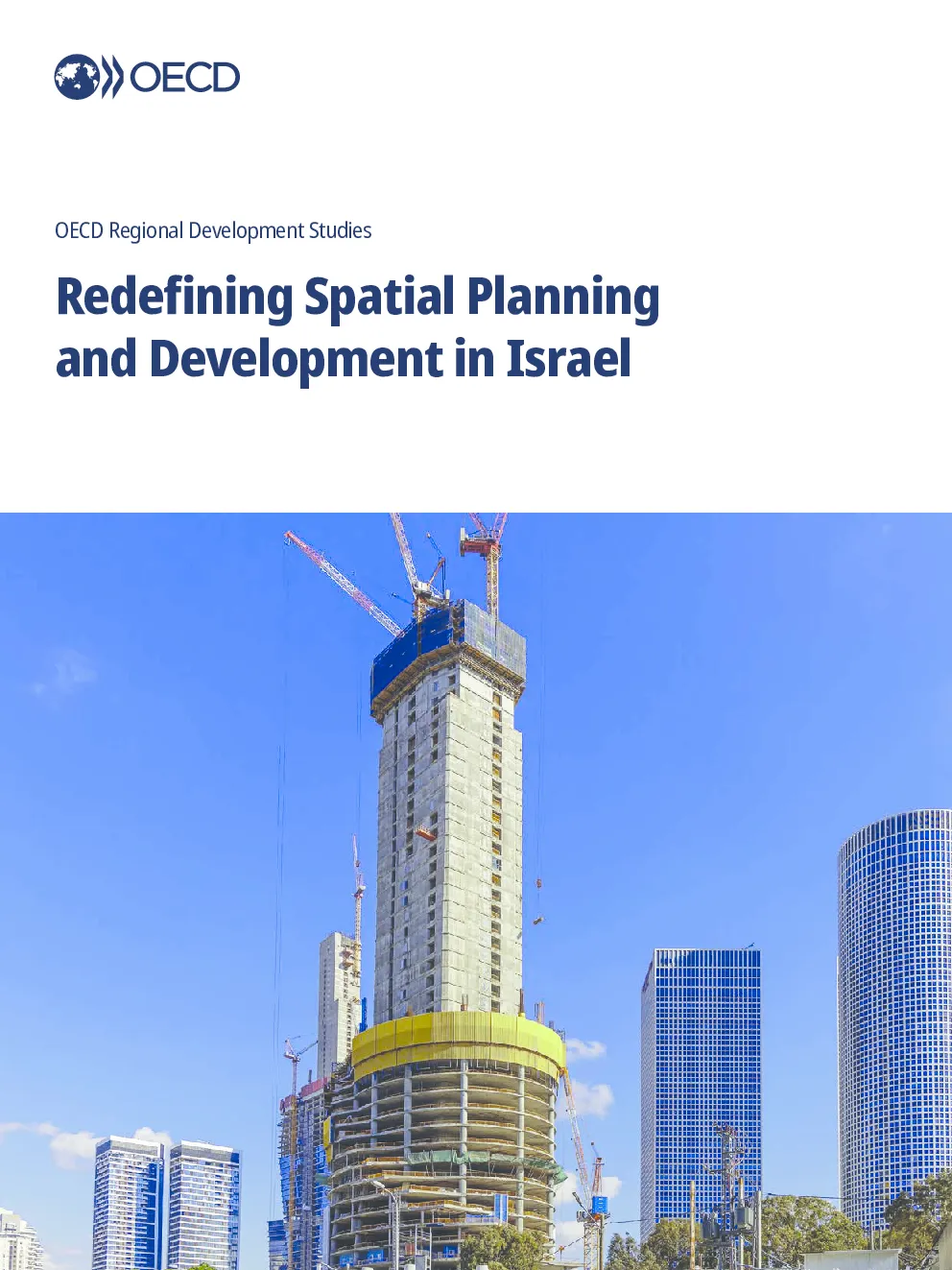
Redefining Spatial PlanningandDevelopment inIsrael OECD Regional Development Studies Redefining Spatial Planningand Development in Israel This work is published under the responsibility of the Secretary-General of the OECD. The opinions expressed andarguments employed herein do not necessarily reflect the official views of the Member countries of the OECD. This document, as well as any data and map included herein, are without prejudice to the status of or sovereignty overany territory, to the delimitation of international frontiers and boundaries and to the name of any territory, city or area. The statistical data for Israel are supplied by and under the responsibility of the relevant Israeli authorities. The use ofsuch data by the OECD is without prejudice to the status of the Golan Heights, East Jerusalem and Israeli settlements inthe West Bank under the terms of international law. Note by the Republic of Türkiye The information in this document with reference to “Cyprus” relates to the southern part of the Island. There is no singleauthority representing both Turkish and Greek Cypriot people on the Island. Türkiye recognises the Turkish Republic ofNorthern Cyprus (TRNC). Until a lasting and equitable solution is found within the context of the United Nations, Türkiyeshall preserve its position concerning the “Cyprus issue”. Note by all the European Union Member States of the OECD and the European UnionThe Republic of Cyprus is recognised by all members of the United Nations with the exception of Türkiye. Theinformation in this document relates to the area under the effective control of the Government of the Republic of Cyprus. Please cite this publication as:OECD (2025),Redefining Spatial Planning and Development in Israel, OECD Regional Development Studies, OECD Publishing,Paris, https://doi.org/10.1787/89036c98-en. ISBN 978-92-64-84164-2 (print)ISBN 978-92-64-35754-9 (PDF)ISBN 978-92-64-99994-7 (HTML) OECD Regional Development StudiesISSN 2789-7990 (print)ISSN 2789-8008 (online) Photo credits:Cover © kolderal/Getty Images Plus. Corrigenda to OECD publications may be found at: https://www.oecd.org/en/publications/support/corrigenda.html.© OECD 2025 Attribution 4.0 International (CC BY 4.0) This work is made available under the Creative Commons Attribution 4.0 International licence. By using this work, you accept to be bound by the terms of this licence(https://creativecommons.org/licenses/by/4.0/).Attribution– you must cite the work.Translations– you must cite the original work, identify changes to the original and add the following text:In the event of any discrepancy between the original work and thetranslation, only the text of the original work should be considered valid.Adaptations– you must cite the original work and add the following text:This is an adaptation of an original work by the OECD. The opinions expressed and arguments employed inthis adaptation should not be reported as representing the official views of the OECD or of its Member countries.Third-party material– the licence does not apply to third-party material in the work. If using such material, you are responsible for obtaining permission from the third party and forany claims of infringement.You must not use the OECD logo, visual identity or cover image without express permission or suggest the OECD endorses your use of the work.Any dispute arising under this licence shall be settled by arbitration in accordance with the Permanent Court of Arbitration (PCA) Arbitration Rules 2012. The seat of arbitration shallbe Paris (France). The number of arbitrators shall be one. Foreword Israel has achievedremarkable economic growth and development in a small, densely populated nation,successfully managing substantial population increases while building a dynamic, innovation-driveneconomy. Yet this success has brought significant spatial planning and development challenges thatrequire urgent attention. The country must balance competing demands for housing, infrastructure andservices while preserving scarce land resources and meeting ambitious environmental commitments,alongside persistent security concerns that influence spatial development decisions. Israel's diversepopulation, with distinct ethnic and religious communities, has created complex spatial patterns that oftenreinforce socioeconomic disparities, which areamong the highest in the OECD. Current developmenttrends and governancestructuresrisk undermining long-term sustainability and social cohesion.In thiscontext,the need for more strategic, coordinated approaches to both spatial planning and developmenthas become critical to ensuring the country's continued prosperity while addressing growing inequalities. This report, developed through a collaboration between the OECD and the Prime Minister's Office of Israel,examines the country's spatial planning and development framework through comprehensive analysis ofinstitutional structures, development patterns and spatia