AI智能总结
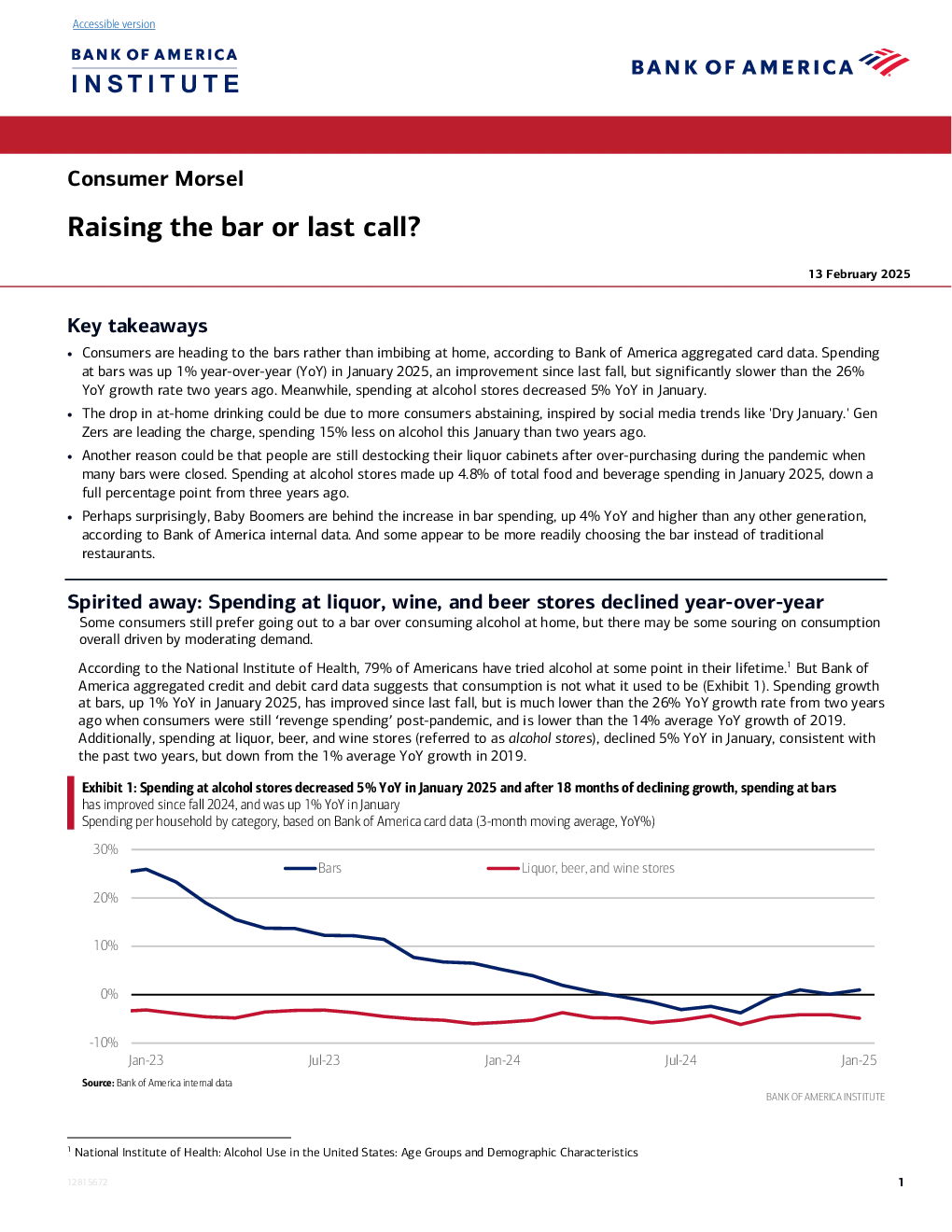
Raising the bar or last call? Key takeaways •Consumers are heading to the bars rather than imbibing at home, according to Bank of America aggregated card data. Spendingat bars was up 1% year-over-year (YoY) in January 2025, an improvement since last fall, but significantly slower than the 26%YoY growth rate two years ago. Meanwhile, spending at alcohol stores decreased 5% YoY in January. •The drop in at-home drinking could be due to more consumers abstaining, inspired by social media trends like 'Dry January.' GenZers are leading the charge, spending 15% less on alcohol this January than two years ago. •Another reason could be that people are still destocking their liquor cabinets after over-purchasing during the pandemic whenmany bars were closed. Spending at alcohol stores made up 4.8% of total food and beverage spending in January 2025, down afull percentage point from three years ago. •Perhaps surprisingly, Baby Boomers are behind the increase in bar spending, up 4% YoY and higher than any other generation,according to Bank of America internal data. And some appear to be more readily choosing the bar instead of traditionalrestaurants. Spirited away: Spending at liquor, wine, and beer stores declined year-over-yearSome consumers still prefer going out to a bar over consuming alcohol at home, but there may be some souring on consumption overall driven by moderating demand. According to the National Institute of Health, 79% of Americans have tried alcohol at some point in their lifetime.1But Bank ofAmerica aggregated credit and debit card data suggests that consumption is not what it used to be (Exhibit 1). Spending growthat bars, up 1% YoY in January 2025, has improved since last fall, but is much lower than the 26% YoY growth rate from two yearsago when consumers were still‘revenge spending’post-pandemic, and is lower than the 14% average YoY growth of 2019.Additionally, spending at liquor, beer, and wine stores (referred to asalcohol stores), declined 5% YoY in January, consistent withthe past two years, but down from the 1% average YoY growth in 2019. Exhibit1:Spending at alcohol stores decreased 5% YoY in January 2025andafter18 months of declining growth,spendingat barshas improved since fall 2024, and was up 1% YoY in JanuarySpending per household by category, based on Bank of America card data (3-month moving average, YoY%) What’s behind this decrease in spending at alcohol stores? Some of it may be due to slowing price growth. Spending on alcoholfor at-home consumption was up 1% YoY in January 2025, but has fallen nearly four percentage points over the past two years,according to Consumer Price Index (CPI) inflation data from the Bureau of Labor Statistics (BLS) (Exhibit 2). Obviously sinceprices are still growing, albeit more slowly, this cannot fully explain the decline in alcohol spending, although the recentacceleration in inflation for bars may explain some of the recent improvement in bar spending on Bank of America cards. CPI growth by category (monthly,YoY%, non-seasonally adjusted (NSA)) Destocking the home bar, abstaining or less room in the booze budget?Another way we can view this is to analyze spending at alcohol stores as a share of total food and beverage spending (e.g., grocery and alcohol stores combined). Our analysis of card spending showed that the share of January spending at alcohol storeshas declined every year for the past four years and now sits at 4.8%, down a full percentage point from three years ago (Exhibit3). Meanwhile, bars spending as a share of total restaurant spend (e.g., bars and restaurants combined) has increased in Januaryalmost every year, although growth was nearly flat YoY. Exhibit3:Spending at alcohol stores made up a smaller share of total grocery spending over the past four years andwasat 4.8% inJanuary 2025, while bar spending has increased as a share of total restaurant spending, also at 4.8% in JanuaryShare of spendingatalcohol stores over total grocery andshare ofspending at bars over total restaurants (3-month moving average, %) It’s likely that some of the decline in at-home consumption can be attributed to a pivot to experiences post-pandemic, as peoplereturned to socializing at bars and, in turn, drank less at home. According to BofA Global Research, it’s also possible that consumers, with elevated deposits from stimulus funds, purchased more spirits than they could consume while bars were closedduring the pandemic and are still‘destocking’their liquor cabinets. Another explanation: some consumers may be abstaining entirely, spurred by the rise of social media trends like‘Dry January’andnon-alcoholic alternatives (e.g., mocktails and soft drinks). In fact, Bank of America card spending at bars and alcohol storesdecreased in January for the past two years, especially for Gen Z, who spent 15% less than in January 2023 (Exhibit 4). Spending per household at bars and alcohol stores for Gen Z and Baby Boomers (January, index January