AI智能总结
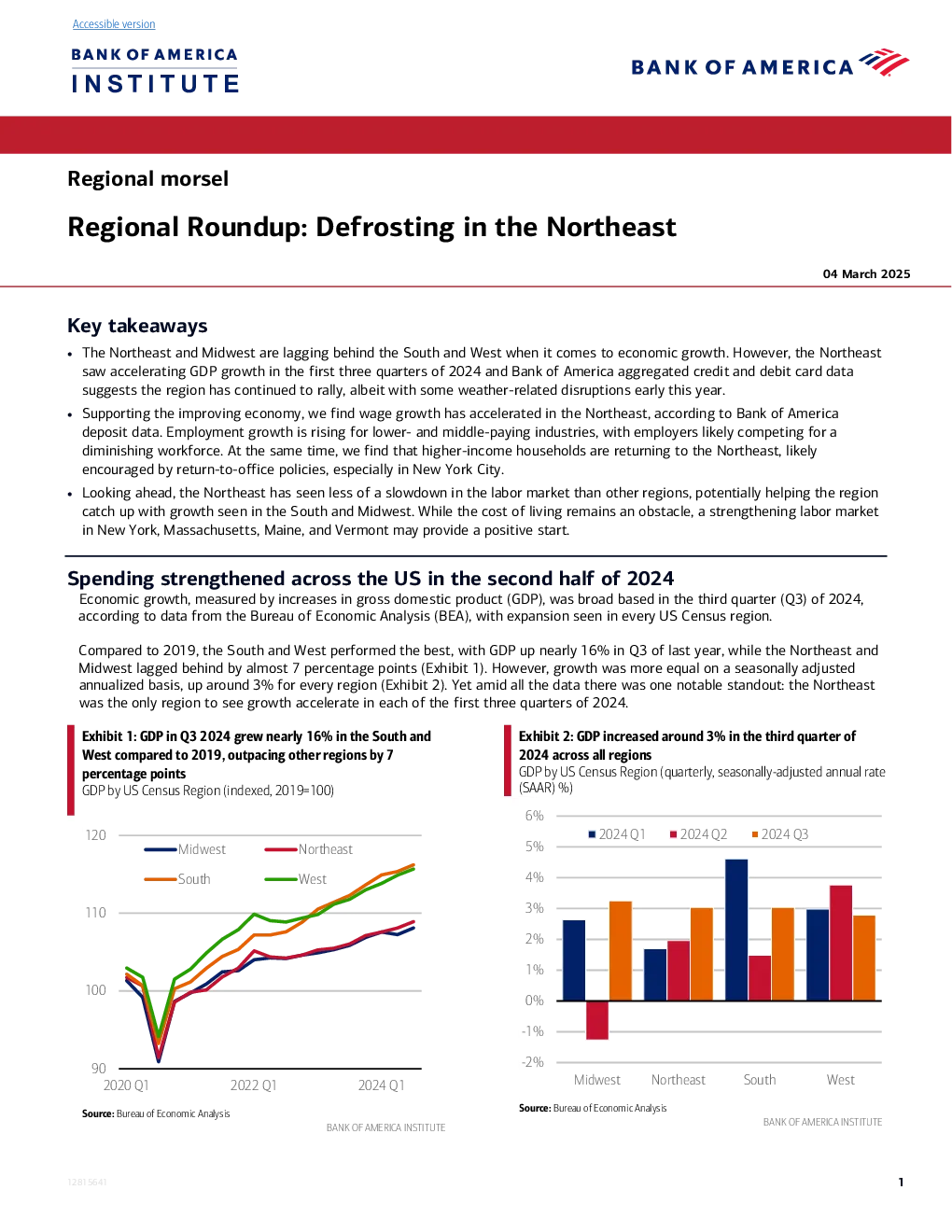
Regional Roundup: Defrosting in the Northeast 04 March 2025 Key takeaways •The Northeast and Midwest are lagging behind the South and West when it comes to economic growth. However, the Northeastsaw accelerating GDP growth in the first three quarters of 2024 and Bank of America aggregated credit and debit card datasuggests the region has continued to rally, albeit with some weather-related disruptions early this year. •Supporting the improving economy, we find wage growth has accelerated in the Northeast, according to Bank of Americadeposit data. Employment growth is rising for lower- and middle-paying industries, with employers likely competing for adiminishing workforce. At the same time, we find that higher-income households are returning to the Northeast, likelyencouraged by return-to-office policies, especially in New York City. •Looking ahead, the Northeast has seen less of a slowdown in the labor market than other regions, potentially helping the regioncatch up with growth seen in the South and Midwest. While the cost of living remains an obstacle, a strengthening labor marketin New York, Massachusetts, Maine, and Vermont may provide a positive start. Spending strengthened across the US in the second half of 2024Economic growth, measured by increases in gross domestic product (GDP), was broad based in the third quarter (Q3) of 2024, according to data from the Bureau of Economic Analysis (BEA), with expansion seen in every US Census region. Compared to 2019, the South and West performed the best, with GDP up nearly 16% in Q3 of last year, while the Northeast andMidwest lagged behind by almost 7 percentage points (Exhibit 1). However, growth was more equal on a seasonally adjustedannualized basis, up around 3% for every region (Exhibit 2). Yet amid all the data there was one notable standout: the Northeastwas the only region to see growth accelerate in each of the first three quarters of 2024. Exhibit1:GDPinQ3 2024grewnearly 16% in the South andWest compared to 2019, outpacing other regions by 7percentage pointsGDP by US Census Region (indexed, 2019=100) Exhibit2:GDP increased around 3%in the third quarter of2024 across all regionsGDP by US Census Region (quarterly, seasonally-adjusted annual rate (SAAR) %) But will this pattern continue into 2025? To better understand these economic trends, we examined Bank of America aggregatedcredit and debit card data, gaining insight into the direction of consumer spending, which accounts for around two-thirds ofoverall GDP. Total credit and debit card spending per household from Bank of America data (3-month moving average,seasonally-adjusted annual rate (SAAR) %) We found that spending growth improved across all regions over the second half of 2024, suggesting GDP growth strengthenedin the final quarter of the year. In the past two months, it has continued to accelerate in the West and Midwest but easedsomewhat in the South and Northeast (Exhibit 3). However, in our view, the weakening in these regions in early 2025 is likelyprimarily weather related due to winter storms and cold temperatures as noted in ourFebruary Consumer Checkpoint. Is the Northeast’s labor market waging a comeback? Wage growth is solid across all regions, but the Northeast shone bright in January 2025It appears that the labor market also supports the proposition that the Northeast’s economy has been improving. While after-tax wage growth accelerated across all regions, in the Northeast it rose 3.4% year-over-year (YoY) in January, the biggest gainamong all regions and a marked turnaround from the same month last year (Exhibit 4), according to Bank of America consumerdeposit data. Exhibit4:Wage growthwas up nearly 3% across all regions, although it accelerated the most in the NortheastAfter-tax wage and salary growth by income group, based on Bank of America aggregated consumer deposit data (%YoY, 3-month moving average, Yet job growth has slowed slightly in the Northeast since July 2024 (Exhibit 5). And there’s an interesting divergence in the data.Typically, wage gains are driven by industries with the highest pay, such as tech and finance. But that’s not the case this time inthe Northeast. In fact, employment growth in the highest paying industries (see Methodology) fell slightly in the Northeast inDecember 2024, down 0.4% YoY. By contrast, jobs in these industries grew 1.1% in the South (Exhibit 6). Exhibit6:Employment growth in industries with higheraverage wages has declined 0.4% YoY in the NortheastEmployment growth for select industries (December 2024, YoY%) Exhibit5:Job growth hasrisenthe most in the South and West,while it has slowed somewhat in the Northeast since mid-2024Totalnonfarm employment (monthly, index 2023 average = 100) Driving the Northeast’s gains: Middle- and lower-wage industriesInstead of higher-paying industries, the Northeast’s wage acceleration appears to have been boosted, in part, by industries at the middle- and lower-end of the pay spe