您的浏览器禁用了JavaScript(一种计算机语言,用以实现您与网页的交互),请解除该禁用,或者联系我们。[美国银行]:生产力的脉搏 - 发现报告

生产力的脉搏

AI智能总结
查看更多
生产力的脉搏

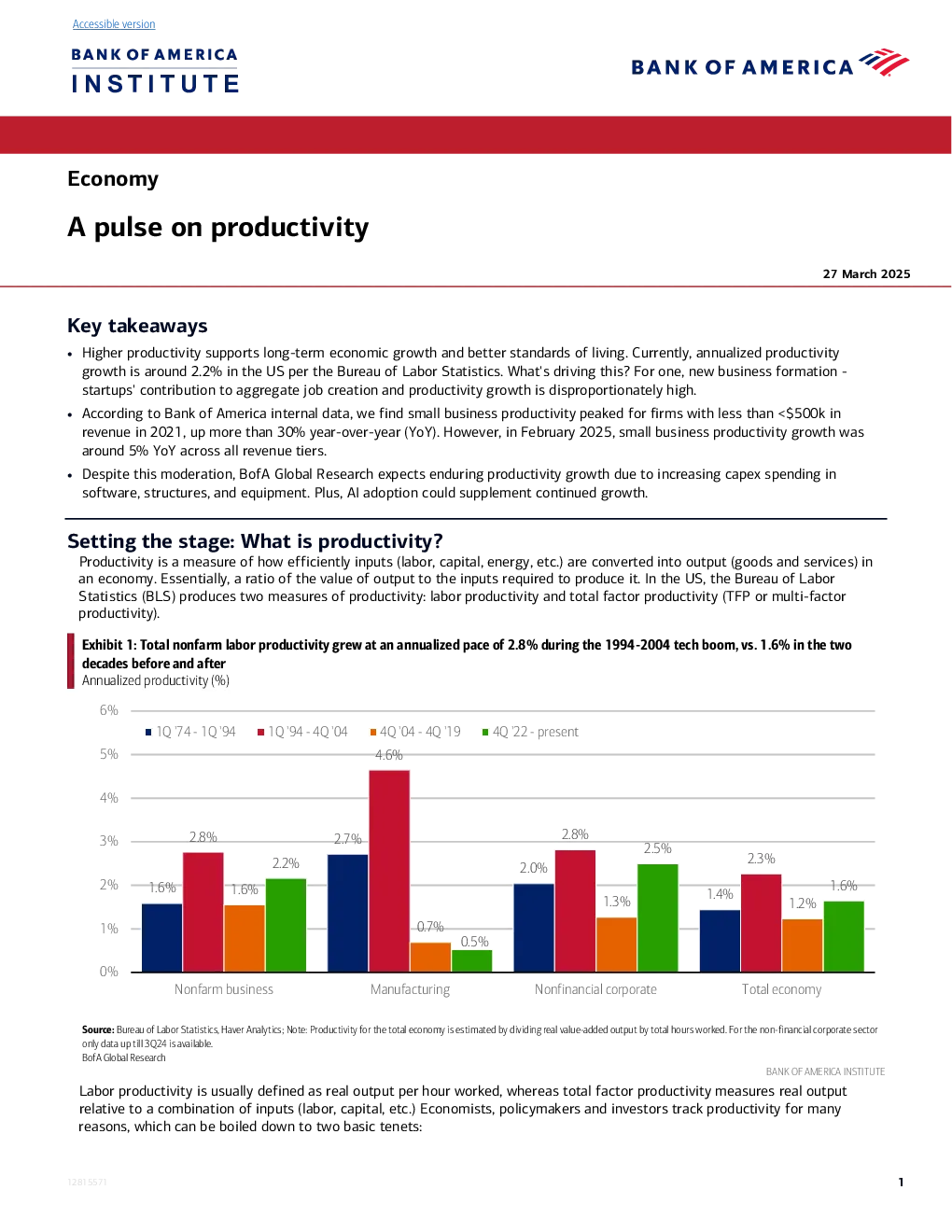
A pulse on productivity Key takeaways •Higher productivity supports long-term economic growth and better standards of living. Currently, annualized productivitygrowth is around 2.2% in the US per the Bureau of Labor Statistics. What's driving this? For one, new business formation -startups' contribution to aggregate job creation and productivity growth is disproportionately high. •According to Bank of America internal data, we find small business productivity peaked for firms with less than <$500k inrevenue in 2021, up more than 30% year-over-year (YoY). However, in February 2025, small business productivity growth wasaround 5% YoY across all revenue tiers. •Despite this moderation, BofA Global Research expects enduring productivity growth due to increasing capex spending insoftware, structures, and equipment. Plus, AI adoption could supplement continued growth. Setting the stage: What is productivity?Productivity is a measure of how efficiently inputs (labor, capital, energy, etc.) are converted into output (goods and services) in an economy. Essentially, a ratio of the value of output to the inputs required to produce it. In the US, the Bureau of LaborStatistics (BLS) produces two measures of productivity: labor productivity and total factor productivity (TFP or multi-factorproductivity). Annualizedproductivity (%) BANK OF AMERICA INSTITUTE Labor productivity is usually defined as real output per hour worked, whereas total factor productivity measures real outputrelative to a combination of inputs (labor, capital, etc.) Economists, policymakers and investors track productivity for manyreasons, which can be boiled down to two basic tenets: 1.Higher productivity = higher long-term living standards–by increasing the amount of output workers produce relative tohow much work they put in, productivity growth means the economy can grow and allow people to spend and save more. 2.Higher productivity = structurally higher interest rates–higher productivity growth increases the returns on investment incapital, which implies the interest rate in an economy will also rise to encourage the savings to fund this capex. Since 1970, there has been one major productivity cycle attributed to the advent of a new technology (the internet) which, basedon economic data, lasted for a decade–from 1994 to 2004. During this period, total nonfarm labor productivity grew at anannualized pace of 2.8% (Exhibit 1). By contrast, in the two decades before and after the tech boom, annualized laborproductivity growth was 1.6%. Is the US entering a new era of productivity?Following the global financial crisis of 2008, a growing consensus was established around a“new normal”for the economy: low productivity, sluggish GDP growth and lower-for-longer rates, inflation, and returns. The Federal Open Market Committee’smedian estimate of longer run GDP growth settled at 1.8-1.9% since September 2016. Potential growth was pegged to remain in that range for several years. Implicit to this view was the notion that laborproductivity was stuck and was likely to continue to grow at an underwhelming pace, according to BofA Global Research. While productivity spiked (and quickly subsided) after Covid, it re-accelerated sharply in 2023, approaching levels seen during theprior tech boom of the 90s (Exhibit 2). And BofA Global Research expects this productivity growth pickup to be enduring, havingprofound implications for the economy and markets. Plus, according to a recent survey, BofA Global Research found that 45% ofrespondents expect labor productivity growth and margins to be higher this year than last year (Exhibit 3). Exhibit3: 45% of respondents expectedlabor productivitygrowth and margins to be higher this year than last year inNovemberExpectations for labor productivity growth and margins in 2025, vs. Exhibit2: Productivity has been running above its pre-CovidtrendNonfarm business productivity (2017 = 100) 2024 Small businesses shed light on productivity growthNew businesses play a key role in productivity growth in the economy by enhancing competition and incentivizing innovation. Indeed, there was a cumulative drag on productivity of 3.1% since 1980 due to a“startup deficit”in the US.1 But the trend in new business applications and formation has turned up significantly since the pandemic. In fact, high-propensitybusiness applications, which include all businesses that are more likely to become employers, were still 35% higher than theaverage level in 2019. See more on this in ourMarch Small Business Checkpoint. At their initial outset these startups and small businesses may struggle with productivity in comparison with large companies, asthey begin to explore their processes and have staff numbers too small for much specialization of tasks. In fact, on average, theirlabor productivity is half that of their larger peers despite them playing a central role in economic growth.2 But looking at Bank of America internal data, we f