AI智能总结
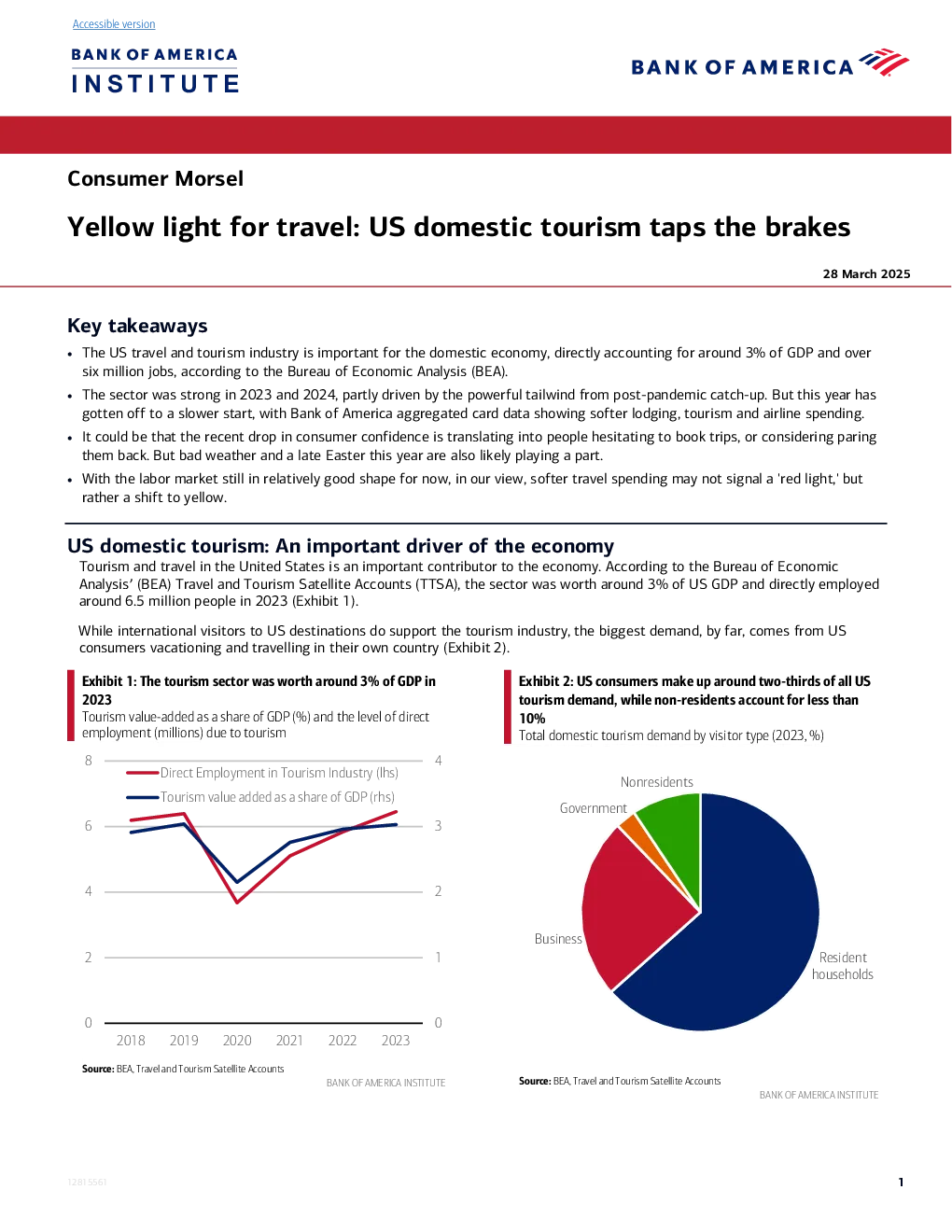
Yellow light for travel: US domestic tourism taps the brakes 28 March 2025 Key takeaways •The US travel and tourism industry is important for the domestic economy, directly accounting for around 3% of GDP and oversix million jobs, according to the Bureau of Economic Analysis (BEA). •The sector was strong in 2023 and 2024, partly driven by the powerful tailwind from post-pandemic catch-up. But this year hasgotten off to a slower start, with Bank of America aggregated card data showing softer lodging, tourism and airline spending.•It could be that the recent drop in consumer confidence is translating into people hesitating to book trips, or considering paringthem back. But bad weather and a late Easter this year are also likely playing a part.•With the labor market still in relatively good shape for now, in our view, softer travel spending may not signal a 'red light,' butrather a shift to yellow. US domestic tourism: An important driver of the economyTourism and travel in the United States is an important contributor to the economy. According to the Bureau of Economic Analysis’(BEA) Travel and Tourism Satellite Accounts (TTSA), the sector was worth around 3% of US GDP and directly employedaround 6.5 million people in 2023 (Exhibit 1). While international visitors to US destinations do support the tourism industry, the biggest demand, by far, comes from USconsumers vacationing and travelling in their own country (Exhibit 2). Exhibit1:The tourism sector was worth around 3% of GDP in2023 Exhibit2: US consumers makeuparound two-thirds of all UStourism demand, while non-residents account for less than10%Total domestic tourism demand by visitor type(2023,%) Tourism value-added as a share of GDP (%) and the level of directemployment (millions) due to tourism The TTSA data only covers up to 2023, but it appears that 2024 was a good year for tourism in the US too, with the post-pandemic rebound in travel continuing.Exhibit 3shows household spending growth across an aggregate of travel and tourism-focused BEA consumer spending categories (see footnote in Exhibit 3). For much of 2024, this growth averaged 4% year-over-year (YoY)–which was down from the stellar rates in 2023 when the rebound in travel following COVID was in full swing, butstill very good. Passenger traffic through the nation’s airports was also very strong in 2024 according to TSA data, while miles driven on roadsreturned back to 2019 levels, before the pandemic called a temporary halt to travel and tourism (Exhibit 4). Exhibit4:2024 was a relatively strong year for traffic throughairports and miles driven on roadsTSA Checkpoint traveler throughput (lhs, monthly, 2019 =100) and Exhibit3:Consumer spending growth on tourism-centriccategories was around 4% YoY throughout much of 2024Household consumption expenditure across tourism- and travel- vehicle miles travelled (rhs, monthly, 2019 =100) focused categories* (monthly, % YoY) 2025 in question?But there is a question hanging in the balance around how tourism and travel will fare in 2025. Why? For one, the rebound from the pandemic is increasingly likely to have played out at this point. And it also appears that US consumers have become lessconfident in recent months.Exhibit 5shows that the University of Michigan consumer sentiment index and the ConferenceBoard consumer confidence measures have both fallen in the first few months of this year. Exhibit5:Measures of consumer confidence and sentiment have fallen in 2025University of Michigan consumer sentiment index and the Conference Board consumer confidence index (monthly, 2019 =100) Bank of America aggregated credit and debit card spending data can provide some insight into how the year is progressing sofar.Exhibit 6shows weekly card spending on lodging, whileExhibit 7shows an aggregate of tourism-related categories year-to-date through the week ending March 22, 2025. It is apparent when looking at both of these spending series that card spendingin 2025 has had a somewhat slower start than in 2023 and 2024, though it is well above 2019 levels. Exhibit7:…and spending on tourism-related activity is alsodown by a similar percentageTotal credit and debit card spending per household, on select Exhibit6:To March 22, 2025, spending on lodging isaround2.5%YoY below 2024 levelsTotal credit and debit card spending per household on lodging services, based on Bank of America card data (non-seasonallyadjusted, daily, 7-day moving average, 2019 =100) travel/tourism-related categories* (non-seasonally adjusted, daily, 7-day moving average, 2019 =100) Spending on lodging will often be done during check-out, while for the tourism categories inExhibit 7, it will tend to be a mix ofadvance purchases and spending done at the time of the travel or activity, such as admissions to amusement parks. Lodging andreal-time tourism spending is typically lower during the winter months, and this year there have been several particularly coldweather disruptions