AI智能总结
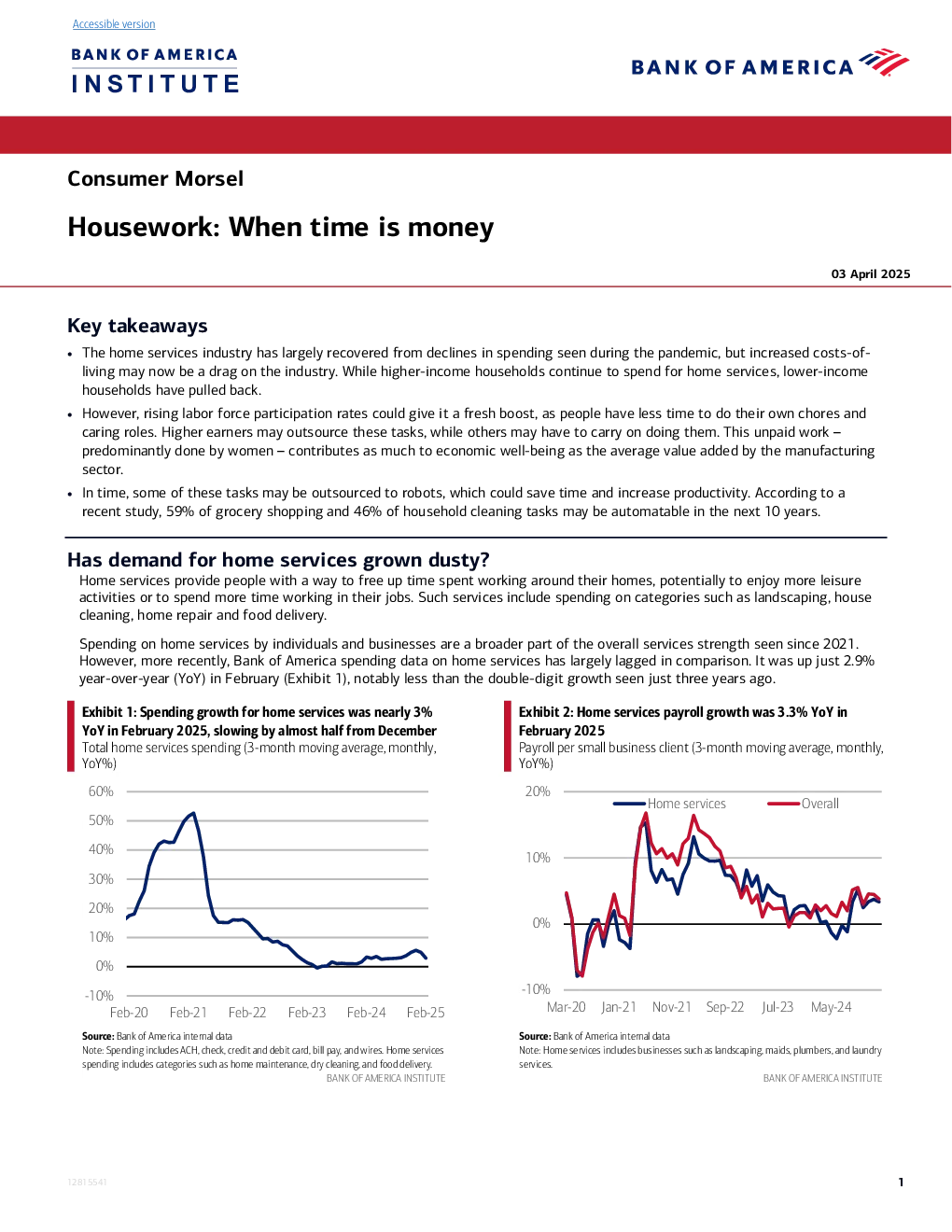
Housework: When time is money Key takeaways •The home services industry has largely recovered from declines in spending seen during the pandemic, but increased costs-of-living may now be a drag on the industry. While higher-income households continue to spend for home services, lower-incomehouseholds have pulled back. •However, rising labor force participation rates could give it a fresh boost, as people have less time to do their own chores andcaring roles. Higher earners may outsource these tasks, while others may have to carry on doing them. This unpaid work–predominantly done by women–contributes as much to economic well-being as the average value added by the manufacturingsector. •In time, some of these tasks may be outsourced to robots, which could save time and increase productivity. According to arecent study, 59% of grocery shopping and 46% of household cleaning tasks may be automatable in the next 10 years. Has demand for home services grown dusty?Home services provide people with a way to free up time spent working around their homes, potentially to enjoy more leisure activities or to spend more time working in their jobs. Such services include spending on categories such as landscaping, housecleaning, home repair and food delivery. Spending on home services by individuals and businesses are a broader part of the overall services strength seen since 2021.However, more recently, Bank of America spending data on home services has largely lagged in comparison. It was up just 2.9%year-over-year (YoY) in February (Exhibit 1), notably less than the double-digit growth seen just three years ago. Exhibit2:Home services payroll growth was 3.3% YoY inFebruary 2025Payroll per small business client (3-month moving average, monthly, Exhibit1: Spending growth for home services was nearly 3%YoY in February 2025, slowing by almost half from DecemberTotal home services spending (3-month moving average, monthly, YoY%) YoY%) Additionally, using Bank of America data, we find payroll growth for small businesses within home services (see footnote inExhibit 2) has eased since 2021 and has been slightly weaker compared to the overall trend in recent months (Exhibit 2). This suggests that some consumers may have pulled back on spending on these services, which are more discretionary in nature,that they might otherwise do themselves in order to save money (seemore on this in our report, The cost of living ain’t easy). Lower-income households have pulled back as cost of living has risen, but higher-income households are still spendingThis is especially true for lower-income (<$50K) households, whose spending on home services was down 0.3% YoY in February(Exhibit 3). Meanwhile, higher-income (>$100K) household spending on home services was still going strong, up 4.1% YoY,roughly in line with 2019 growth rates. It could be that weaker spending on home services may be one explanation for the corresponding slowdown we have seen inleisure spending (Exhibit 4). Leisure spending includes outdoor activities like amusement parks and golf clubs as well as indooractivities such as going to the movies. It suggests that people might have less time for genuine“leisure”if they are having to domore work at home. Exhibit3: Higher-income households continued to increasetheir home services spending, while lower- and middle-incomehouseholds are pulling backSpending on home services by income (3-month moving average, Exhibit4:Leisure spending growth was negative for lower-andmiddle-income households in FebruarySpending on leisure activities by income (3-month moving average, monthly, YoY%) monthly, YoY%) An increase in the labor force participation rate may be a tailwind for the home services industryInterestingly, the slowing in spending on home services is coming at a time when labor force participation has been rising for both men and women (Exhibit 5). In fact, the participation rate for prime-age women in 2024 was at an all-time high at 77.9%. With more hours going toward paid work, combined with slowing spending on home services–suggesting people are workingmore around the home after clocking out–and have less genuine leisure time. And this finding that Americans, especially those with children, are getting less time for fun is consistent with the AmericanTime Use Survey (ATUS) from the Bureau of Labor Statistics (BLS) (Exhibit 6). It shows that in 2023, the average person with ajob and children under 18 years old had less time for leisure than at any other point of the previous decade. But an interesting divergence has emerged, after a decade of declines, men saw a large increase in leisure time in the past twoyears, around four hours of leisure time a day–a small rise compared to 2013; whereas women’s leisure time continues todecline, around three hours a day in 2023–a drop from 2013. Exhibit5: The labor force participation rate has increasedcompared to 2019 for women and remains the same for men inFebruaryLabo