您的浏览器禁用了JavaScript(一种计算机语言,用以实现您与网页的交互),请解除该禁用,或者联系我们。[美国银行]:五月的花会枯萎吗? - 发现报告

五月的花会枯萎吗?

商贸零售2025-05-01美国银行惊***
五月的花会枯萎吗?

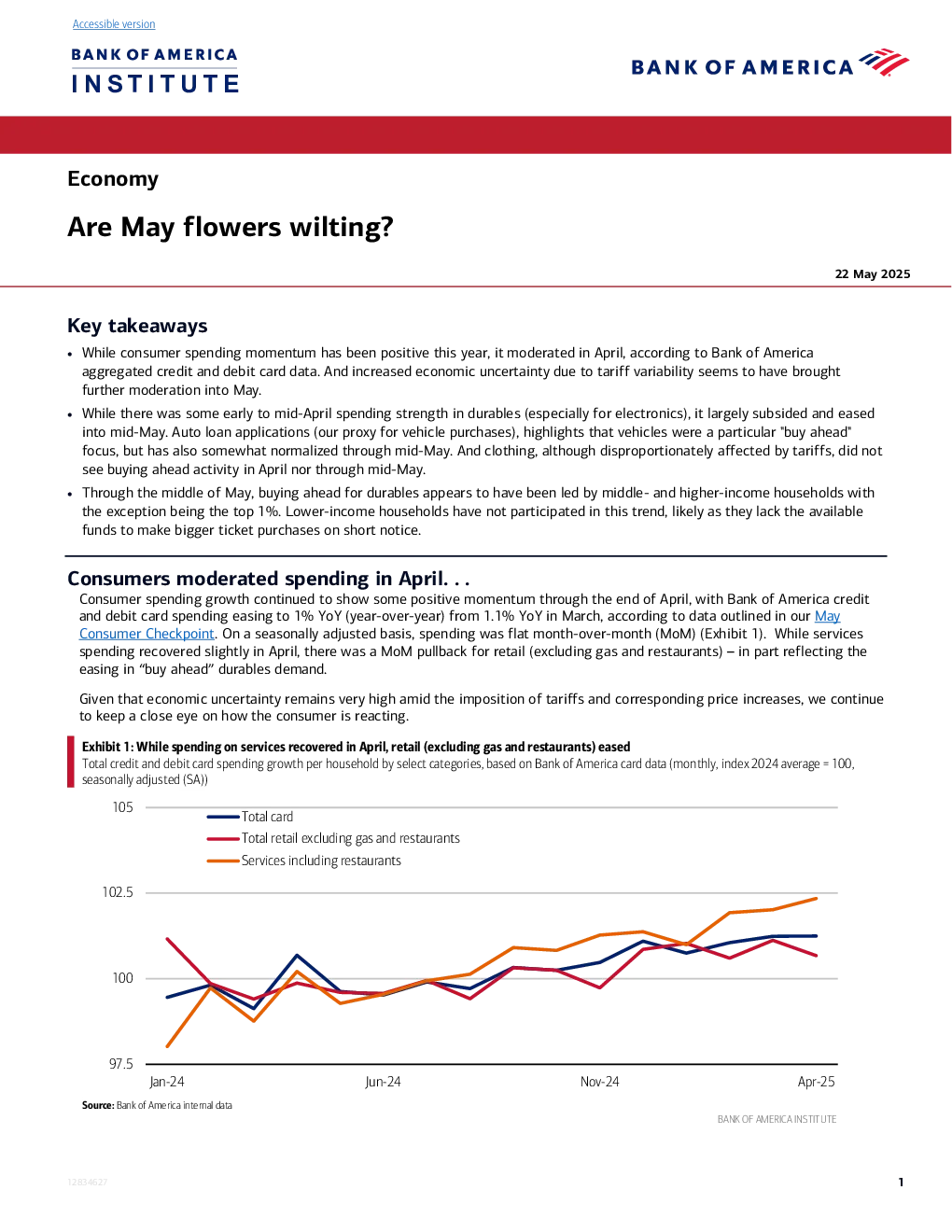
Are May flowers wilting? Key takeaways •While consumer spending momentum has been positive this year, it moderated in April, according to Bank of Americaaggregated credit and debit card data. And increased economic uncertainty due to tariff variability seems to have broughtfurther moderation into May. •While there was some early to mid-April spending strength in durables (especially for electronics), it largely subsided and easedinto mid-May. Auto loan applications (our proxy for vehicle purchases), highlights that vehicles were a particular "buy ahead"focus, but has also somewhat normalized through mid-May. And clothing, although disproportionately affected by tariffs, did notsee buying ahead activity in April nor through mid-May. •Through the middle of May, buying ahead for durables appears to have been led by middle- and higher-income households withthe exception being the top 1%. Lower-income households have not participated in this trend, likely as they lack the availablefunds to make bigger ticket purchases on short notice. Consumers moderated spending in April. . .Consumer spending growth continued to show some positive momentum through the end of April, with Bank of America credit and debit card spending easing to 1% YoY (year-over-year) from 1.1% YoY in March, according to data outlined in ourMayConsumer Checkpoint. On a seasonally adjusted basis, spending was flat month-over-month (MoM) (Exhibit 1). While servicesspending recovered slightly in April, there was a MoM pullback for retail (excluding gas and restaurants)–in part reflecting theeasing in“buy ahead”durables demand. Given that economic uncertainty remains very high amid the imposition of tariffs and corresponding price increases, we continueto keep a close eye on how the consumer is reacting. Total credit and debit card spending growth per household by select categories, based on Bank of America card data (monthly, index 2024 average = 100, . . . And that continuedWhat do we see in May? So far, Bank of America card data suggests that consumer spending was flat at the start of the first half of the month, with no YoY increase in the two weeks ending on May 17 (Exhibit 2). Exhibit3:While durables spending was strong in early April, iteased back in the second half of the month and remainedrestrained in early MayCredit and debit card spending per household on durables*, based on Exhibit2:Spending growth YoY in May appears more muted thanAprilTotal credit and debit card spending per household, based on Bank of America data (7-day moving average, index January 2024 average = 100) Bank of America data (7-day moving average, index January 2024 average= 100) Three remaining questions Are consumers still “buying ahead” of tariffs?In our view, this trend may have largely run its course. In ourApril Consumer Checkpoint, we found evidence of consumers bringing forward some spending on durables (e.g. furniture, electronics, auto parts, etc.) out of concern that prices mightincrease as a result of tariffs. However, in ourlatest Consumer Checkpoint, we did see that activity moderate. In fact, using Bankof America daily card spending data, we see a spike in durables spending in early April followed by a sharp pullback extendinginto mid-May (Exhibit 3). Exhibit4:Electronics spending peaked on April 12, but eased to2024 levels quickly after, before dropping again through mid-MayCredit and debit card spending per household on electronics, based on Exhibit5:Consumer vehicle loan application growth for Bank ofAmerica auto loans eased significantly in mid-MayAverage daily consumer vehicle loan applications for different time Bank of America data (7-day moving average, index January 2024 average= 100) periods (daily, YoY%) Dwindling buying ahead was much clearer in electronics spending. While spending spiked in late March and early April, it peakedon April 12 after exemptions were granted for several electronics products including computers and smartphones, andsubsequently fell below 2024 levels (Exhibit 4). Additionally, as we’ve previously discussed, buying ahead has been significant in auto purchases. Bank of America internal dataon consumer vehicle loan (CVL) applications suggests application growth remained elevated through April compared to theperiod between October 2024 through most of March 2025. However, it has been far lower in recent weeks (Exhibit 5). Is there buying ahead beyond durables?In our view, it doesn’t look like it. In addition to electronics and autos, clothing prices are also heavily influenced by imports both directly and indirectly (read more about thisin our previous Consumer Checkpoint). And according to research from The BudgetLab at Yale University, price increases due to tariffs may disproportionately affect clothing1. But so far, we’re not seeing consumers rushing to purchase clothing, likely as they are more focused on bigger ticket items (likedurables) affected by tariffs. Other than a spike around East