您的浏览器禁用了JavaScript(一种计算机语言,用以实现您与网页的交互),请解除该禁用,或者联系我们。 [美国银行]:制造业:是时候回家了吗? - 发现报告

制造业:是时候回家了吗?

报告封面

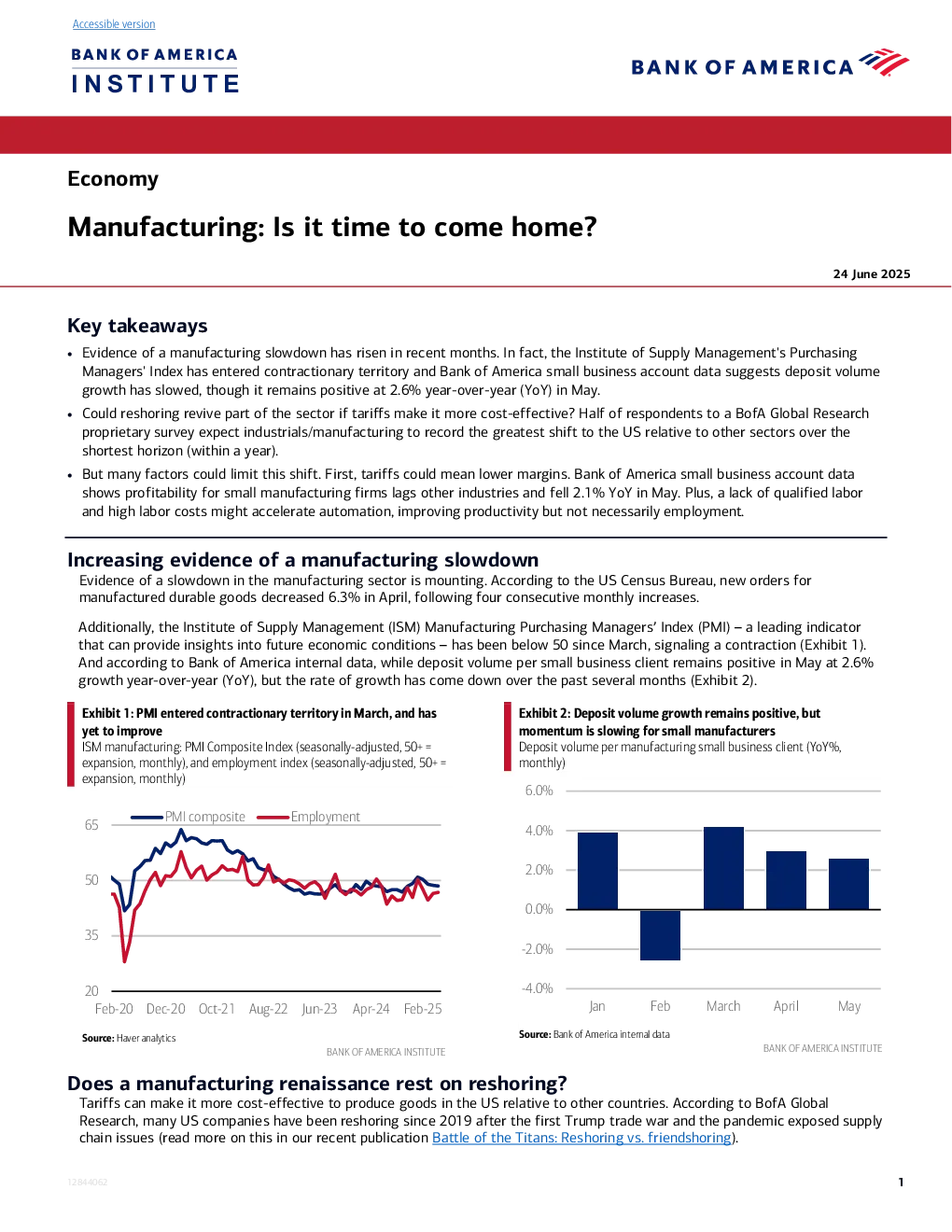
Manufacturing: Is it time to come home? 24 June 2025 Key takeaways •Evidence of a manufacturing slowdown has risen in recent months. In fact, the Institute of Supply Management's PurchasingManagers' Index has entered contractionary territory and Bank of America small business account data suggests deposit volumegrowth has slowed, though it remains positive at 2.6% year-over-year (YoY) in May. •Could reshoring revive part of the sector if tariffs make it more cost-effective? Half of respondents to a BofA Global Researchproprietary survey expect industrials/manufacturing to record the greatest shift to the US relative to other sectors over theshortest horizon (within a year). •But many factors could limit this shift. First, tariffs could mean lower margins. Bank of America small business account datashows profitability for small manufacturing firms lags other industries and fell 2.1% YoY in May. Plus, a lack of qualified laborand high labor costs might accelerate automation, improving productivity but not necessarily employment. Increasing evidence of a manufacturing slowdownEvidence of a slowdown in the manufacturing sector is mounting. According to the US Census Bureau, new orders for manufactured durable goods decreased 6.3% in April, following four consecutive monthly increases. Additionally, the Institute of Supply Management (ISM) Manufacturing Purchasing Managers’Index (PMI)–a leading indicatorthat can provide insights into future economic conditions–has been below 50 since March, signaling a contraction (Exhibit 1).And according to Bank of America internal data, while deposit volume per small business client remains positive in May at 2.6%growth year-over-year (YoY), but the rate of growth has come down over the past several months (Exhibit 2). Exhibit2: Deposit volume growth remains positive, butmomentum is slowing for small manufacturersDeposit volume per manufacturing small business client (YoY%, Exhibit1:PMI entered contractionary territory in March, and hasyet to improveISM manufacturing: PMI Composite Index (seasonally-adjusted, 50+ = expansion, monthly), and employment index (seasonally-adjusted, 50+ =expansion, monthly) monthly) Does a manufacturing renaissance rest on reshoring?Tariffs can make it more cost-effective to produce goods in the US relative to other countries. According to BofA Global Research, many US companies have been reshoring since 2019 after the first Trump trade war and the pandemic exposed supplychain issues (read more on this in our recent publicationBattle of the Titans: Reshoring vs. friendshoring). In a recent BofA Global Research survey, most respondents who expected production to shift to the US from elsewhere thoughtthis would happen within the next three years, with the expectation that production would shift out of China over a similartimeframe. Respondents also expected industrials/manufacturing would exhibit the greatest degree of movement toward the US,and over the shortest time horizon. Aided by reshoring, US industrial firms are building new plants at a rapid pace. On an inflation-adjusted basis, construction onmanufacturing plants grew 24% YoY in 2022, 45% YoY in 2023, and 21% YoY in 2024 to $234 billion (Exhibit 3). Thisconstruction leads to spending on production machinery as well as hiring and is roughly double average real spending of $117billion (2016-20), according to the US Census Bureau. Spending on US manufacturing facilities ($bn, trailing 12 months) But reshoring is no free lunch, especially for US consumersWhile BofA Global Research’s survey suggests that tariffs could continue to drive reshoring of production, this is not without costs. Nearly 80% of respondents expect the companies they cover to pass on the cost of higher tariffs to consumers to somedegree (Exhibit 4). Most also expect some of the tariff impact to fall on the producer, putting downward pressure on margins (read more on this inourJune Small Business Checkpoint). And Bank of America small business account data shows profitability for smallmanufacturing firms lags other industries and fell 2.1% YoY in May (Exhibit 5). Exhibit4: Most respondents expect companies to pass onthe costsof higher tariffs to a degreeDo you expect your companies to raise prices because of tariffs? (% of Exhibit5: Manufacturing had the weakest profitability ratio andprofitability growth in MayMonthly small business account inflow-to-outflow ratio (left hand side (lhs)) and YoY profitability growth (right hand side (rhs)) by sector respondents) According to a recent survey from the New York Fed, over half of manufacturers said they raised prices within a month ofexperiencing tariff-related cost increases—many within a day or week. Another quarter indicated that they had raised prices (orplanned to do so) within one to three months of such cost increases, while few were waiting longer than three months1. Lack of labor impeding manufacturingSeveral factors could limit firms’ability t