极端高温作用曲线
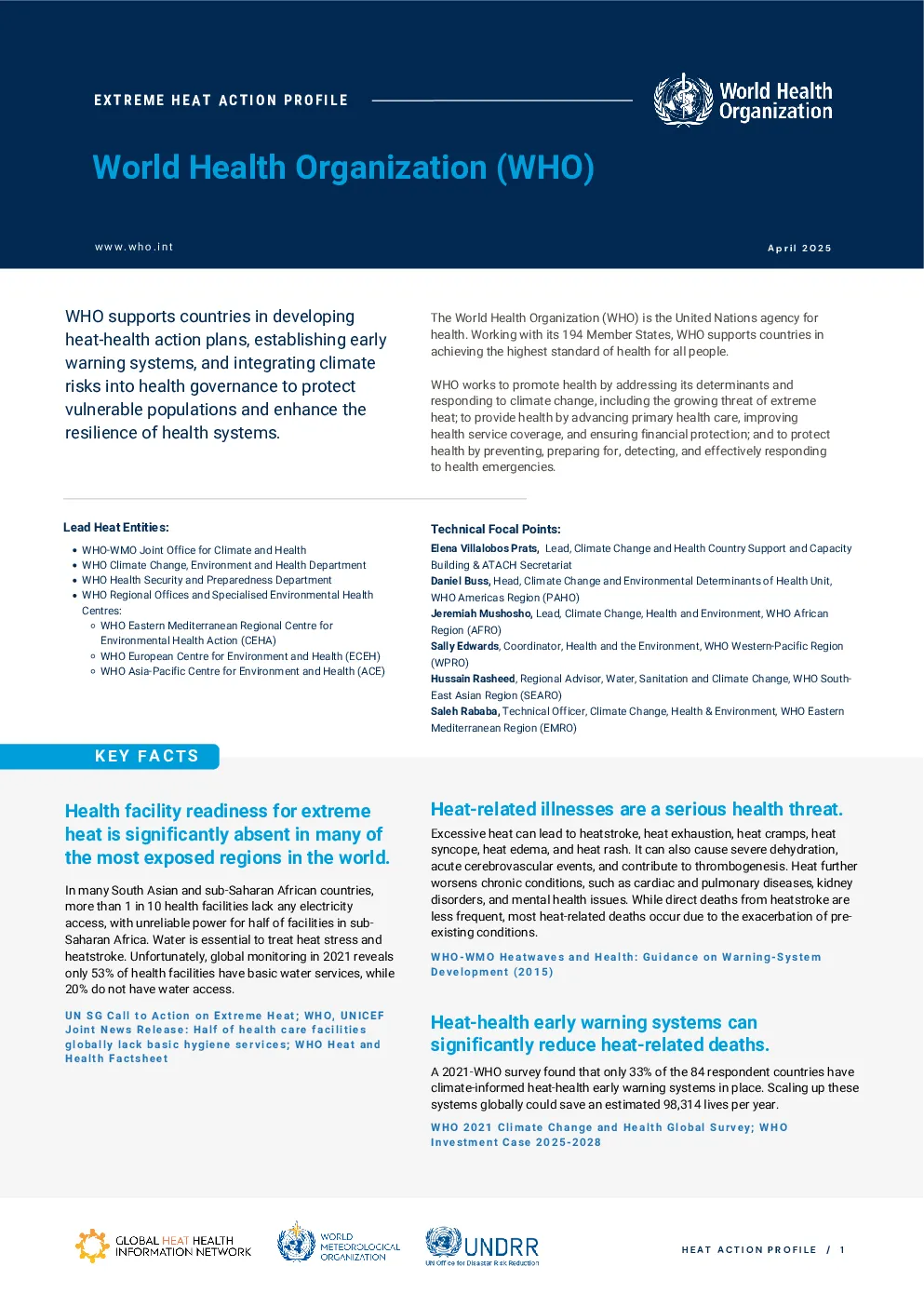
Technical Focal Points:Elena Villalobos Prats,Lead,Climate Change and Health Country Support and CapacityBuilding & ATACH SecretariatDaniel Buss,Head, Climate Change and Environmental Determinants of Health Unit,WHO Americas Region (PAHO)Jeremiah Mushosho,Lead, Climate Change, Health and Environment, WHO AfricanRegion (AFRO)Sally Edwards, Coordinator, Health and the Environment, WHO Western-Pacific Region(WPRO)Hussain Rasheed, Regional Advisor, Water, Sanitation and Climate Change, WHO South-East Asian Region (SEARO)Saleh Rababa,Technical Officer, Climate Change, Health & Environment, WHO EasternMediterranean Region (EMRO)The World Health Organization (WHO) is the United Nations agency forhealth. Working with its 194 Member States, WHO supports countries inachieving the highest standard of health for all people.WHO works to promote health by addressing its determinants andresponding to climate change, including the growing threat of extremeheat; to provide health by advancing primary health care, improvinghealth service coverage, and ensuring financial protection; and to protecthealth by preventing, preparing for, detecting, and effectively respondingto health emergencies.Heat-health early warning systems cansignificantly reduce heat-related deaths.Heat-related illnesses are a serious health threat.Excessive heat can lead to heatstroke, heat exhaustion, heat cramps, heatsyncope, heat edema, and heat rash. It can also cause severe dehydration,acute cerebrovascular events, and contribute to thrombogenesis. Heat furtherworsens chronic conditions, such as cardiac and pulmonary diseases, kidneydisorders, and mental health issues. While direct deaths from heatstroke areless frequent, most heat-related deaths occur due to the exacerbation of pre-existing conditions.W H O - W M O H e a t w a v e s a n d H e a l t h : G u i d a n c e o n W a r n i n g - S y s t e mD e v e l o p m e n t ( 2 0 1 5 )A 2021-WHO survey found that only 33% of the 84 respondent countries haveclimate-informed heat-health early warning systems in place. Scaling up thesesystems globally could save an estimated 98,314 lives per year.W H O 2 0 2 1 C l i m a t e C h a n g e a n d H e a l t h G l o b a l S u r v e y ;W H OI n v e s t m e n t C a s e 2 0 2 5 - 2 0 2 8 H E A TA C T I O N P R O F I L E/1A p r i l2 0 2 5 Country Technical SupportThe WHO supports countries to:DevelopVulnerability and Adaptation (V&A) Assessmentstoimprove the understanding of the linkages between climatechange and health, including an element of heat and health,when relevant, and serve as a baseline analysis against whichprotective measures can be monitored.DevelopHealth National Adaptation Plans (HNAP) ensuring thata comprehensive response to climate change risks is alsoincluded in the overall National Adaptation Planning (NAP)process.Provided that heat-related illnesses are identified as a priorityhealth issue in V&As and HNAPs, assist countries in thedevelopment ofHeat-Health Action Plans,which are specificallytargeted at heat prevention, adaptation, and response.Develop climate-informed healthearly warning systems,including for heat-related health risks when relevant.Analyze, adapt, and/or implementenvironmental healthobservatories.Provide guidance and technical support to countries to identifyand address the health risks from heat, including to accessfunds for implementation of heat related interventions.Integrate climate considerations into health systemsstrengthening and health programmes, and incorporate healthinto Nationally Determined Contributions (NDCs).WHO Thematic Platform for Health Emergencyand Disaster Risk Management ResearchNetwork (Health EDRM RN)The Health Emergency and Disaster Risk Management (HealthEDRM) Research Network aims to inform its field ofemergency and disaster medicine, disaster risk reduction,humanitarian response, community health resilience, andhealth system resilience on the integration of health as a coredimension.Environmental HealthInitiativesThe WHO leads key environmental health areas of workrelating to extreme heat.TheWHO Climate Change and Health Programmeaddresses the health impacts of climate change, includingheat related impacts, by issuing technical guidance andtools, building capacity in countries and providing qualityassurance for the integration of climate change withinother WHO programmes.TheWHO-WMO Joint Office on Climate Change and Healthworks to advance integrated climate and health sciencesand services to better protect human health from climatechange, extreme weather, including heat, and otherhazards.The WHOOccupational Healthtopic area works topromote and maintain the highest degree of physical,mental, and social well-being of workers in all occupations.Heat stress is identified as an occupational risk, and isaddressed through guidance, technical support, andcountry assistance.H E A TA C T I O N P R O F I L E/ Alliance for Transformative Action onClimate and Health (ATACH)ATACH works to fulfill the ambition